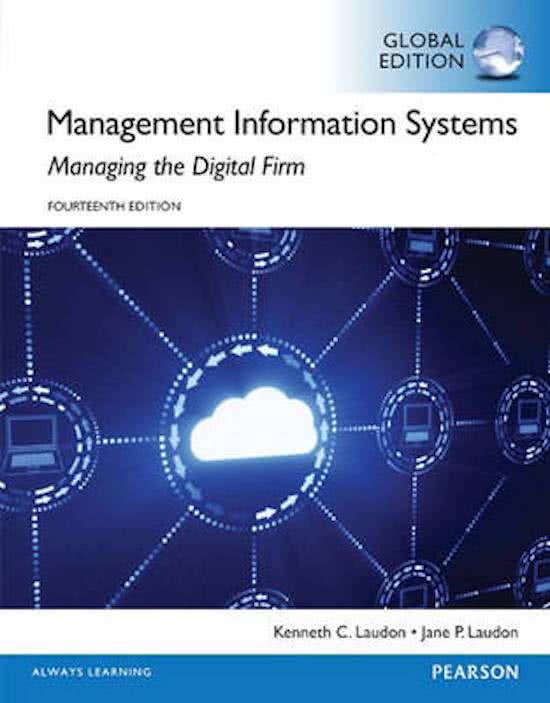
TEST BANK For Management Information Systems,
10th Edition by Hossein Bidgoli, Chapters 1 - 14
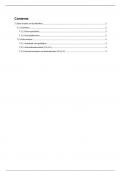
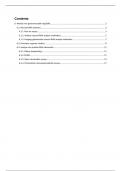
, Table of Contents
1. Information Systems in Business.
2. Computers and Their Business Applications.
3. Data and Business Intelligence.
4. Personal, Legal, Ethical, and Organizational Issues.
5. Protecting Information Resources.
6. Data Communication: Delivering Information Anywhere and Anytime.
7. A Connected World.
8. E-Commerce.
9. Global Information Systems.
10. Building Successful Information Systems.
11. Enterprise Systems.
12. Supporting Decisions and Processes.
13. Artificial Intelligence and Automation.
14. Emerging Trends, Technologies, and Applications.
,1. Information Systems in Business.
2.
True / False
1. When repetitive transaction-processing operations are automated, human involvement is increasingly required.
a. True
b. False
ANSWER: False
RATIONALE: Correct
Computers are most beneficial in transaction- processing operations. These operations are
repetitive, such as printing numerous checks, or involve enormous volumes of data, such as
inventory control in a multinational textile company. When these systems are automated,
human involvement is minimal. See 1-3:The Beginning: Transaction-Processing Systems
POINTS: 1
DIFFICULTY: Easy
REFERENCES: Define transaction-processing systems
QUESTION TYPE: True / False
HAS VARIABLES: False
LEARNING OBJECTIVES: MIS.10e.1.3
TOPICS: Information systems
Information systems importance
KEYWORDS: Remember
DATE CREATED: 10/22/2019 1:26 PM
DATE MODIFIED: 11/20/2019 7:17 PM
2. Information systems are broader in scope than information technologies.
a. True
b. False
ANSWER: True
RATIONALE: Correct
Information systems are broader in scope than information technologies, but the two
overlap in many areas. Both are used to help organizations be more competitive and to
improve their overall efficiency and effectiveness. See 1-1: Computers and Information
Systems in Daily Life
POINTS: 1
DIFFICULTY: Moderate
REFERENCES: Discuss common applications of computers and information systems.
QUESTION TYPE: True / False
HAS VARIABLES: False
LEARNING OBJECTIVES: MIS.10e.1.1
TOPICS: Information systems
Information systems importance
KEYWORDS: Understand
DATE CREATED: 10/22/2019 1:26 PM
, DATE MODIFIED: 10/22/2019 1:26 PM
3. In a management information system (MIS) application, processes are usually methods for performing a task.
a. True
b. False
ANSWER: True
RATIONALE: Correct
In an MIS application, processes are usually methods for performing a task. See 1-4:
Management Information Systems
POINTS: 1
DIFFICULTY: Moderate
REFERENCES: Define management information systems.
QUESTION TYPE: True / False
HAS VARIABLES: False
LEARNING OBJECTIVES: MIS.10e.1.4
TOPICS: Management information systems
KEYWORDS: Remember
DATE CREATED: 10/22/2019 1:26 PM
DATE MODIFIED: 10/22/2019 1:26 PM
4. In designing a management information system (MIS), the first task is to collect data and analyze it.
a. True
b. False
ANSWER: False
RATIONALE: Correct
In designing an MIS, the first task is to clearly define the system’s objectives. See 1-4:
Management Information Systems
POINTS: 1
DIFFICULTY: Moderate
REFERENCES: Define management information systems.
QUESTION TYPE: True / False
HAS VARIABLES: False
LEARNING OBJECTIVES: MIS.10e.1.4
TOPICS: Management information systems
KEYWORDS: Remember
DATE CREATED: 10/22/2019 1:26 PM
DATE MODIFIED: 10/22/2019 1:26 PM
5. An winformation wsystem wshould wcollect wdata wfrom wboth wexternal wand winternal wsources, walthough
worganizational wobjectives wand wthe wtype wof wapplication walso wdetermine wwhat wsources wto wuse.
a. True
b. False
ANSWER: True
RATIONALE: Correct
The winformation wthat wusers wneed waffects wthe wtype wof wdata wthat wis wcollected
wand wused. wAn winformation wsystem wshould wcollect wdata wfrom wboth wexternal wand
10th Edition by Hossein Bidgoli, Chapters 1 - 14
, Table of Contents
1. Information Systems in Business.
2. Computers and Their Business Applications.
3. Data and Business Intelligence.
4. Personal, Legal, Ethical, and Organizational Issues.
5. Protecting Information Resources.
6. Data Communication: Delivering Information Anywhere and Anytime.
7. A Connected World.
8. E-Commerce.
9. Global Information Systems.
10. Building Successful Information Systems.
11. Enterprise Systems.
12. Supporting Decisions and Processes.
13. Artificial Intelligence and Automation.
14. Emerging Trends, Technologies, and Applications.
,1. Information Systems in Business.
2.
True / False
1. When repetitive transaction-processing operations are automated, human involvement is increasingly required.
a. True
b. False
ANSWER: False
RATIONALE: Correct
Computers are most beneficial in transaction- processing operations. These operations are
repetitive, such as printing numerous checks, or involve enormous volumes of data, such as
inventory control in a multinational textile company. When these systems are automated,
human involvement is minimal. See 1-3:The Beginning: Transaction-Processing Systems
POINTS: 1
DIFFICULTY: Easy
REFERENCES: Define transaction-processing systems
QUESTION TYPE: True / False
HAS VARIABLES: False
LEARNING OBJECTIVES: MIS.10e.1.3
TOPICS: Information systems
Information systems importance
KEYWORDS: Remember
DATE CREATED: 10/22/2019 1:26 PM
DATE MODIFIED: 11/20/2019 7:17 PM
2. Information systems are broader in scope than information technologies.
a. True
b. False
ANSWER: True
RATIONALE: Correct
Information systems are broader in scope than information technologies, but the two
overlap in many areas. Both are used to help organizations be more competitive and to
improve their overall efficiency and effectiveness. See 1-1: Computers and Information
Systems in Daily Life
POINTS: 1
DIFFICULTY: Moderate
REFERENCES: Discuss common applications of computers and information systems.
QUESTION TYPE: True / False
HAS VARIABLES: False
LEARNING OBJECTIVES: MIS.10e.1.1
TOPICS: Information systems
Information systems importance
KEYWORDS: Understand
DATE CREATED: 10/22/2019 1:26 PM
, DATE MODIFIED: 10/22/2019 1:26 PM
3. In a management information system (MIS) application, processes are usually methods for performing a task.
a. True
b. False
ANSWER: True
RATIONALE: Correct
In an MIS application, processes are usually methods for performing a task. See 1-4:
Management Information Systems
POINTS: 1
DIFFICULTY: Moderate
REFERENCES: Define management information systems.
QUESTION TYPE: True / False
HAS VARIABLES: False
LEARNING OBJECTIVES: MIS.10e.1.4
TOPICS: Management information systems
KEYWORDS: Remember
DATE CREATED: 10/22/2019 1:26 PM
DATE MODIFIED: 10/22/2019 1:26 PM
4. In designing a management information system (MIS), the first task is to collect data and analyze it.
a. True
b. False
ANSWER: False
RATIONALE: Correct
In designing an MIS, the first task is to clearly define the system’s objectives. See 1-4:
Management Information Systems
POINTS: 1
DIFFICULTY: Moderate
REFERENCES: Define management information systems.
QUESTION TYPE: True / False
HAS VARIABLES: False
LEARNING OBJECTIVES: MIS.10e.1.4
TOPICS: Management information systems
KEYWORDS: Remember
DATE CREATED: 10/22/2019 1:26 PM
DATE MODIFIED: 10/22/2019 1:26 PM
5. An winformation wsystem wshould wcollect wdata wfrom wboth wexternal wand winternal wsources, walthough
worganizational wobjectives wand wthe wtype wof wapplication walso wdetermine wwhat wsources wto wuse.
a. True
b. False
ANSWER: True
RATIONALE: Correct
The winformation wthat wusers wneed waffects wthe wtype wof wdata wthat wis wcollected
wand wused. wAn winformation wsystem wshould wcollect wdata wfrom wboth wexternal wand