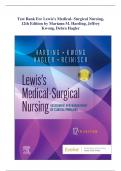
Test Bank For Lewis's Medical- Surgical Nursing,
12th Edition by Mariann M. Harding, Jeffrey
Kwong, Debra Hagler
, Chapter 01: Professional Nursing
Harding: Lewis’s Medical-Surgical Nursing, 12th Edition
MULTIPLE CHOICE
1. A nurse gathers patient information during admission and explains that the care plan and discharge objectives
will be created with the patient's involvement. The patient then asks, “How does this differ from what the doctor
does?” How should the nurse respond?
a. “The nurse's role includes administering medications and treatments as prescribed by the doctor.”
b. “In addition to providing care during your illness, nurses assist in planning how to maintain your health.”
c. “The nurse collects information and informs the doctor about any issues that arise.”
d. “Nurses perform many procedures similar to doctors but spend more time with patients.”
Correct Answer: B
The American Nurses Association (ANA) defines nursing as promoting health. The other options describe
dependent and collaborative functions rather than the nurse’s unique role.
2. Which statement best explains evidence-based practice (EBP)?
a. “Patient care is guided by clinical experience, judgment, and traditional methods.”
b. “After patient care, data is reviewed to confirm that outcomes are consistently achieved.”
c. “All published research is used as a basis for planning patient care.”
d. “Decisions are made using research findings, clinical expertise, and patient preferences.”
Correct Answer: D
EBP integrates the best research evidence, clinical expertise, and patient choices. While clinical experience is
valuable, decisions should also incorporate up-to-date research. Not all published studies provide credible
evidence, and patient outcomes should be evaluated during care, not just afterward.
3. How should a nurse explain the nursing process?
a. “It is a research method used to diagnose health problems.”
b. “It is mainly used to explain nursing care to other healthcare providers.”
c. “It is a problem-solving method for identifying and managing patient needs.”
d. “It is based on nursing theories that consider the biological, psychological, and social aspects of humans.”
,Correct Answer: C
The nursing process is a structured approach to assessing and addressing patient problems. It is not a research
method, primarily for explaining care to others, or a theory-based model.
4. A patient scheduled for surgery tells the nurse, “I don’t feel comfortable leaving my children with my parents.”
What should the nurse do first?
a. Assure the patient that such feelings are common.
b. Suggest that the patient call the children to check on them.
c. Gather more details about the patient’s concerns regarding childcare.
d. Contact the patient’s parents to verify the quality of childcare.
Correct Answer: C
Before choosing an intervention, the nurse should first assess the patient’s concerns. The other actions may be
helpful, but they should come after understanding the issue.
5. A patient with a bacterial infection is experiencing fluid loss due to fever and sweating. What is the most
appropriate expected outcome for this patient?
a. The patient maintains a balanced fluid intake and output.
b. The patient’s bedding remains clean and dry.
c. The patient understands the need for increased fluid intake.
d. The patient’s skin remains cool and dry throughout hospitalization.
Correct Answer: A
Balanced fluid intake and output provide measurable evidence that dehydration has been addressed. The other
statements do not directly confirm that the fluid deficit has been resolved.
6. What is the primary goal of the evaluation phase in the nursing process?
a. To document the nursing care plan in the patient’s health record.
b. To assess whether interventions have effectively met patient goals.
c. To determine if all health problems have been resolved.
d. To confirm that the patient is satisfied with the care provided.
, Correct Answer: B
The evaluation phase determines if nursing interventions have successfully achieved patient outcomes. The other
options do not accurately describe this phase.
7. What is the main purpose of the assessment phase in the nursing process?
a. To teach interventions that help manage health problems.
b. To use patient data to evaluate the effectiveness of care.
c. To collect information to identify patient strengths and issues.
d. To assist the patient in setting achievable health goals.
Correct Answer: C
During assessment, the nurse gathers data to determine patient needs and strengths. The other options refer to
different phases of the nursing process.
8. When developing a plan of care, what should be included in the clinical problem statement?
a. The problem along with the proposed patient goals or outcomes.
b. The problem, its causes, and the associated signs and symptoms.
c. The problem, the likely causes, and the planned interventions.
d. The problem, its underlying pathology, and the expected outcome.
Correct Answer: B
A clinical problem statement should include the problem itself, contributing factors, and observable signs and
symptoms. Goals, interventions, and pathophysiology are not part of this statement.
9. Which task can the nurse assign to experienced assistive personnel (AP)?
a. Teach the patient about balancing activity and rest.
b. Monitor the patient’s shortness of breath after walking.
c. Check the patient’s blood pressure and pulse after ambulation.
d. Determine if the patient is ready to increase their activity level.
Correct Answer: C
APs are trained to take vital signs, but assessment and patient education require a nurse’s expertise.
12th Edition by Mariann M. Harding, Jeffrey
Kwong, Debra Hagler
, Chapter 01: Professional Nursing
Harding: Lewis’s Medical-Surgical Nursing, 12th Edition
MULTIPLE CHOICE
1. A nurse gathers patient information during admission and explains that the care plan and discharge objectives
will be created with the patient's involvement. The patient then asks, “How does this differ from what the doctor
does?” How should the nurse respond?
a. “The nurse's role includes administering medications and treatments as prescribed by the doctor.”
b. “In addition to providing care during your illness, nurses assist in planning how to maintain your health.”
c. “The nurse collects information and informs the doctor about any issues that arise.”
d. “Nurses perform many procedures similar to doctors but spend more time with patients.”
Correct Answer: B
The American Nurses Association (ANA) defines nursing as promoting health. The other options describe
dependent and collaborative functions rather than the nurse’s unique role.
2. Which statement best explains evidence-based practice (EBP)?
a. “Patient care is guided by clinical experience, judgment, and traditional methods.”
b. “After patient care, data is reviewed to confirm that outcomes are consistently achieved.”
c. “All published research is used as a basis for planning patient care.”
d. “Decisions are made using research findings, clinical expertise, and patient preferences.”
Correct Answer: D
EBP integrates the best research evidence, clinical expertise, and patient choices. While clinical experience is
valuable, decisions should also incorporate up-to-date research. Not all published studies provide credible
evidence, and patient outcomes should be evaluated during care, not just afterward.
3. How should a nurse explain the nursing process?
a. “It is a research method used to diagnose health problems.”
b. “It is mainly used to explain nursing care to other healthcare providers.”
c. “It is a problem-solving method for identifying and managing patient needs.”
d. “It is based on nursing theories that consider the biological, psychological, and social aspects of humans.”
,Correct Answer: C
The nursing process is a structured approach to assessing and addressing patient problems. It is not a research
method, primarily for explaining care to others, or a theory-based model.
4. A patient scheduled for surgery tells the nurse, “I don’t feel comfortable leaving my children with my parents.”
What should the nurse do first?
a. Assure the patient that such feelings are common.
b. Suggest that the patient call the children to check on them.
c. Gather more details about the patient’s concerns regarding childcare.
d. Contact the patient’s parents to verify the quality of childcare.
Correct Answer: C
Before choosing an intervention, the nurse should first assess the patient’s concerns. The other actions may be
helpful, but they should come after understanding the issue.
5. A patient with a bacterial infection is experiencing fluid loss due to fever and sweating. What is the most
appropriate expected outcome for this patient?
a. The patient maintains a balanced fluid intake and output.
b. The patient’s bedding remains clean and dry.
c. The patient understands the need for increased fluid intake.
d. The patient’s skin remains cool and dry throughout hospitalization.
Correct Answer: A
Balanced fluid intake and output provide measurable evidence that dehydration has been addressed. The other
statements do not directly confirm that the fluid deficit has been resolved.
6. What is the primary goal of the evaluation phase in the nursing process?
a. To document the nursing care plan in the patient’s health record.
b. To assess whether interventions have effectively met patient goals.
c. To determine if all health problems have been resolved.
d. To confirm that the patient is satisfied with the care provided.
, Correct Answer: B
The evaluation phase determines if nursing interventions have successfully achieved patient outcomes. The other
options do not accurately describe this phase.
7. What is the main purpose of the assessment phase in the nursing process?
a. To teach interventions that help manage health problems.
b. To use patient data to evaluate the effectiveness of care.
c. To collect information to identify patient strengths and issues.
d. To assist the patient in setting achievable health goals.
Correct Answer: C
During assessment, the nurse gathers data to determine patient needs and strengths. The other options refer to
different phases of the nursing process.
8. When developing a plan of care, what should be included in the clinical problem statement?
a. The problem along with the proposed patient goals or outcomes.
b. The problem, its causes, and the associated signs and symptoms.
c. The problem, the likely causes, and the planned interventions.
d. The problem, its underlying pathology, and the expected outcome.
Correct Answer: B
A clinical problem statement should include the problem itself, contributing factors, and observable signs and
symptoms. Goals, interventions, and pathophysiology are not part of this statement.
9. Which task can the nurse assign to experienced assistive personnel (AP)?
a. Teach the patient about balancing activity and rest.
b. Monitor the patient’s shortness of breath after walking.
c. Check the patient’s blood pressure and pulse after ambulation.
d. Determine if the patient is ready to increase their activity level.
Correct Answer: C
APs are trained to take vital signs, but assessment and patient education require a nurse’s expertise.