core material for the IAAO Course 600 Mapping Exam, focusing on GIS applications in parcel mapping, cadastral systems, and
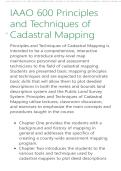
IAAO 600 Principles
and Techniques of
Cadastral Mapping
Principles and Techniques of Cadastral Mapping is
intended to be a comprehensive, interactive
program to introduce entry-level map
maintenance personnel and assessment
technicians to the field of cadastral mapping.
Students are presented basic mapping principles
and techniques and are expected to demonstrate
basic skills that will allow them to plot deeded
descriptions in both the metes and bounds land
description system and the Public Land Survey
System. Principles and Techniques of Cadastral
Mapping utilize lectures, classroom discussion,
and exercises to emphasize the main concepts and
procedures taught in the course.
Chapter One provides the students with a
background and history of mapping in
general and addresses the specifics of
creating a county-wide assessment mapping
program.
Chapter Two introduces the students to the
various tools and techniques used by
cadastral mappers to plot deed descriptions
,core material for the IAAO Course 600 Mapping Exam, focusing on GIS applications in parcel mapping, cadastral systems, and
that contain bearings, azimuths, curves and
field angles.
Chapter Three provides an overview of
locational systems including latitude and
longitude and state plane coordinates. This
chapter discusses mathematical projections
used in the creation of a flat map from a
curved surface.
Chapter Four discusses the various base maps
available to today’s assessment mapping
personnel. In addition, aerial photograph
displacement is discussed and explained. This
provides an understanding of how photo
distortion can affect the accuracy of
assessment maps.
Chapter Five explains the various methods
available to describe land, provides examples
of each and uses exercises to enhance the
learning experience.
Chapter Six covers conveyance records, area
determination and parcel identification
systems.
Chapter Seven addresses the importance of
proper map maintenance, explains the
different types of maintenance the
assessment map technician must complete
and provides exercises to enhance the
learning experience.
Chapter Eight provides guidance in
determining the requirements for a proper
cadastral mapping program and explains the
,core material for the IAAO Course 600 Mapping Exam, focusing on GIS applications in parcel mapping, cadastral systems, and
value of creating and managing a parcel-level
information system.
, core material for the IAAO Course 600 Mapping Exam, focusing on GIS applications in parcel mapping, cadastral systems,
IAAO 600 (Chapters 1–8) – Q&A with Explanations
1. What provides an in-depth understanding of what can and cannot be
accomplished?
Answer: Needs Analysis
Explanation:
A needs analysis evaluates requirements, limitations, and goals before starting a mapping or GIS
project. It prevents wasted time and resources.
2. What map component explains symbols used on a map?
Answer: Legend
Explanation:
The legend helps users interpret map symbols (colors, lines, icons), making the map
understandable.
3. What is a map?
Answer: A two-dimensional portrayal of a three-dimensional world
Explanation:
Maps simplify real-world features into flat representations for easier analysis and communication.
4. What are the three functions of a map?
Answer: Location, Identification, Inventory
Explanation:
Location: Shows where things are
Identification: Tells what features are
Inventory: Shows quantity or distribution of features
5. Name two types of records used in early parcel mapping.
Answer: Public, Private, Assessment, Government
Explanation:
These records provided land ownership and boundary information for mapping.
6. What are key map components?
IAAO 600 Principles
and Techniques of
Cadastral Mapping
Principles and Techniques of Cadastral Mapping is
intended to be a comprehensive, interactive
program to introduce entry-level map
maintenance personnel and assessment
technicians to the field of cadastral mapping.
Students are presented basic mapping principles
and techniques and are expected to demonstrate
basic skills that will allow them to plot deeded
descriptions in both the metes and bounds land
description system and the Public Land Survey
System. Principles and Techniques of Cadastral
Mapping utilize lectures, classroom discussion,
and exercises to emphasize the main concepts and
procedures taught in the course.
Chapter One provides the students with a
background and history of mapping in
general and addresses the specifics of
creating a county-wide assessment mapping
program.
Chapter Two introduces the students to the
various tools and techniques used by
cadastral mappers to plot deed descriptions
,core material for the IAAO Course 600 Mapping Exam, focusing on GIS applications in parcel mapping, cadastral systems, and
that contain bearings, azimuths, curves and
field angles.
Chapter Three provides an overview of
locational systems including latitude and
longitude and state plane coordinates. This
chapter discusses mathematical projections
used in the creation of a flat map from a
curved surface.
Chapter Four discusses the various base maps
available to today’s assessment mapping
personnel. In addition, aerial photograph
displacement is discussed and explained. This
provides an understanding of how photo
distortion can affect the accuracy of
assessment maps.
Chapter Five explains the various methods
available to describe land, provides examples
of each and uses exercises to enhance the
learning experience.
Chapter Six covers conveyance records, area
determination and parcel identification
systems.
Chapter Seven addresses the importance of
proper map maintenance, explains the
different types of maintenance the
assessment map technician must complete
and provides exercises to enhance the
learning experience.
Chapter Eight provides guidance in
determining the requirements for a proper
cadastral mapping program and explains the
,core material for the IAAO Course 600 Mapping Exam, focusing on GIS applications in parcel mapping, cadastral systems, and
value of creating and managing a parcel-level
information system.
, core material for the IAAO Course 600 Mapping Exam, focusing on GIS applications in parcel mapping, cadastral systems,
IAAO 600 (Chapters 1–8) – Q&A with Explanations
1. What provides an in-depth understanding of what can and cannot be
accomplished?
Answer: Needs Analysis
Explanation:
A needs analysis evaluates requirements, limitations, and goals before starting a mapping or GIS
project. It prevents wasted time and resources.
2. What map component explains symbols used on a map?
Answer: Legend
Explanation:
The legend helps users interpret map symbols (colors, lines, icons), making the map
understandable.
3. What is a map?
Answer: A two-dimensional portrayal of a three-dimensional world
Explanation:
Maps simplify real-world features into flat representations for easier analysis and communication.
4. What are the three functions of a map?
Answer: Location, Identification, Inventory
Explanation:
Location: Shows where things are
Identification: Tells what features are
Inventory: Shows quantity or distribution of features
5. Name two types of records used in early parcel mapping.
Answer: Public, Private, Assessment, Government
Explanation:
These records provided land ownership and boundary information for mapping.
6. What are key map components?