

FLUVIAL GEOMORPHOLOGY
DRAINAGE SYSTEMS
The role that rivers play in shaping the Earth’s surface
Rivers come from:
• Precipitation
• Snowmelt
• Surface runoff
• Groundwater
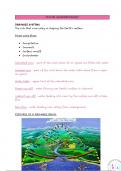
Saturated zone - part of the crust where all air spaces are filled with water
Aerated zone - part of the crust above the water table where there is open
air spaces
Water table - upper limit of the saturated zone
Direct run-off - water flowing over Earth’s surface in channels
Indirect run-off - water feeding into rivers by the surface run-off or base
flow
Base flow - water feeding river valleys from underground
FEATURES OF A DRAINAGE BASIN:
,Drainage basin - an area drained by a river system (main river &
tributaries)
Catchment Area - the area that feeds water into a river system
Watershed - the highlying ground that separates one drainage basin from
another
River system - a network of tributaries that join a main river that flows
into the sea
Main stream - main channel of the river system
Tributaries - smaller channels that join to the main river
Confluence - the point where any two river systems meet
Interfluve - highlying ground separating any two streams within a
drainage basin
Source - the start of the river
Mouth - the end of a river - where the river flows into the sea
DRAINAGE BASINS IN SOUTH AFRICA
The Orange River Basin and the Limpopo River Basin are the largest in SA
Orange River catchment area
Approximately 973 000km2
77% of SA’s total area
Average discharge of 365m3/s
Serves as a boarder between SA and Namibia
, Limpopo River catchment area
Approximately 415 000km2
Average discharge of 170m3/s
Falls outside of SA boarders, in Zimbabwe, Botswana & Mozambique
A - mainstream
B - tributary
C - watershed
D - confluence
E - interfluves
TYPES OF RIVERS
Found in high rainfall
Flow all year round areas -> the water table is
close to the surface
PERMANENT
*perennial
Create deep valleys
due to their large Common in the
volume eastern regions of
SA
Breede River (WC)
Tugela River (KZN)
Crocodile River (MP)
DRAINAGE SYSTEMS
The role that rivers play in shaping the Earth’s surface
Rivers come from:
• Precipitation
• Snowmelt
• Surface runoff
• Groundwater
Saturated zone - part of the crust where all air spaces are filled with water
Aerated zone - part of the crust above the water table where there is open
air spaces
Water table - upper limit of the saturated zone
Direct run-off - water flowing over Earth’s surface in channels
Indirect run-off - water feeding into rivers by the surface run-off or base
flow
Base flow - water feeding river valleys from underground
FEATURES OF A DRAINAGE BASIN:
,Drainage basin - an area drained by a river system (main river &
tributaries)
Catchment Area - the area that feeds water into a river system
Watershed - the highlying ground that separates one drainage basin from
another
River system - a network of tributaries that join a main river that flows
into the sea
Main stream - main channel of the river system
Tributaries - smaller channels that join to the main river
Confluence - the point where any two river systems meet
Interfluve - highlying ground separating any two streams within a
drainage basin
Source - the start of the river
Mouth - the end of a river - where the river flows into the sea
DRAINAGE BASINS IN SOUTH AFRICA
The Orange River Basin and the Limpopo River Basin are the largest in SA
Orange River catchment area
Approximately 973 000km2
77% of SA’s total area
Average discharge of 365m3/s
Serves as a boarder between SA and Namibia
, Limpopo River catchment area
Approximately 415 000km2
Average discharge of 170m3/s
Falls outside of SA boarders, in Zimbabwe, Botswana & Mozambique
A - mainstream
B - tributary
C - watershed
D - confluence
E - interfluves
TYPES OF RIVERS
Found in high rainfall
Flow all year round areas -> the water table is
close to the surface
PERMANENT
*perennial
Create deep valleys
due to their large Common in the
volume eastern regions of
SA
Breede River (WC)
Tugela River (KZN)
Crocodile River (MP)


