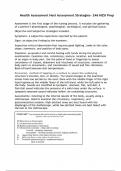
Health Assessment Hesi Assessment Strategies- 246 HESI Prep
Assessment is the first stage of the nursing process. It includes the gathering of a patient’s physiological, psychological, sociological, and spiritual status. Objective and Subjective strategies included. Symptoms- a subjective experience reported by the patient. Signs- an objective finding by the examiner. Inspection-critical observation that requires good lighting. Looks at the color, shape, symmetry, and position of body parts. Palpation- purposeful and careful feeling with hands during the physical examination. Examines size, consistency, texture, location, and tenderness of an organ or body part. Use the palm of hand or fingertips to assess consistency of tissues, alignment and intactness of structures, symmetry of body parts or movements, and transmission of sound and fine vibrations. Back of hand assesses skin temperature. Percussion- method of tapping on a surface to assess the underlying structure’s location, size, or density. The sound changes as the examiner moves from one section to the next. Done with the middle finger of the right hand tapping on the middle finger of the left hand, while the left palm is on the body. Sounds are classified as tympanic, resonant, flat, and dull. A flat/dull sound indicates the presence of a solid mass under the surface. A tympanic/resonant sound indicates hollow, air-containing structures. Auscultation- listening to the internal sounds of the body, usually using a stethoscope. Used to examine the circulatory, respiratory, and gastrointestinal systems. High-pitched tones are best heard with the diaphragm of the stethoscope, while low-pitched tones are best heard with the bell of the stethoscope. lOMoARcPSD| Cardiovascular System Assess- Pulses (peripheral and JVD) assess bilaterally and compare. Palpable pulses indicate the body and extremities are receiving adequate perfusion. Radial, brachial, femoral, popliteal, tibial, and dorsalis pedal pulses. Capillary refill > 3 seconds Auscultate heart sounds- S1, S2. Listen for intensity, rhythm, duration, and quality of sounds. Evaluate extra heart sounds and murmurs. 5 auscultation points= aortic, pulmonic, Erb’s Point, Tricuspid, and Mitral. Remember that the Apical Pulse is taken at the mitral valve. Heart rate and rhythm- notice if pulse if increased or decreased with arrhythmias. Blood Pressure- systolic (90-120) and diastolic (60-90). Mean Arterial Pressure (MAP). MAP = x2 diastolic + systolic /3. Example: 120/90 = MAP of 100. Normal range is 70-110. A MAP of 60 and above is necessary to adequately perfuse the kidneys, coronary arteries, and the brain. Report anything under 60. Over 110 indicates excess pressure and should also be addressed. Assess for decreased level of consciousness (LOC) and syncope. A patient that is alert and responsive indicated adequate perfusion to the brain. Urine output- equal of greater than 30 mL per hour. Less than 30 must be reported. Compare intake vs. output and monitor daily weight. Compare, lOMoARcPSD| contrast, and trend all. The kidneys are affected early with decreased perfusion leading to a retention of fluid that puts excess strain on the heart. Moist lung sounds and edema- increased respirations, check oxygen saturation. A patient with heart failure of PVD may have edema or crackly lung sounds present because the pumping action of the heart is not adequate to either return blood to the heart or pump blood to the body. This in combination leads to decreased oxygenation. Pain- angina, MI, PV. Assess to see if pain increases with activity. Chest pain is caused by inadequate oxygen delivery to the heart muscle. Decreased perfusion = decreased oxygenation= chest pain. Skin color- pale, cool extremities, increased temperature (for infections of the heart or heart valve disorders). Pale skin and cool temperatures may indicate inadequate perfusion of the tissues. Labs- electrolytes, CBC, PTT, PT, INR, Platelets, Liver Function Tests, BUN and Creatinine, Lipid Panel, Total Cholesterol Levels, Glucose, C-Reactive Proteins, Homocysteine Level, Urinalysis, Cardiac Enzymes (Myoglobin, Troponin, and CK-MB), BNP. Diagnostic Testing- Electrocardiogram, Echocardiogram, Chest X-ray, Stress Test, Cardiac Catherization, Thallium Scan, Pet Scan, MRI, Transesophageal Echo (TEE), Hemodynamic Monitoring (Art line and telemetry), Central Venous Pressure (CVP) normal is 2-6 mm Hg, Pulmonary Artery Catheter. lOMoARcPSD| Respiratory/Gas Exchange Ischemia- insufficient oxygenated blood flows to the tissues that may lead to cell injury or death. Hypoxia- insufficient oxygen reaches the cells. Anoxia- no oxygen reaches the cells. Hypoxemia- decreased oxygen in the arterial blood. Adventitious breath sounds: Crackles- auscultated during inspiration and does not clear with cough. Occurs when fluid is in airway. Also known as rales. Often heard with pneumonia, heart failure, and atelectasis. Wheezes- constriction. The sounds are from air moving through narrowed passages. Sound is continuous and music-like. Heard with asthma, bronchitis, and/or chronic emphysema (COPD). Pleural Friction Rub- typically on inspiration over inflammation or the pleural area. Described as a grating sound. May present with pain when breathing. Stridor- sounds like a crowing sound. This is high pitched and is heard with croup and epiglottitis. Orthopnea- patient has difficulty breathing unless sitting erect or standing. Results from an increase in pulmonary venous and capillary pressure in the lungs when the patient lies in the supine position and is relieved when the patient is upright. Diminished breath sounds- sound distant due to “trapped air”. Occurs often with COPD. Absent- no breath sounds are heard on the side of a collapsed lung (pneumothorax). Assess lungs with the diaphragm of the stethoscope in both front and back on bare skin if possible. Have patient sit upright unless unable. Start from left to right, comparing and contrasting. lOMoARcPSD| Assess the ABCDs- Airway patency Breathing- depressed respirations from anesthesia, lack of mobility, or pain. Circulation decreased- affects oxygenation Developmental changes (LOC). Watch for signs of restlessness or acute confusion, tachycardia, increased or decreased respirations (normal 12-20), elevated BP, color of skin and mucous membranes, shortness of breath (dyspnea). lOMoARcPSD| Labs- ABG, CBC, electrolytes, sputum cultures. Cystic Fibrosis specific labs include sweat chloride test, stool analysis, serum blood glucose for hyperglycemia. Diagnostic testing- pulmonary function test, Chest X-ray, Pulse Oximetry, Chest Physiotherapy, Chest Tubes, Hemodynamic Monitoring, Bronchoscopy, Torancentesis. lOMoARcPSD| Fluid Balance Regulated through intake and output. Intake maintained through the thirst mechanism. The output is regulated by the skin, lungs, GI tract, and kidneys. Watch for deficits and excesses. For deficits (dehydration) assess for: • Diminished kidney function • Elevated temperature • Dry mucous membranes • Decrease in vascular volume • Tachycardia • Weight loss • Hypotension and syncope • Decreased CVP • Flattened JVD • Decreased urine output or oliguria • Decrease skin turgor • Decreased peripheral pulse • Decreased LOC Fluid volume excess- assess for: • Bounding pulse • Hypertension • Increased CVP • Confusion • Edema • Weight gain • Lung crackles • Increased respirations and dyspnea, orthopnea • Swelling JVD • Skin breakdown Labs: hematocrit, serum osmolality, protein level, BUN, sodium, glucose, urine specific gravity. lOMoARcPSD| Neurological System Problems with perfusion, neurotransmission, and pathology are three categories that affect neurological dysfunction. Assess for signs of cognitive impairment: Significant memory loss, agitation, restlessness Awareness of person, place, time, and situation (Alert and oriented x 4) Can patient identify three or four common objects? Do they show lack of judgment? Can they perform ADLs? Recall the president’s name? Assess for sensory deficits Appearance- manner of dress and grooming Attitude and behavior- appropriate for age? Situation? Mood and affect- emotional state Speech Thought process Perception- hallucinations, illusions Insight- patient’s understanding of their illness Reflex testing Motor assessment- muscle strength, balance, coordination Sensory assessment-sensitivity to touch with various stimuli If neuro decline is suspected, assess for metabolic changes, UTI, fluid and electrolyte imbalance, glucose regulation imbalance, cardiac output, acidosis, shallow breathing, infection, pneumonia, cerebral edema, hypothermia, or hypothermia. lOMoARcPSD| Cranial Nerve Assessments: • CN I Olfactory • CN II Optic- Snellen chart • CN III Oculomotor- pupil size and reaction • CN IV and CN VI-Trochlear and Abducens- Check eye movement by following finger movements • CN V Trigeminal- palpate jaw and temples while patient clenches teeth. Touch cotton ball to areas of face. • CN VII Facial- symmetry and mobility. Frown, smile, lift brows, puff cheeks, ability to identify sour, sweet, salty. • CN VIII Acoustic- check hearing acuity • CN IX Glossopharyngeal and CN X Vagus- evaluate movement of the uvula and soft palate. Assess gag reflex. • CN XI Spinal Accessory- Check movement of head and neck. • CN XII Hypoglossal- assess tongue control. lOMoARcPSD| Gastrointestinal Assessment From the mouth headed south! Mouth and throat assessment- inspect for sores, condition of teeth and gums, look under tongue for tumors or lesions, assess for unusual breath odors. Inspect opopharnx for presence/absence of tonsils, and for color, swelling and movement of uvula. Gag reflex. Abdominal assessment- inspect all 4 quadrants for contour, symmetry, abdominal aortic distention, and pulsation. A lower quadrant bulge may indicate a distended bladder. A midline bulge may indicate an umbilical hernia. Assess for abdominal distension. May be caused by obesity, ascites, and obstruction. Obesity- soft and rounded, with sunken umbilicus. Ascites- skin is shiny and glistening, with an everted umbilicus and dilated, prominent veins. Obstruction- visible, marked peristalsis, restlessness, lying with knees flexed, grimacing facial expression and uneven respirations. Auscultation- auscultate BEFORE palpitations and percussion to avoid increasing the frequency of bowel sounds. Bowel sounds best heard with the diaphragm of the stethoscope. Begin in the right lower quadrant and listen to each quadrant in a clockwise pattern for at least 2 minutes. Note the frequency of the bowel sounds. Assess for pain. Assess for frequency and date of last bowel movement. Assess for nausea and vomiting and diarrhea or constipation. Assess for heart burn and acid reflux Watch for signs of bleeding.
Written for
- Institution
-
Walden University
- Course
-
NURS HESI
Document information
- Uploaded on
- February 16, 2025
- Number of pages
- 19
- Written in
- 2024/2025
- Type
- Exam (elaborations)
- Contains
- Questions & answers
Subjects
- hesi
-
hesi assessment strategies 246
-
health assessment hesi assessment strategies 246

Also available in package deal