1|Page
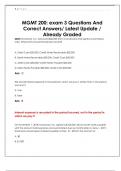
MGMT 200: exam 3 Questions And
Correct Answers/ Latest Update /
Already Graded
QUIZ:Woodcrest, Inc. borrowed $50,000 from a local bank and signed a promissory
note. What entry should Woodcrest record?
A. Debit Cash $50,000; Credit Notes Receivable $50,000
B. Debit Notes Receivable $50,000; Credit Cash $50,000
C. Debit Cash $50,000; Credit Notes Payable $50,000
D. Debit Notes Payable $50,000; Credit Cash $50,000
Ans: C
We record interest expense in the period in which we pay it, rather than in the period
we incur it
A. true
B. false
Ans: B
Interest expense is recorded in the period incurred, not in the period in
which we pay it
On November 1, 2018, Knomarck, Inc. signed a $100,000, 6% six-month note payable
with the amount borrowed plus accrued interest due six months later on May 1, 2019.
Knomarck should report interest payable at Dec. 31, 2018 in the amount of
A. $0
B. $1,000
,2|Page
C. $2,000
D. $3,000
Ans: B
[(100,000)x6%)x2/12] = $1,000
On Nov. 1, 2018, Boiler Bakery signed a $200,000, 6% six-month payable with the amount
borrowed plus accrued interest due six months later on May 1, 2019. Boiler Bakery
records the appropriate adjusting entry for the note on Dec. 31, 2018. What amount of
cash will be needed to pay back the note payable plus any accrued interest on May 1,
2019?
A. $200,000
B. $202,000
C. $204,000
D. $206,000
Ans: D
200,000+[200,000x6%x6/12] = 206,000
A contingency is best described as a(n)
A. current liability
B. probably liability
C. potential liability
D. estimated liability
Ans: C
,3|Page
If management can estimate the amount of loss that will occur due to litigation against
the company, and the likelihood of the loss is reasonably possible, a contingent liability
should be
A. Disclosed, but not reported as a liability
B. Disclosed and reported as a liability
C. Neither disclosed nor reported as a liability
D. Reported as a liability, but not disclosed
Ans: A
Reeves Co. filed suit against Higgins Inc, seeking damages for copyright violations.
Higgins' legal counsel believes it is probable that Higgins will settle the lawsuit for an
estimated amount in the range of $100,000 to $200,000, with all amounts in the range
considered equally likely. How should Higgins report this litigation?
A. As a liability for $100,000 with disclosure of the range
B. As a liability for $150,000 with disclosure of the range
C. As a liability for $200,000 with disclosure of the range
D. As a disclosure only. No liability reported
Ans: A.
When no amount within a range of potential losses appears more likely
than others, the liability is recorded at the minimum amount in the range
Away Travel filed suit against West Coast Travel seeking damages for copyright
violations. West Coast Travel's legal counsel believes it is reasonably possible that West
Coast Travel will settle the lawsuit for an estimated amount in the range of $100,000 to
$200,000, with all amounts in the range considered equally. How should West Coast
Travel report this litigation?
A. As a liability for $100,000 with disclosure of the range
B. As a liability for $150,000 with disclosure of the range
C. As a liability for $200,000 with disclosure of the range
, 4|Page
D. As a disclosure only. No liability reported
Ans: D
A contingent liability is not recorded if the likelihood of loss is only
reasonably possible
If management can estimate the amount of loss that will occur due to litigation against
the company, and the likelihood of the loss is probable, a contingent liability should be
A. disclosed, but not reported as a liability
B. disclosed and reported as a liability
C. neither disclosed nor reported as a liability
D. reported as a liability, but not disclosed
Ans: B
Footnote disclosure is required for material potential losses when the loss is at least
reasonably possible:
A. only if the amount is known
B. Only if the amount is known or reasonably estimable
C. unless the amount is not reasonably estimable
D. even if the amount is not reasonably estimable
Ans: D
For estimates engine warranty expense in the year a car is sold. This best follows which
of the following accounting principles?
A. historical cost
B. full disclosure
C. consistency
MGMT 200: exam 3 Questions And
Correct Answers/ Latest Update /
Already Graded
QUIZ:Woodcrest, Inc. borrowed $50,000 from a local bank and signed a promissory
note. What entry should Woodcrest record?
A. Debit Cash $50,000; Credit Notes Receivable $50,000
B. Debit Notes Receivable $50,000; Credit Cash $50,000
C. Debit Cash $50,000; Credit Notes Payable $50,000
D. Debit Notes Payable $50,000; Credit Cash $50,000
Ans: C
We record interest expense in the period in which we pay it, rather than in the period
we incur it
A. true
B. false
Ans: B
Interest expense is recorded in the period incurred, not in the period in
which we pay it
On November 1, 2018, Knomarck, Inc. signed a $100,000, 6% six-month note payable
with the amount borrowed plus accrued interest due six months later on May 1, 2019.
Knomarck should report interest payable at Dec. 31, 2018 in the amount of
A. $0
B. $1,000
,2|Page
C. $2,000
D. $3,000
Ans: B
[(100,000)x6%)x2/12] = $1,000
On Nov. 1, 2018, Boiler Bakery signed a $200,000, 6% six-month payable with the amount
borrowed plus accrued interest due six months later on May 1, 2019. Boiler Bakery
records the appropriate adjusting entry for the note on Dec. 31, 2018. What amount of
cash will be needed to pay back the note payable plus any accrued interest on May 1,
2019?
A. $200,000
B. $202,000
C. $204,000
D. $206,000
Ans: D
200,000+[200,000x6%x6/12] = 206,000
A contingency is best described as a(n)
A. current liability
B. probably liability
C. potential liability
D. estimated liability
Ans: C
,3|Page
If management can estimate the amount of loss that will occur due to litigation against
the company, and the likelihood of the loss is reasonably possible, a contingent liability
should be
A. Disclosed, but not reported as a liability
B. Disclosed and reported as a liability
C. Neither disclosed nor reported as a liability
D. Reported as a liability, but not disclosed
Ans: A
Reeves Co. filed suit against Higgins Inc, seeking damages for copyright violations.
Higgins' legal counsel believes it is probable that Higgins will settle the lawsuit for an
estimated amount in the range of $100,000 to $200,000, with all amounts in the range
considered equally likely. How should Higgins report this litigation?
A. As a liability for $100,000 with disclosure of the range
B. As a liability for $150,000 with disclosure of the range
C. As a liability for $200,000 with disclosure of the range
D. As a disclosure only. No liability reported
Ans: A.
When no amount within a range of potential losses appears more likely
than others, the liability is recorded at the minimum amount in the range
Away Travel filed suit against West Coast Travel seeking damages for copyright
violations. West Coast Travel's legal counsel believes it is reasonably possible that West
Coast Travel will settle the lawsuit for an estimated amount in the range of $100,000 to
$200,000, with all amounts in the range considered equally. How should West Coast
Travel report this litigation?
A. As a liability for $100,000 with disclosure of the range
B. As a liability for $150,000 with disclosure of the range
C. As a liability for $200,000 with disclosure of the range
, 4|Page
D. As a disclosure only. No liability reported
Ans: D
A contingent liability is not recorded if the likelihood of loss is only
reasonably possible
If management can estimate the amount of loss that will occur due to litigation against
the company, and the likelihood of the loss is probable, a contingent liability should be
A. disclosed, but not reported as a liability
B. disclosed and reported as a liability
C. neither disclosed nor reported as a liability
D. reported as a liability, but not disclosed
Ans: B
Footnote disclosure is required for material potential losses when the loss is at least
reasonably possible:
A. only if the amount is known
B. Only if the amount is known or reasonably estimable
C. unless the amount is not reasonably estimable
D. even if the amount is not reasonably estimable
Ans: D
For estimates engine warranty expense in the year a car is sold. This best follows which
of the following accounting principles?
A. historical cost
B. full disclosure
C. consistency