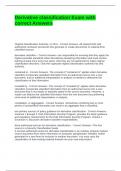
Derivative classification Exam with
correct Answers
Original Classification Authority, or OCA - Correct Answers -All cleared DoD and
authorized contractor personnel who generate or create documents or material from
classified sources
derivative classifiers - Correct Answers -are responsible for ensuring that they apply the
highest possible standards when derivatively classifying information and must receive
training at least once every two years. Also they are not authorized to make original
classification decisions. Only the cognizant original classification authority has that
authority.
contained in - Correct Answers -The concept of "contained in" applies when derivative
classifiers incorporate classified information from an authorized source into a new
document, and no additional interpretation or analysis is needed to determine the
classification of that information.
revealed by - Correct Answers -The concept of "revealed by" applies when derivative
classifiers incorporate classified information from an authorized source into a new
document that is not clearly or explicitly stated in the source document. However, a
reader can deduce the classified information from the new document by performing
some level of additional interpretation or analysis.
compilation, or aggregation - Correct Answers -Sometimes combining two or more
pieces of unclassified information can result in an aggregate that is classified.
two primary sources of policy guidance for derivative classification - Correct Answers -
Volumes 1 through 4: DoD Information Security Program, provides the basic guidance
and regulatory requirements for the DoD Information Security Program. Volume 1,
Enclosure 4, discusses derivative classifier responsibilities.
three authorized sources for derivative classification. - Correct Answers -The first
source is a Security Classification Guide.
A second authorized source for derivative classification is an existing, properly marked
source document from which information is extracted, paraphrased, restated, and/or
generated in a new form for inclusion in another document. You must carry the
classification of that existing material forward into your new end product.
correct Answers
Original Classification Authority, or OCA - Correct Answers -All cleared DoD and
authorized contractor personnel who generate or create documents or material from
classified sources
derivative classifiers - Correct Answers -are responsible for ensuring that they apply the
highest possible standards when derivatively classifying information and must receive
training at least once every two years. Also they are not authorized to make original
classification decisions. Only the cognizant original classification authority has that
authority.
contained in - Correct Answers -The concept of "contained in" applies when derivative
classifiers incorporate classified information from an authorized source into a new
document, and no additional interpretation or analysis is needed to determine the
classification of that information.
revealed by - Correct Answers -The concept of "revealed by" applies when derivative
classifiers incorporate classified information from an authorized source into a new
document that is not clearly or explicitly stated in the source document. However, a
reader can deduce the classified information from the new document by performing
some level of additional interpretation or analysis.
compilation, or aggregation - Correct Answers -Sometimes combining two or more
pieces of unclassified information can result in an aggregate that is classified.
two primary sources of policy guidance for derivative classification - Correct Answers -
Volumes 1 through 4: DoD Information Security Program, provides the basic guidance
and regulatory requirements for the DoD Information Security Program. Volume 1,
Enclosure 4, discusses derivative classifier responsibilities.
three authorized sources for derivative classification. - Correct Answers -The first
source is a Security Classification Guide.
A second authorized source for derivative classification is an existing, properly marked
source document from which information is extracted, paraphrased, restated, and/or
generated in a new form for inclusion in another document. You must carry the
classification of that existing material forward into your new end product.