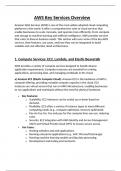
AWS Key Services Overview
Amazon Web Services (AWS) is one of the most widely adopted cloud computing
platforms in the world. It offers a comprehensive suite of cloud services that
enable businesses to scale, innovate, and operate more efficiently. From compute
and storage to machine learning and artificial intelligence, AWS provides services
that cater to diverse business needs. This section will cover some of the key AWS
services, their features, use cases, and how they can be integrated to build
scalable and cost-effective cloud architectures.
1. Compute Services: EC2, Lambda, and Elastic Beanstalk
AWS provides a variety of compute services designed to handle diverse
application requirements. Compute resources are essential for running
applications, processing data, and managing workloads in the cloud.
a) Amazon EC2 (Elastic Compute Cloud): Amazon EC2 is the backbone of AWS’s
compute offering, providing resizable compute capacity in the cloud. EC2
instances are virtual servers that run on AWS infrastructure, enabling businesses
to run applications and workloads without the need for physical hardware.
Key Features:
o Scalability: EC2 instances can be scaled up or down based on
demand.
o Flexibility: EC2 offers a variety of instance types to meet different
computing needs (e.g., compute-optimized, memory-optimized).
o Pay-As-You-Go: You only pay for the compute time you use, reducing
costs.
o Security: EC2 integrates with AWS Identity and Access Management
(IAM) and Virtual Private Cloud (VPC) to ensure secure access.
Use Cases:
o Hosting websites and web applications.
o Running enterprise applications (e.g., SAP, Microsoft Exchange).
o Running machine learning models and big data processing.
o Development and testing environments.
, b) AWS Lambda: AWS Lambda is a serverless compute service that allows users to
run code in response to events without provisioning or managing servers. Lambda
automatically scales to handle incoming traffic, and users only pay for the
compute time consumed.
Key Features:
o Serverless: No need to manage infrastructure, Lambda automatically
scales based on demand.
o Event-Driven: Lambda functions are triggered by events such as file
uploads, database changes, or API calls.
o Cost-Efficient: Lambda charges based on execution time and memory
usage, making it ideal for small workloads or infrequent tasks.
Use Cases:
o Real-time file processing (e.g., image or video processing).
o Data transformation and enrichment in data pipelines.
o Running microservices and APIs.
o Automating workflows and tasks.
c) AWS Elastic Beanstalk: AWS Elastic Beanstalk is a Platform-as-a-Service (PaaS)
offering that simplifies the deployment and management of web applications. It
abstracts away the infrastructure layer, enabling developers to focus on writing
code rather than managing servers.
Key Features:
o Managed Environment: Automatically handles the deployment,
monitoring, and scaling of applications.
o Flexibility: Supports various programming languages (e.g., Java, .NET,
Node.js, Python).
o Integrated with other AWS services: Seamlessly integrates with
Amazon RDS, Amazon S3, and others.
Use Cases:
o Web application deployment and management.
o Quick development and deployment of APIs and microservices.
o Scalable applications with automatic load balancing.
Amazon Web Services (AWS) is one of the most widely adopted cloud computing
platforms in the world. It offers a comprehensive suite of cloud services that
enable businesses to scale, innovate, and operate more efficiently. From compute
and storage to machine learning and artificial intelligence, AWS provides services
that cater to diverse business needs. This section will cover some of the key AWS
services, their features, use cases, and how they can be integrated to build
scalable and cost-effective cloud architectures.
1. Compute Services: EC2, Lambda, and Elastic Beanstalk
AWS provides a variety of compute services designed to handle diverse
application requirements. Compute resources are essential for running
applications, processing data, and managing workloads in the cloud.
a) Amazon EC2 (Elastic Compute Cloud): Amazon EC2 is the backbone of AWS’s
compute offering, providing resizable compute capacity in the cloud. EC2
instances are virtual servers that run on AWS infrastructure, enabling businesses
to run applications and workloads without the need for physical hardware.
Key Features:
o Scalability: EC2 instances can be scaled up or down based on
demand.
o Flexibility: EC2 offers a variety of instance types to meet different
computing needs (e.g., compute-optimized, memory-optimized).
o Pay-As-You-Go: You only pay for the compute time you use, reducing
costs.
o Security: EC2 integrates with AWS Identity and Access Management
(IAM) and Virtual Private Cloud (VPC) to ensure secure access.
Use Cases:
o Hosting websites and web applications.
o Running enterprise applications (e.g., SAP, Microsoft Exchange).
o Running machine learning models and big data processing.
o Development and testing environments.
, b) AWS Lambda: AWS Lambda is a serverless compute service that allows users to
run code in response to events without provisioning or managing servers. Lambda
automatically scales to handle incoming traffic, and users only pay for the
compute time consumed.
Key Features:
o Serverless: No need to manage infrastructure, Lambda automatically
scales based on demand.
o Event-Driven: Lambda functions are triggered by events such as file
uploads, database changes, or API calls.
o Cost-Efficient: Lambda charges based on execution time and memory
usage, making it ideal for small workloads or infrequent tasks.
Use Cases:
o Real-time file processing (e.g., image or video processing).
o Data transformation and enrichment in data pipelines.
o Running microservices and APIs.
o Automating workflows and tasks.
c) AWS Elastic Beanstalk: AWS Elastic Beanstalk is a Platform-as-a-Service (PaaS)
offering that simplifies the deployment and management of web applications. It
abstracts away the infrastructure layer, enabling developers to focus on writing
code rather than managing servers.
Key Features:
o Managed Environment: Automatically handles the deployment,
monitoring, and scaling of applications.
o Flexibility: Supports various programming languages (e.g., Java, .NET,
Node.js, Python).
o Integrated with other AWS services: Seamlessly integrates with
Amazon RDS, Amazon S3, and others.
Use Cases:
o Web application deployment and management.
o Quick development and deployment of APIs and microservices.
o Scalable applications with automatic load balancing.