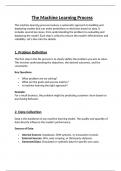
The Machine Learning Process
The machine learning process involves a systematic approach to building and
deploying models that can make predictions or decisions based on data. It
includes several key steps, from understanding the problem to evaluating and
deploying the model. Each step is critical to ensure the model's effectiveness and
reliability. Let’s dive into the details.
1. Problem Definition
The first step in the ML process is to clearly define the problem you aim to solve.
This involves understanding the objectives, the desired outcomes, and the
constraints.
Key Questions:
What problem are we solving?
What are the goals and success metrics?
Is machine learning the right approach?
Example:
For a retail business, the problem might be predicting customer churn based on
purchasing behavior.
2. Data Collection
Data is the backbone of any machine learning model. The quality and quantity of
data directly influence the model's performance.
Sources of Data:
Internal Sources: Databases, CRM systems, or transaction records.
External Sources: APIs, web scraping, or third-party datasets.
Generated Data: Simulated or synthetic data for specific use cases.
, Fun Fact:
The phrase “garbage in, garbage out” perfectly describes ML. If the input data is
flawed, the output will be unreliable!
3. Data Preprocessing
Raw data is rarely ready for use in ML models. Preprocessing ensures that the
data is clean, structured, and suitable for analysis.
Steps in Data Preprocessing:
Cleaning: Removing duplicates, handling missing values, and correcting
errors.
Normalization and Scaling: Transforming data into a consistent range or
format.
Feature Selection: Identifying the most relevant variables to reduce
complexity.
Encoding: Converting categorical data into numerical formats (e.g., one-hot
encoding).
Example:
For a weather prediction model, missing temperature values might be filled using
the average temperature for that location and season.
4. Exploratory Data Analysis (EDA)
EDA is a critical step where the data is analyzed to uncover patterns, correlations,
and insights. It helps in understanding the data better and guides feature
engineering.
Key Techniques:
Visualization: Using graphs and charts to identify trends and outliers.
Statistical Analysis: Calculating means, medians, and standard deviations.
Correlation Analysis: Identifying relationships between variables.
The machine learning process involves a systematic approach to building and
deploying models that can make predictions or decisions based on data. It
includes several key steps, from understanding the problem to evaluating and
deploying the model. Each step is critical to ensure the model's effectiveness and
reliability. Let’s dive into the details.
1. Problem Definition
The first step in the ML process is to clearly define the problem you aim to solve.
This involves understanding the objectives, the desired outcomes, and the
constraints.
Key Questions:
What problem are we solving?
What are the goals and success metrics?
Is machine learning the right approach?
Example:
For a retail business, the problem might be predicting customer churn based on
purchasing behavior.
2. Data Collection
Data is the backbone of any machine learning model. The quality and quantity of
data directly influence the model's performance.
Sources of Data:
Internal Sources: Databases, CRM systems, or transaction records.
External Sources: APIs, web scraping, or third-party datasets.
Generated Data: Simulated or synthetic data for specific use cases.
, Fun Fact:
The phrase “garbage in, garbage out” perfectly describes ML. If the input data is
flawed, the output will be unreliable!
3. Data Preprocessing
Raw data is rarely ready for use in ML models. Preprocessing ensures that the
data is clean, structured, and suitable for analysis.
Steps in Data Preprocessing:
Cleaning: Removing duplicates, handling missing values, and correcting
errors.
Normalization and Scaling: Transforming data into a consistent range or
format.
Feature Selection: Identifying the most relevant variables to reduce
complexity.
Encoding: Converting categorical data into numerical formats (e.g., one-hot
encoding).
Example:
For a weather prediction model, missing temperature values might be filled using
the average temperature for that location and season.
4. Exploratory Data Analysis (EDA)
EDA is a critical step where the data is analyzed to uncover patterns, correlations,
and insights. It helps in understanding the data better and guides feature
engineering.
Key Techniques:
Visualization: Using graphs and charts to identify trends and outliers.
Statistical Analysis: Calculating means, medians, and standard deviations.
Correlation Analysis: Identifying relationships between variables.