

NEXT GENERATION RN ATI
FUNDAMENTALS OF NURSING
PROCTORED EXAM 2024/25 WITH NGN
GRADED A+ WITH VERIFIED QUESTIONS
AND DETAILED RATIONALES EXAM 3
Antepartum period
Answer: 3, 5, 6
1. A client comes to the office for her first prenatal
visit. She reports that October 5 was the first day of
her last menstrual period. Which statements represent
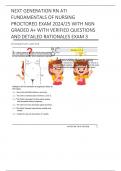
2. A nurse is assisting with a prenatal assessment on a
client who is 32 weeks pregnant. She performs
Leopold’s maneuvers and determines that the fetus is in
the cephalic position. Identify the area where the nurse
should place the Doppler to auscultate fetal heart
tones.
findings in the first trimester of pregnancy? Select all
that apply.
□ 1. Slow fetal cell differentiation is occurring.
□ 2. The client’s estimated date of delivery is June 12.
□ 3. The client may expect to have some nausea
and increased urinary frequency.
□ 4. The client will notice decreased vaginal secretions.
□ 5. The client’s breasts may become swollen and
tender.
□ 6. Chadwick’s sign will be positive at 9 weeks.
A N T E P A R TU M P E R IOD 1
,Rationale: The client can expect to have nausea,
possi- ble vomiting, urinary frequency, and swollen,
tender breasts in the first trimester. Bluish
discoloration of the mucous membranes of the
vagina, cervix, and vulva (Chadwick’s sign) can be
noticed beginning at 9 weeks. There’s rapid fetal cell
differentiation occurring and the client may expect
increased—not decreased—vaginal se- cretions. The
estimated date of delivery is calculated us- ing
Nägele’s rule; thus October 5 - 3 months = July 5; + 7
days makes the date July 12, not June 12.
Nursing process step: Planning
Client needs category: Health promotion and main-
tenance
Client needs subcategory: None
Cognitive level: Analysis
Rationale: When the fetus is in the cephalic Answer:
position, fetal heart tones are best auscultated
midway be- tween the symphysis pubis and the
umbilicus. When the fetus is in the breech position,
fetal heart tones are best heard at or above the
level of the umbilicus.
Nursing process step: Data collection
Client needs category: Health promotion and main-
tenance
Client needs subcategory: None
Cognitive level: Analysis
A N T E P A R TU M P E R IOD 2
, 3. A client comes to the office for her first prenatal
visit. She asks the nurse what physiological changes
Answer:
she can expect during pregnancy. The nurse knows 2. Serum laboratory tests are positive for human chorionic
that changes can be in three categories: presumptive, gonadotropin.
probable, and positive. The nurse prepares to start the
1. The vagina changes color from pink to violet (Chad-
discussion with the probable changes of pregnancy. wick’s sign); cervix softens (Goodell’s sign).
Put the following probable changes in ascending
chronological order. Use all the options. 4. Fetus can be felt to rise against the abdominal wall
when lower uterine segment is tapped during a biman-
1. The vagina changes color from pink to violet (Chad- ual examination (Ballottement).
wick’s sign); cervix softens (Goodell’s sign).
3. Braxton Hicks contractions and fetal outline can be pal-
2. Serum laboratory tests are positive for human chorionic pated through the abdomen.
gonadotropin.
Rationale: Probable changes that strongly suggest
3. Braxton Hicks contractions and fetal outline can be pal- pregnancy include laboratory tests, which are positive
pated through the abdomen.
at about 1 week from implantation. Chadwick’s and
4. Fetus can be felt to rise against the abdominal wall
Goodell’s signs occur at 6 weeks. Ballottement occurs
when lower uterine segment is tapped during a biman- at 16 weeks. Braxton Hicks contractions and palpation
ual examination (Ballottement). of the fetal outline can occur as early as 20 weeks.
Nursing process step: Planning
Client needs category: Health promotion and main-
tenance
Client needs subcategory: None
Cognitive level: Application
4. Which nutritional instructions should the nurse re-
view with a 32-year-old primigravida? Select all that
Answer: 1, 2, 5
apply. Rationale: A pregnant woman should increase her
caloric intake by 300 cal/day. The protein require-
□ 1. Caloric intake should be increased by
ments (76 g/day) of a pregnant woman exceed those
300 cal/day.
of a nonpregnant woman by 30 g/day. All mineral re-
□ 2. Protein intake should be increased to more than quirements, especially iron, are increased in a preg-
30 g/day. nant woman. The woman should increase her intake
of all vitamins and a prenatal vitamin is usually recom-
□ 3. Vitamin intake should not increase from mended. Folic acid intake is particularly important to
prepregnancy requirements. help prevent fetal anomalies such as neural tube de-
□ 4. Folic acid intake should be increased to fect. Intake should be increased from 400 to 800 mg/
400 mg/day. day.
□ 5. Intake of all minerals, especially iron, should be Nursing process step: Planning
increased. Client needs category: Physiological integrity
Client needs subcategory: Basic care and comfort
Cognitive level: Comprehension
A N T E P A R TU M P E R IOD 3
FUNDAMENTALS OF NURSING
PROCTORED EXAM 2024/25 WITH NGN
GRADED A+ WITH VERIFIED QUESTIONS
AND DETAILED RATIONALES EXAM 3
Antepartum period
Answer: 3, 5, 6
1. A client comes to the office for her first prenatal
visit. She reports that October 5 was the first day of
her last menstrual period. Which statements represent
2. A nurse is assisting with a prenatal assessment on a
client who is 32 weeks pregnant. She performs
Leopold’s maneuvers and determines that the fetus is in
the cephalic position. Identify the area where the nurse
should place the Doppler to auscultate fetal heart
tones.
findings in the first trimester of pregnancy? Select all
that apply.
□ 1. Slow fetal cell differentiation is occurring.
□ 2. The client’s estimated date of delivery is June 12.
□ 3. The client may expect to have some nausea
and increased urinary frequency.
□ 4. The client will notice decreased vaginal secretions.
□ 5. The client’s breasts may become swollen and
tender.
□ 6. Chadwick’s sign will be positive at 9 weeks.
A N T E P A R TU M P E R IOD 1
,Rationale: The client can expect to have nausea,
possi- ble vomiting, urinary frequency, and swollen,
tender breasts in the first trimester. Bluish
discoloration of the mucous membranes of the
vagina, cervix, and vulva (Chadwick’s sign) can be
noticed beginning at 9 weeks. There’s rapid fetal cell
differentiation occurring and the client may expect
increased—not decreased—vaginal se- cretions. The
estimated date of delivery is calculated us- ing
Nägele’s rule; thus October 5 - 3 months = July 5; + 7
days makes the date July 12, not June 12.
Nursing process step: Planning
Client needs category: Health promotion and main-
tenance
Client needs subcategory: None
Cognitive level: Analysis
Rationale: When the fetus is in the cephalic Answer:
position, fetal heart tones are best auscultated
midway be- tween the symphysis pubis and the
umbilicus. When the fetus is in the breech position,
fetal heart tones are best heard at or above the
level of the umbilicus.
Nursing process step: Data collection
Client needs category: Health promotion and main-
tenance
Client needs subcategory: None
Cognitive level: Analysis
A N T E P A R TU M P E R IOD 2
, 3. A client comes to the office for her first prenatal
visit. She asks the nurse what physiological changes
Answer:
she can expect during pregnancy. The nurse knows 2. Serum laboratory tests are positive for human chorionic
that changes can be in three categories: presumptive, gonadotropin.
probable, and positive. The nurse prepares to start the
1. The vagina changes color from pink to violet (Chad-
discussion with the probable changes of pregnancy. wick’s sign); cervix softens (Goodell’s sign).
Put the following probable changes in ascending
chronological order. Use all the options. 4. Fetus can be felt to rise against the abdominal wall
when lower uterine segment is tapped during a biman-
1. The vagina changes color from pink to violet (Chad- ual examination (Ballottement).
wick’s sign); cervix softens (Goodell’s sign).
3. Braxton Hicks contractions and fetal outline can be pal-
2. Serum laboratory tests are positive for human chorionic pated through the abdomen.
gonadotropin.
Rationale: Probable changes that strongly suggest
3. Braxton Hicks contractions and fetal outline can be pal- pregnancy include laboratory tests, which are positive
pated through the abdomen.
at about 1 week from implantation. Chadwick’s and
4. Fetus can be felt to rise against the abdominal wall
Goodell’s signs occur at 6 weeks. Ballottement occurs
when lower uterine segment is tapped during a biman- at 16 weeks. Braxton Hicks contractions and palpation
ual examination (Ballottement). of the fetal outline can occur as early as 20 weeks.
Nursing process step: Planning
Client needs category: Health promotion and main-
tenance
Client needs subcategory: None
Cognitive level: Application
4. Which nutritional instructions should the nurse re-
view with a 32-year-old primigravida? Select all that
Answer: 1, 2, 5
apply. Rationale: A pregnant woman should increase her
caloric intake by 300 cal/day. The protein require-
□ 1. Caloric intake should be increased by
ments (76 g/day) of a pregnant woman exceed those
300 cal/day.
of a nonpregnant woman by 30 g/day. All mineral re-
□ 2. Protein intake should be increased to more than quirements, especially iron, are increased in a preg-
30 g/day. nant woman. The woman should increase her intake
of all vitamins and a prenatal vitamin is usually recom-
□ 3. Vitamin intake should not increase from mended. Folic acid intake is particularly important to
prepregnancy requirements. help prevent fetal anomalies such as neural tube de-
□ 4. Folic acid intake should be increased to fect. Intake should be increased from 400 to 800 mg/
400 mg/day. day.
□ 5. Intake of all minerals, especially iron, should be Nursing process step: Planning
increased. Client needs category: Physiological integrity
Client needs subcategory: Basic care and comfort
Cognitive level: Comprehension
A N T E P A R TU M P E R IOD 3


