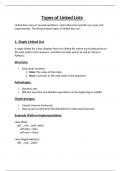
Types of Linked Lists
Linked lists come in several variations, each tailored to specific use cases and
requirements. The three primary types of linked lists are:
1. Singly Linked List
A singly linked list is the simplest form of a linked list where each node points to
the next node in the sequence, and the last node points to null (or None in
Python).
Structure:
Each node contains:
1. Data: The value of the node.
2. Next: A pointer to the next node in the sequence.
Advantages:
Dynamic size.
Efficient insertion and deletion operations at the beginning or middle.
Disadvantages:
Cannot traverse backward.
Slow access to elements (O(n)O(n)O(n) for index-based access).
Example (Python Implementation):
class Node:
def __init__(self, data):
self.data = data
self.next = None
class SinglyLinkedList:
def __init__(self):
Linked lists come in several variations, each tailored to specific use cases and
requirements. The three primary types of linked lists are:
1. Singly Linked List
A singly linked list is the simplest form of a linked list where each node points to
the next node in the sequence, and the last node points to null (or None in
Python).
Structure:
Each node contains:
1. Data: The value of the node.
2. Next: A pointer to the next node in the sequence.
Advantages:
Dynamic size.
Efficient insertion and deletion operations at the beginning or middle.
Disadvantages:
Cannot traverse backward.
Slow access to elements (O(n)O(n)O(n) for index-based access).
Example (Python Implementation):
class Node:
def __init__(self, data):
self.data = data
self.next = None
class SinglyLinkedList:
def __init__(self):