Backtracking Algorithm
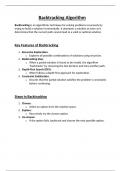
Backtracking is an algorithmic technique for solving problems recursively by
trying to build a solution incrementally. It abandons a solution as soon as it
determines that the current path cannot lead to a valid or optimal solution.
Key Features of Backtracking
1. Recursive Exploration:
o Explores all possible combinations of solutions using recursion.
2. Backtracking Step:
o When a partial solution is found to be invalid, the algorithm
"backtracks" by removing the last decision and tries another path.
3. Depth-First Search (DFS):
o Often follows a depth-first approach for exploration.
4. Constraint Satisfaction:
o Ensures that the partial solution satisfies the problem's constraints
before continuing.
Steps in Backtracking
1. Choose:
o Select an option from the solution space.
2. Explore:
o Recursively try the chosen option.
3. Un-choose:
o If the option fails, backtrack and choose the next possible option.
, Common Problems Solved Using Backtracking
1. N-Queens Problem
Problem: Place nnn queens on an n×nn \times nn×n chessboard so that no
two queens threaten each other.
Approach:
o Place a queen in each row.
o Ensure no two queens share the same column, row, or diagonal.
Time Complexity: O(n!)O(n!)O(n!).
Applications:
o Puzzle solving.
2. Sudoku Solver
Problem: Solve a 9×99 \times 99×9 Sudoku puzzle.
Approach:
o Try placing digits 1−91-91−9 in empty cells.
o Backtrack if a placement violates Sudoku rules.
Time Complexity: Depends on the number of empty cells.
Applications:
o Puzzle solving.
3. Subset Sum Problem
Problem: Find subsets of a set that sum to a target value.
Approach:
o Include or exclude each element and check for the target sum.
Time Complexity: O(2n)O(2^n)O(2n).
Applications:
o Decision-making problems.
Backtracking is an algorithmic technique for solving problems recursively by
trying to build a solution incrementally. It abandons a solution as soon as it
determines that the current path cannot lead to a valid or optimal solution.
Key Features of Backtracking
1. Recursive Exploration:
o Explores all possible combinations of solutions using recursion.
2. Backtracking Step:
o When a partial solution is found to be invalid, the algorithm
"backtracks" by removing the last decision and tries another path.
3. Depth-First Search (DFS):
o Often follows a depth-first approach for exploration.
4. Constraint Satisfaction:
o Ensures that the partial solution satisfies the problem's constraints
before continuing.
Steps in Backtracking
1. Choose:
o Select an option from the solution space.
2. Explore:
o Recursively try the chosen option.
3. Un-choose:
o If the option fails, backtrack and choose the next possible option.
, Common Problems Solved Using Backtracking
1. N-Queens Problem
Problem: Place nnn queens on an n×nn \times nn×n chessboard so that no
two queens threaten each other.
Approach:
o Place a queen in each row.
o Ensure no two queens share the same column, row, or diagonal.
Time Complexity: O(n!)O(n!)O(n!).
Applications:
o Puzzle solving.
2. Sudoku Solver
Problem: Solve a 9×99 \times 99×9 Sudoku puzzle.
Approach:
o Try placing digits 1−91-91−9 in empty cells.
o Backtrack if a placement violates Sudoku rules.
Time Complexity: Depends on the number of empty cells.
Applications:
o Puzzle solving.
3. Subset Sum Problem
Problem: Find subsets of a set that sum to a target value.
Approach:
o Include or exclude each element and check for the target sum.
Time Complexity: O(2n)O(2^n)O(2n).
Applications:
o Decision-making problems.