Divide and Conquer Algorithm
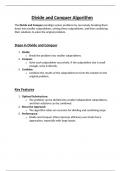
The Divide and Conquer paradigm solves problems by recursively breaking them
down into smaller subproblems, solving these subproblems, and then combining
their solutions to solve the original problem.
Steps in Divide and Conquer
1. Divide:
o Break the problem into smaller subproblems.
2. Conquer:
o Solve each subproblem recursively. If the subproblem size is small
enough, solve it directly.
3. Combine:
o Combine the results of the subproblems to form the solution to the
original problem.
Key Features
1. Optimal Substructure:
o The problem can be divided into smaller independent subproblems,
and their solutions can be combined.
2. Recursive Approach:
o The algorithm relies on recursion for dividing and combining steps.
3. Performance:
o Divide and Conquer often improves efficiency over brute force
approaches, especially with large inputs.
, Common Problems Solved Using Divide and Conquer
1. Merge Sort
Problem: Sort an array.
Approach:
o Divide the array into two halves.
o Recursively sort each half.
o Merge the two sorted halves.
Time Complexity: O(nlogn)O(n \log n)O(nlogn).
Applications:
o Sorting large datasets.
2. Quick Sort
Problem: Sort an array.
Approach:
o Pick a pivot element.
o Partition the array into elements smaller than the pivot and elements
larger than the pivot.
o Recursively sort the partitions.
Time Complexity:
o Best/Average Case: O(nlogn)O(n \log n)O(nlogn).
o Worst Case: O(n2)O(n^2)O(n2) (occurs when the pivot is poorly
chosen).
Applications:
o Efficient in-memory sorting.
3. Binary Search
Problem: Find an element in a sorted array.
Approach:
o Divide the array into two halves.
o Check if the middle element is the target.
The Divide and Conquer paradigm solves problems by recursively breaking them
down into smaller subproblems, solving these subproblems, and then combining
their solutions to solve the original problem.
Steps in Divide and Conquer
1. Divide:
o Break the problem into smaller subproblems.
2. Conquer:
o Solve each subproblem recursively. If the subproblem size is small
enough, solve it directly.
3. Combine:
o Combine the results of the subproblems to form the solution to the
original problem.
Key Features
1. Optimal Substructure:
o The problem can be divided into smaller independent subproblems,
and their solutions can be combined.
2. Recursive Approach:
o The algorithm relies on recursion for dividing and combining steps.
3. Performance:
o Divide and Conquer often improves efficiency over brute force
approaches, especially with large inputs.
, Common Problems Solved Using Divide and Conquer
1. Merge Sort
Problem: Sort an array.
Approach:
o Divide the array into two halves.
o Recursively sort each half.
o Merge the two sorted halves.
Time Complexity: O(nlogn)O(n \log n)O(nlogn).
Applications:
o Sorting large datasets.
2. Quick Sort
Problem: Sort an array.
Approach:
o Pick a pivot element.
o Partition the array into elements smaller than the pivot and elements
larger than the pivot.
o Recursively sort the partitions.
Time Complexity:
o Best/Average Case: O(nlogn)O(n \log n)O(nlogn).
o Worst Case: O(n2)O(n^2)O(n2) (occurs when the pivot is poorly
chosen).
Applications:
o Efficient in-memory sorting.
3. Binary Search
Problem: Find an element in a sorted array.
Approach:
o Divide the array into two halves.
o Check if the middle element is the target.