100% satisfaction guarantee Immediately available after payment Both online and in PDF No strings attached 4.2 TrustPilot
logo-home
Exam (elaborations)

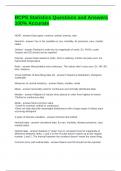
BCPS Statistics Questions and Answers 100% Accurate

Rating
-
Sold
-
Pages
7
Grade
A+
Uploaded on
23-01-2025
Written in
2024/2025

BCPS Statistics Questions and Answers 100% Accurate NOIR Data types: nominal, ordinal, interval, ratio Nominal Yes or No variables or sex, mortality, dz presence, race, marital status Ordinal Ranked in order but no magnitude of ranks. Ex: NYHA, scale *means and SD should not be reported Interval Data ranked in order. Zero is arbitrary. Points can pass zero. Ex: Fahrenheit temperature Ratio Measurables and continuous. The values don't cross zero. Ex: HR, BP, time, distance Visual methods of describing data (3) Frequency distribution, histogram, scatterplot Measures of central tendency Mean, median, mode Mean Generally used for continuous and normally distributed data Median Midpoint of values when placed in order from highest to lowest *ordinal or continuous data Mode Most common value * used for nominal, ordinal or continuous *does not help describe meaningful distributions with a large range of values each occurring infrequent 2 types of discrete variables Nominal and ordinal Nominal data Unordered data. Ex-sex, mortality, disease presence, race, marital status Ordinal data Ranked in "order" but no consistent level of magnitude of difference between ranks. 1 and 2 in the hf scale doesn't match up as the regular number 1 and 2. The interval between the numbers doesn't mean the same thing. Common error with ordinal data Means and SD should not be reported Interval scale Data ranked in a specific order with a chance consistent change in magnitude between units. The zero point is arbitrary. Ex-degrees Fahrenheit. You can have a negative temperature Ratio scale Interval but with an absolute zero -degrees kelvin -age -hr -BP -time -distance Visual methods of describing data (3) -frequency distribution -histogram -scatterplot Numerical methods of describing data (3) -mean -median -mode Mean used for what type of data? -continuous and -normally distributed Median AKA 50th percentile Median used for what type of data? -ordinal or -continuous -especially good for skewed populations -insensitive to outliers Continuous variables AKA and types of -counting variables -interval & ratio Mode used for what types of data? -most common Value in a distribution -nominal, ordinal or continuous Standard deviation is Most common measure used to describe a spread of data Standard deviation data has to be... -continuous -normally distributed Variance equation Standard deviation squared Coefficient of variation meaning Relates the mean and the SD Coefficient of variation equation SD/mean * 100% Standard deviation sample values 68% of the sample values falls in 1 SD, 95% in 2 SD, and 99% in 3 SD Variance describes The variability Range -The difference between the smallest and largest value in a data set. -does not provide a lot of info -sensitive to outliers 3 ways to measure variability -standard deviation -range -percentiles Percentiles and population reporting -iqr What does iqr encompass? -the 25th to 75th percentile Which measure of central tendency should NOT be used for ordinal data? -means and sd should not be used Best measure of central tendency for ordinal data Median and IQR Best measurement of central tendency for continuous data Means and SD How to tell if data normally distributed? Eyeball it or if mean and median look close its likely it is Formal test to tell if data is normally distributed Kolmogorov-Smirnov test Another indicator data isn't normally disttibuted If the SD is larger relative to the mean it's likely it isn't normally distributed Parametric data Mean and SD parameters that define a normally distributed population SEM Quantifies the uncertainty and the estimate of the mean SEM calculation SD/square root of the n Why do you need to calculate SEM? -calculate confidence intervals -hypothesis testing -deception Does the CI and the p-value need to be reported? No Is a CI that includes zero statistically significant? No Null hypothesis (Ho) No difference between groups being compared. If this is rejected there is a statistically significant difference Alternative hypothesis (Ha) Opposite of null hypothesis. It is stated there is a difference Parametric test assumptions -normally distributed -continuous data -variances are approximately equal Non parametric tests -Data is not normally distributed -discrete data Student t test-parametric or non parametric -parametric Student t test -compares study sample with the known population mean Ex: ldl samples of meeting goers versus the population average 3 types of t tests -Student t test -2 sample, independent sample or unpaired test -paired t test 2 sample, independent or unpaired test Compared the means of two independent samples Paired t-test Compares the mean difference of paired or matched samples -2 samples from each person at a different time period Paired t-test parametric or non parametric test Parametric Anova -compares the means of three or more groups in a study Anova test parametric or non parametric test Parametric Anova limitations -we only know one of the groups are different when the p value is statistically significant. We don't know which one of the three is different, post hoc analysis needs to be done Post hoc done -after Anova shows a statistically significant difference Post hoc tests (4) -Tukey HSD -bonferroni -scheffe -Newman-keuls Non parametric tests -wilcoxon rank sum or Mann Whitney U (same test) -Kruskal-wallis one way Anova Non parametric tests, type of data and distribution -ordinal or counting data -data not normally distributed Wilcoxon rank sum/Mann Whitney u test -2 independent samples -not normally distributed -related to the t-test Kruskal-wallis one way Anova -related to one way Anova -not normally distributed data Test done after Kruskal-Wallis for post hoc testing Wilcoxon rank Sum test

Show more Read less
Institution
BCPS
Course
BCPS


Whoops! We can’t load your doc right now. Try again or contact support.

Written for

Institution
BCPS
Course
BCPS

Document information

Uploaded on
January 23, 2025
Number of pages
7
Written in
2024/2025
Type
Exam (elaborations)
Contains
Questions & answers

Subjects

  • ratio

Content preview

BCPS Statistics Questions and Answers
100% Accurate

NOIR - answer Data types: nominal, ordinal, interval, ratio

Nominal - answer Yes or No variables or sex, mortality, dz presence, race, marital
status

Ordinal - answer Ranked in order but no magnitude of ranks. Ex: NYHA, scale
*means and SD should not be reported

Interval - answer Data ranked in order. Zero is arbitrary. Points can pass zero. Ex:
Fahrenheit temperature

Ratio - answer Measurables and continuous. The values don't cross zero. Ex: HR, BP,
time, distance

Visual methods of describing data (3) - answer Frequency distribution, histogram,
scatterplot

Measures of central tendency - answer Mean, median, mode

Mean - answer Generally used for continuous and normally distributed data

Median - answer Midpoint of values when placed in order from highest to lowest
*Ordinal or continuous data

Mode - answer Most common value
* Used for nominal, ordinal or continuous
*Does not help describe meaningful distributions with a large range of values each
occurring infrequent

2 types of discrete variables - answer Nominal and ordinal

Nominal data - answer Unordered data. Ex-sex, mortality, disease presence, race,
marital status

Ordinal data - answer Ranked in "order" but no consistent level of magnitude of
difference between ranks. 1 and 2 in the hf scale doesn't match up as the regular
number 1 and 2. The interval between the numbers doesn't mean the same thing.

Common error with ordinal data - answer Means and SD should not be reported

, Interval scale - answerData ranked in a specific order with a chance consistent change
in magnitude between units. The zero point is arbitrary. Ex-degrees Fahrenheit. You
can have a negative temperature

Ratio scale - answerInterval but with an absolute zero
-degrees kelvin
-age
-hr
-BP
-time
-distance

Visual methods of describing data (3) - answer-frequency distribution
-histogram
-scatterplot

Numerical methods of describing data (3) - answer-mean
-median
-mode

Mean used for what type of data? - answer-continuous and
-normally distributed

Median AKA - answer50th percentile

Median used for what type of data? - answer-ordinal or
-continuous

-especially good for skewed populations
-insensitive to outliers

Continuous variables AKA and types of - answer-counting variables
-interval & ratio

Mode used for what types of data? - answer-most common
Value in a distribution
-nominal, ordinal or continuous

Standard deviation is - answerMost common measure used to describe a spread of
data

Standard deviation data has to be... - answer-continuous
-normally distributed

Variance equation - answerStandard deviation squared

Get to know the seller

Seller avatar
Reputation scores are based on the amount of documents a seller has sold for a fee and the reviews they have received for those documents. There are three levels: Bronze, Silver and Gold. The better the reputation, the more your can rely on the quality of the sellers work.
julianah420 Phoenix University
View profile
Follow You need to be logged in order to follow users or courses
Sold
658
Member since
2 year
Number of followers
324
Documents
34030
Last sold
12 hours ago
NURSING,TESTBANKS,ASSIGNMENT,AQA AND ALL REVISION MATERIALS

On this page, you find all documents, package deals, and flashcards offered by seller julianah420

4.3

149 reviews

5
101
4
20
3
8
2
5
1
15

Recently viewed by you

Why students choose Stuvia

Created by fellow students, verified by reviews

Quality you can trust: written by students who passed their tests and reviewed by others who've used these notes.

Didn't get what you expected? Choose another document

No worries! You can instantly pick a different document that better fits what you're looking for.

Pay as you like, start learning right away

No subscription, no commitments. Pay the way you're used to via credit card and download your PDF document instantly.

Student with book image

“Bought, downloaded, and aced it. It really can be that simple.”

Alisha Student

Frequently asked questions