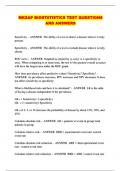
MKSAP BIOSTATISTICS TEST QUESTIONS
AND ANSWERS
Sensitivity - ANSWER The ability of a test to detect a disease when it is truly
present.
Specificity - ANSWER The ability of a test to exclude disease when it is truly
absent.
ROC curve - ANSWER Graphed as sensitivity (y-axis) vs 1-specificity (x-
axis). When comparing to or more tests, the test w/ the greatest overall accuracy
will have the largest area under the ROC graph.
How does prevalence affect predictive values? Sensitivity? Specificity? -
ANSWER As prevalence increases, PPV increases and NPV decreases. It does
not affect sensitivity or specificity.
What is likelihood ratio and how it is calculated? - ANSWER LR is the odds
of having a disease independent of the prevalence.
LR+ = Sensitivity/ (1-specificity)
LR- = (1-sensitivity)/ Specificity
LR+ of 2, 5, or 10 increases the probability of disease by about 15%, 30%, and
45%.
Calculate absolute risk - ANSWER AR = patients w/ event in group/ total
patients in group
Calculate relative risk - ANSWER RRR = experimental event rate/ control
event rate
Calculate absolute risk reduction - ANSWER ARR = abs(experimental event
rate - control event rate)
Calculate relative risk reduction - ANSWER RRR = ARR / control event rate
AND ANSWERS
Sensitivity - ANSWER The ability of a test to detect a disease when it is truly
present.
Specificity - ANSWER The ability of a test to exclude disease when it is truly
absent.
ROC curve - ANSWER Graphed as sensitivity (y-axis) vs 1-specificity (x-
axis). When comparing to or more tests, the test w/ the greatest overall accuracy
will have the largest area under the ROC graph.
How does prevalence affect predictive values? Sensitivity? Specificity? -
ANSWER As prevalence increases, PPV increases and NPV decreases. It does
not affect sensitivity or specificity.
What is likelihood ratio and how it is calculated? - ANSWER LR is the odds
of having a disease independent of the prevalence.
LR+ = Sensitivity/ (1-specificity)
LR- = (1-sensitivity)/ Specificity
LR+ of 2, 5, or 10 increases the probability of disease by about 15%, 30%, and
45%.
Calculate absolute risk - ANSWER AR = patients w/ event in group/ total
patients in group
Calculate relative risk - ANSWER RRR = experimental event rate/ control
event rate
Calculate absolute risk reduction - ANSWER ARR = abs(experimental event
rate - control event rate)
Calculate relative risk reduction - ANSWER RRR = ARR / control event rate