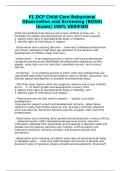
FL DCF Child Care Behavioral Observation and Screening
(BOSR) 2024 100% Verified
Benefits of Screening:
-Identify specific areas of concern
-Determine if further assessment or evaluation may be necessary
-Provide a basis for referral
-Empower parents with information to help them make decisions
-Present a basis for necessary and ongoing communication with parents and others
KEY POINT of Screening
Screening determines if children are developing typically, identifies early signs of delay or disability,
and provides a basis for referral.
Sometimes, the results of a program's observation and screening processes indicate a possible
developmental delay or disability. When this happens,
child care providers talk to parents so that parents can contact organizations that will provide further
screening and assessment.
Assessment is a process whereby an agency or organization
gathers and reviews multiple sources of information about a child's suspected or confirmed
developmental delay or disability, and uses that information to improve a child's outcomes.
Child Find
Child care professionals in Florida refer families to this. (Florida Diagnostic and Learning Resource
System)
Benefits of Assessment
-Empower parents to help their child grow and develop
-Improve a family's ability to navigate a complex system of services
-Result in a referral for evaluation so eligible children may receive benefits they are entitled to under
the Individuals with Disabilities Education Act, or IDEA, which is a federal law
IDEA
Individuals with Disabilities Education Act
Benefits for child
Assessment can lead to an evaluation, which may qualify the child for benefits under IDEA.
According to Children's Medical Services (CMS), assessment refers to
"...ongoing procedures used by appropriate qualified personnel throughout the period of a child's
eligibility to identify the following: (A) the child's unique strengths and needs and the services
,appropriate to meet those needs, and (B) the resources, priorities, and concerns of the family and the
supports and services necessary to enhance the family's capacity to meet the developmental needs of
their infant or toddler with a disability."
CMS defines evaluation as
"...procedures used by appropriate qualified personnel to determine a child's initial and continuing
eligibility for Early Steps, consistent with the definition of "infants and toddlers with disabilities" in
§303.16, including determining the status of the child in each of the developmental areas in 34 CFR
§303.322 (c)(3)(ii).
To summarize, evaluation is a process that
determines a child's eligibility for federal, state, and local programs and services.
Assessment
is a process whereby an agency or organization gathers and reviews multiple sources of information
about a child's suspected or confirmed developmental delay or disability and uses that information to
improve a child's outcomes.
Evaluation
is a process that determines a child's eligibility for federal, state, and local programs and services.
Your role as a child care professional is
observation, screening, and referral.
In observation and screening processes, your main responsibilities are to
document the child's skills and abilities fairly, objectively, and accurately; and work with families to
refer children for further assessment and evaluation. Remember, if information causes you to suspect
child abuse or neglect, you must report it.
During an observation period, you will
monitor a child as he or she demonstrates identified skills or abilities within a developmental domain
or domains. You should conduct the screening in the child's natural environment when he or she is at
his or her best. After the observation, you will document the child's file following guidelines presented
in this course and your employer's written procedures.
During a screening, you will
identify and measure a child's specific skills and abilities using a screening instrument.
While you are working, bear in mind two things:
-one, your results are only one source of information that will be used to better understand a child's
behavior and development; and
-two, it is critical to involve the child's family in the process.
Sometimes, the results of a program's observation and screening processes
, will indicate a possible developmental delay or disability. When this happens, you or a designated
coworker will talk to the child's parents and assist them in making an appropriate referral.
Child care professionals observe and screen children so they can
1. Facilitate the growth and development of every child in their program,
2. Detect early signs of developmental delay or disability,
3. Identify signs of child abuse or neglect.
Observation and screening describe
how early childhood professionals use certain methods to help them pay attention to the behavior
and development of children under their care.
Observation
is an ongoing process in which child care professionals recognize and document identifiable
developmental milestones as they appear, using tools such as checklists, anecdotal records, and
running records.
Screening
is an ongoing process in which child care professionals use specialized observation and documentation
tools to identify, document, and monitor typical development or possible developmental delay.
The three main reasons child care programs observe and screen children are to
1. To foster growth and development in every child,
2. Detect early signs of developmental delay or disability, and
3. Identify signs of child abuse and neglect.
These processes are also used to support
-quality curriculum development;
-help parents support growth and development at home; -allow timely referral for early intervention
services; and -provide a common reference point and basis for interaction between parents, program
staff, and other professionals.
Observation and screening foster growth and development in every child by
determining the child's developmental-age level and by using the information obtained from
observation and screening to develop inside and outside learning spaces, personal care routines,
communication and interaction practices, learning activities, and program policies and procedures.
Observation and screening can detect early signs of developmental delay or disability when
child care staff members are trained to identify and document signs of typical or atypical growth and
development. Since staff members see children throughout the day and have training in child growth
and development, they may be in the best position to spot the earliest signs of atypical development.
Therefore, staff may be in the best position to help the child and family.
Child care personnel should not
(BOSR) 2024 100% Verified
Benefits of Screening:
-Identify specific areas of concern
-Determine if further assessment or evaluation may be necessary
-Provide a basis for referral
-Empower parents with information to help them make decisions
-Present a basis for necessary and ongoing communication with parents and others
KEY POINT of Screening
Screening determines if children are developing typically, identifies early signs of delay or disability,
and provides a basis for referral.
Sometimes, the results of a program's observation and screening processes indicate a possible
developmental delay or disability. When this happens,
child care providers talk to parents so that parents can contact organizations that will provide further
screening and assessment.
Assessment is a process whereby an agency or organization
gathers and reviews multiple sources of information about a child's suspected or confirmed
developmental delay or disability, and uses that information to improve a child's outcomes.
Child Find
Child care professionals in Florida refer families to this. (Florida Diagnostic and Learning Resource
System)
Benefits of Assessment
-Empower parents to help their child grow and develop
-Improve a family's ability to navigate a complex system of services
-Result in a referral for evaluation so eligible children may receive benefits they are entitled to under
the Individuals with Disabilities Education Act, or IDEA, which is a federal law
IDEA
Individuals with Disabilities Education Act
Benefits for child
Assessment can lead to an evaluation, which may qualify the child for benefits under IDEA.
According to Children's Medical Services (CMS), assessment refers to
"...ongoing procedures used by appropriate qualified personnel throughout the period of a child's
eligibility to identify the following: (A) the child's unique strengths and needs and the services
,appropriate to meet those needs, and (B) the resources, priorities, and concerns of the family and the
supports and services necessary to enhance the family's capacity to meet the developmental needs of
their infant or toddler with a disability."
CMS defines evaluation as
"...procedures used by appropriate qualified personnel to determine a child's initial and continuing
eligibility for Early Steps, consistent with the definition of "infants and toddlers with disabilities" in
§303.16, including determining the status of the child in each of the developmental areas in 34 CFR
§303.322 (c)(3)(ii).
To summarize, evaluation is a process that
determines a child's eligibility for federal, state, and local programs and services.
Assessment
is a process whereby an agency or organization gathers and reviews multiple sources of information
about a child's suspected or confirmed developmental delay or disability and uses that information to
improve a child's outcomes.
Evaluation
is a process that determines a child's eligibility for federal, state, and local programs and services.
Your role as a child care professional is
observation, screening, and referral.
In observation and screening processes, your main responsibilities are to
document the child's skills and abilities fairly, objectively, and accurately; and work with families to
refer children for further assessment and evaluation. Remember, if information causes you to suspect
child abuse or neglect, you must report it.
During an observation period, you will
monitor a child as he or she demonstrates identified skills or abilities within a developmental domain
or domains. You should conduct the screening in the child's natural environment when he or she is at
his or her best. After the observation, you will document the child's file following guidelines presented
in this course and your employer's written procedures.
During a screening, you will
identify and measure a child's specific skills and abilities using a screening instrument.
While you are working, bear in mind two things:
-one, your results are only one source of information that will be used to better understand a child's
behavior and development; and
-two, it is critical to involve the child's family in the process.
Sometimes, the results of a program's observation and screening processes
, will indicate a possible developmental delay or disability. When this happens, you or a designated
coworker will talk to the child's parents and assist them in making an appropriate referral.
Child care professionals observe and screen children so they can
1. Facilitate the growth and development of every child in their program,
2. Detect early signs of developmental delay or disability,
3. Identify signs of child abuse or neglect.
Observation and screening describe
how early childhood professionals use certain methods to help them pay attention to the behavior
and development of children under their care.
Observation
is an ongoing process in which child care professionals recognize and document identifiable
developmental milestones as they appear, using tools such as checklists, anecdotal records, and
running records.
Screening
is an ongoing process in which child care professionals use specialized observation and documentation
tools to identify, document, and monitor typical development or possible developmental delay.
The three main reasons child care programs observe and screen children are to
1. To foster growth and development in every child,
2. Detect early signs of developmental delay or disability, and
3. Identify signs of child abuse and neglect.
These processes are also used to support
-quality curriculum development;
-help parents support growth and development at home; -allow timely referral for early intervention
services; and -provide a common reference point and basis for interaction between parents, program
staff, and other professionals.
Observation and screening foster growth and development in every child by
determining the child's developmental-age level and by using the information obtained from
observation and screening to develop inside and outside learning spaces, personal care routines,
communication and interaction practices, learning activities, and program policies and procedures.
Observation and screening can detect early signs of developmental delay or disability when
child care staff members are trained to identify and document signs of typical or atypical growth and
development. Since staff members see children throughout the day and have training in child growth
and development, they may be in the best position to spot the earliest signs of atypical development.
Therefore, staff may be in the best position to help the child and family.
Child care personnel should not