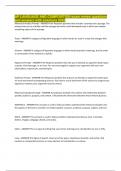
AP LANGUAGE AND COMPOSITION exam review questions
and answers with solutions 2025
Rhetorical Analysis Prompt - ANSWER Free Response question that includes a prompt and a passage. The
prompt asks you to critically read the passage and write a well developed essay in which you analyze
something aspect of the passage.
Trope - ANSWER A category of figurative language in which words are used in a way that changes their
meanings.
Scheme - ANSWER A category of figurative language in which words keep their meanings, but the order
or construction of the sentence is stylistic.
Argument Prompt - ANSWER Free Response question that asks you to develop an argument based upon
a quote, a brief passage, or an issue. You are encouraged to support your argument with your own
observations, experiences, and examples.
Synthesis Prompt - ANSWER Free Response question that asks you to develop an argument based upon
an issue and several accompanying sources. You have to use at least three of the sources to support your
argument; however, your argument must be central.
Rhetorical Situation/Triangle - ANSWER According to Aristotle, this outlines the relationship between
speaker, audience, purpose, and context. It illustrates the interaction between these rhetorical pieces.
SOAPSTone - ANSWER This acronym is used to help you better understand the rhetorical situation and
the aspects of the text to consider. It includes speaker, occasion, audience, purpose, subject, and tone.
DILDS - ANSWER This acronym is used to help you better understand and discuss tone. It includes
diction, imagery, language, details, and syntax.
Satire - ANSWER This is a type of writing that uses humor techniques to call attention to vice or folly.
Irony - ANSWER This figure of speech--there are three types: situational, dramatic, and verbal--that
involves an unexpected outcome or some element of contradiction or surprise.
, Hyperbole - ANSWER A figure of speech that involves over exaggeration to emphasize something.
Paradox - ANSWER A statement or proposition that seems self-contradictory or absurd but in reality
expresses a possible truth.
Tone - ANSWER The attitudes and emotions an author demonstrates towards a topic.
Mood - ANSWER The attitudes and emotions a text elicits from the reader.
Syntax - ANSWER The structure and construction of sentences.
Diction - ANSWER Word choice.
Claim, Evidence, Reasoning - ANSWER A structure recommended for paragraphing in essays--the
acronym for this structure is CER.
Ethos - ANSWER The way a text builds and reinforces the speaker's/author's credibility and character.
Pathos - ANSWER An appeal to emotions in a rhetorical text.
Logos - ANSWER An appeal to logic in a rhetorical text.
Fallacy - ANSWER A misconception resulting from incorrect/manipulating reasoning.
Anaphora - ANSWER Repetition of a word or phrase as the beginning of successive clauses
Euphamism - ANSWER A indirect, less offensive way of saying something that is considered unpleasant
and answers with solutions 2025
Rhetorical Analysis Prompt - ANSWER Free Response question that includes a prompt and a passage. The
prompt asks you to critically read the passage and write a well developed essay in which you analyze
something aspect of the passage.
Trope - ANSWER A category of figurative language in which words are used in a way that changes their
meanings.
Scheme - ANSWER A category of figurative language in which words keep their meanings, but the order
or construction of the sentence is stylistic.
Argument Prompt - ANSWER Free Response question that asks you to develop an argument based upon
a quote, a brief passage, or an issue. You are encouraged to support your argument with your own
observations, experiences, and examples.
Synthesis Prompt - ANSWER Free Response question that asks you to develop an argument based upon
an issue and several accompanying sources. You have to use at least three of the sources to support your
argument; however, your argument must be central.
Rhetorical Situation/Triangle - ANSWER According to Aristotle, this outlines the relationship between
speaker, audience, purpose, and context. It illustrates the interaction between these rhetorical pieces.
SOAPSTone - ANSWER This acronym is used to help you better understand the rhetorical situation and
the aspects of the text to consider. It includes speaker, occasion, audience, purpose, subject, and tone.
DILDS - ANSWER This acronym is used to help you better understand and discuss tone. It includes
diction, imagery, language, details, and syntax.
Satire - ANSWER This is a type of writing that uses humor techniques to call attention to vice or folly.
Irony - ANSWER This figure of speech--there are three types: situational, dramatic, and verbal--that
involves an unexpected outcome or some element of contradiction or surprise.
, Hyperbole - ANSWER A figure of speech that involves over exaggeration to emphasize something.
Paradox - ANSWER A statement or proposition that seems self-contradictory or absurd but in reality
expresses a possible truth.
Tone - ANSWER The attitudes and emotions an author demonstrates towards a topic.
Mood - ANSWER The attitudes and emotions a text elicits from the reader.
Syntax - ANSWER The structure and construction of sentences.
Diction - ANSWER Word choice.
Claim, Evidence, Reasoning - ANSWER A structure recommended for paragraphing in essays--the
acronym for this structure is CER.
Ethos - ANSWER The way a text builds and reinforces the speaker's/author's credibility and character.
Pathos - ANSWER An appeal to emotions in a rhetorical text.
Logos - ANSWER An appeal to logic in a rhetorical text.
Fallacy - ANSWER A misconception resulting from incorrect/manipulating reasoning.
Anaphora - ANSWER Repetition of a word or phrase as the beginning of successive clauses
Euphamism - ANSWER A indirect, less offensive way of saying something that is considered unpleasant