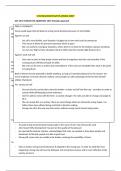
UTILITARIANISM ESSAY PLANNING SHEET
ACT UTIL VS RULE UTIL QUESTION (40)- thematic approach
PARA 2: FLEXIBILITY
INTRO:
Some would argue that util leads to wrong moral decisions because it is too flexible
What is util- relativist theory based on an absolutist principle- the principle of utility “the greatest good for
Against- act util
the greatest number of people”- teleological, consequentialist theory
- Act util is very flexible, each situation is judged on its own merit and circumstances
- Hedonic- seeking pleasure over pain
- This means it allows for personal autonomy which is good
- Act util and rule util
- But- not useful in emergeny situations, where there is no time for the hedonic calculus (emotions
- Bentham- act- each act must be judges individually, no moral rules set in place – autonomy-
can run very high in these situations) hard to think what the morally right thing to do is
hedonic calculus
-Against-
Mill- weak
rule- there is a guideline for moral decision making based on rules that are able to adapt with
rule util
time- focusing on happiness as the ultimate goal
- Sets rules in place to help shape society and lead to happiness but they can be broken if the
My line of argument: Act util
consequences canthe
fulfil lead to wrong
principle of moral
utility decision making as it is too optimistic about human
nature and- fails
But-tothis
work
caninbepractice-
seen as but the guidance
useless provided from
and contradictory- if the rule
rulesutil
aremakes it easy
breakable to follow
then what isinthe point
moral decision makingthem
in having particularly that of strong rule util as it is logically coherent – creates a balance
between human autonomy and moral laws
Both of these have the potential to justify anything, as long as it provides pleasure for the masses- too
much emphasis on human decision making- some people can take advantage of this for their benefit
PARA (Alister Macintyre)
ONE- QUALITY AND QUANTITATE
For- strong
Against- act utilrule
andutil
the hedonic calculus
- -Created
Has set rules for society
by Bentham, that cannot
who wanted be broken-
to move away fromso does not based
theories fall into
onthis trap –authority
a divine provides an order to
- society while still keeping human autonomy
A moral theory focused on social reform and justice for the masses- at the time politics in the UK
-worked
And init is able to
favour of move
the richwith the time- as society changes- the rules are able to change and adapt to
minority
- fit into focus on creating the most amount of pleasure for the most amount of people
Wanted
- -CameWeupcanwithaccept this as acalculus
the hedonic socitey-to
there are some
support thingsused
his views- which are inherently
to measure wrong
how good (rape)- can
something is
follow these laws without being restricted
(duration, intensity, certainty)- measuring pleasure in decision making
- -Might
Strong
seemrulelikeutil is thething
a good onlybecause
way thatitworks- without
provides a clearwrong moral choices
mathematical methodbeing made making
of decision
- BUT- this leads to wrong moral decisions- as it is time consuming and not practical
- Supported by Ross- hedonic calculus is too simplistic and ignores the role of duty
For- rule util- qualitative
- To avoid wrong moral decisions being made in the name of util- rule util must be used
- John Stuart Mills development- focused on the quality of the pleasure
- He rejected the hedonic calculus- acknowledges that rules are needed as they allow people and
businesses to flourish, people are able to gain trust
- Strong util- some rules are unable to be broken, reducing the possibility of harm
So
- Util can lead to wrong normal decisions if adapted in the wrong way- in order to avoid this from
happening, strong rule util must be followed, sets moral laws in place and is more reflective of the
society we live in
ACT UTIL VS RULE UTIL QUESTION (40)- thematic approach
PARA 2: FLEXIBILITY
INTRO:
Some would argue that util leads to wrong moral decisions because it is too flexible
What is util- relativist theory based on an absolutist principle- the principle of utility “the greatest good for
Against- act util
the greatest number of people”- teleological, consequentialist theory
- Act util is very flexible, each situation is judged on its own merit and circumstances
- Hedonic- seeking pleasure over pain
- This means it allows for personal autonomy which is good
- Act util and rule util
- But- not useful in emergeny situations, where there is no time for the hedonic calculus (emotions
- Bentham- act- each act must be judges individually, no moral rules set in place – autonomy-
can run very high in these situations) hard to think what the morally right thing to do is
hedonic calculus
-Against-
Mill- weak
rule- there is a guideline for moral decision making based on rules that are able to adapt with
rule util
time- focusing on happiness as the ultimate goal
- Sets rules in place to help shape society and lead to happiness but they can be broken if the
My line of argument: Act util
consequences canthe
fulfil lead to wrong
principle of moral
utility decision making as it is too optimistic about human
nature and- fails
But-tothis
work
caninbepractice-
seen as but the guidance
useless provided from
and contradictory- if the rule
rulesutil
aremakes it easy
breakable to follow
then what isinthe point
moral decision makingthem
in having particularly that of strong rule util as it is logically coherent – creates a balance
between human autonomy and moral laws
Both of these have the potential to justify anything, as long as it provides pleasure for the masses- too
much emphasis on human decision making- some people can take advantage of this for their benefit
PARA (Alister Macintyre)
ONE- QUALITY AND QUANTITATE
For- strong
Against- act utilrule
andutil
the hedonic calculus
- -Created
Has set rules for society
by Bentham, that cannot
who wanted be broken-
to move away fromso does not based
theories fall into
onthis trap –authority
a divine provides an order to
- society while still keeping human autonomy
A moral theory focused on social reform and justice for the masses- at the time politics in the UK
-worked
And init is able to
favour of move
the richwith the time- as society changes- the rules are able to change and adapt to
minority
- fit into focus on creating the most amount of pleasure for the most amount of people
Wanted
- -CameWeupcanwithaccept this as acalculus
the hedonic socitey-to
there are some
support thingsused
his views- which are inherently
to measure wrong
how good (rape)- can
something is
follow these laws without being restricted
(duration, intensity, certainty)- measuring pleasure in decision making
- -Might
Strong
seemrulelikeutil is thething
a good onlybecause
way thatitworks- without
provides a clearwrong moral choices
mathematical methodbeing made making
of decision
- BUT- this leads to wrong moral decisions- as it is time consuming and not practical
- Supported by Ross- hedonic calculus is too simplistic and ignores the role of duty
For- rule util- qualitative
- To avoid wrong moral decisions being made in the name of util- rule util must be used
- John Stuart Mills development- focused on the quality of the pleasure
- He rejected the hedonic calculus- acknowledges that rules are needed as they allow people and
businesses to flourish, people are able to gain trust
- Strong util- some rules are unable to be broken, reducing the possibility of harm
So
- Util can lead to wrong normal decisions if adapted in the wrong way- in order to avoid this from
happening, strong rule util must be followed, sets moral laws in place and is more reflective of the
society we live in