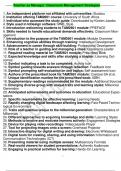
Teacher as Manager: Classroom Management Strategies
1. An independent platform not affiliated with universities: Studocu
2. Institution offering TAM2601 course: University of South Africa
3. Individual who accessed the study guide: Downloaded by Kirsten Jacobs
4. Style used in InDesign software: MNB_Style
5. Introduction welcoming students to TAM2601 module: PREFACE
6. Skills needed to handle educational demands effectively: Classroom Man-
agement
7. Introduction to the purpose of the TAM2601 module: Module Overview
8. Enhancing cognitive abilities through training: Intellectual Development
9. Advancement in career through skill-building: Professional Development
10. Role of a teacher in guiding and managing a class: Classroom Leader
11. Required reading material for TAM2601 module: Prescribed Book
12. Expected knowledge and skills after studying a chapter: Learning Out-
comes
13. Symbol indicating a task to be completed: Activity Icon
14. Symbol guiding towards answers through reflection: Feedback Icon
15. Symbol prompting self-evaluation on unit topics: Self-assessment Icon
16. Authors of the prescribed book for TAM2601 module: Coetzee SA et al.
17. Unique identification number for the prescribed book: ISBN
18. Supplementary readings recommended for the module: Additional Sources
19. Emerging diverse group with unique traits and learning styles: Millennial
Generation
20. Anticipated achievements and outcomes in education: Educational Expec-
tations
21. Specific requirements for effective learning: Learning Needs
22. Rapidly changing digital landscape affecting learning: Fast-Paced Techno-
logical Environment
23. Traits and qualities unique to the millennial generation: Characteristics of
Millennials
24. Different approaches to acquiring knowledge and skills: Learning Styles
25. Methods to involve and motivate learners actively: Engagement Strategies
26. Device for playing video recordings: Videocassette Player
27. Tool for projecting images onto a screen: Overhead Projector
28. Interactive display for digital writing and drawing: Electronic Whiteboard
29. Digital tools for creating, sharing, and using information: Information and
Communication Technologies (ICT)
30. Presenting material using multiple senses: Multisensory Formats
31. Real-world viewers for student presentations: Authentic Audiences
32. Engaging in practical activities for learning: Hands-On Learning
1/3
1. An independent platform not affiliated with universities: Studocu
2. Institution offering TAM2601 course: University of South Africa
3. Individual who accessed the study guide: Downloaded by Kirsten Jacobs
4. Style used in InDesign software: MNB_Style
5. Introduction welcoming students to TAM2601 module: PREFACE
6. Skills needed to handle educational demands effectively: Classroom Man-
agement
7. Introduction to the purpose of the TAM2601 module: Module Overview
8. Enhancing cognitive abilities through training: Intellectual Development
9. Advancement in career through skill-building: Professional Development
10. Role of a teacher in guiding and managing a class: Classroom Leader
11. Required reading material for TAM2601 module: Prescribed Book
12. Expected knowledge and skills after studying a chapter: Learning Out-
comes
13. Symbol indicating a task to be completed: Activity Icon
14. Symbol guiding towards answers through reflection: Feedback Icon
15. Symbol prompting self-evaluation on unit topics: Self-assessment Icon
16. Authors of the prescribed book for TAM2601 module: Coetzee SA et al.
17. Unique identification number for the prescribed book: ISBN
18. Supplementary readings recommended for the module: Additional Sources
19. Emerging diverse group with unique traits and learning styles: Millennial
Generation
20. Anticipated achievements and outcomes in education: Educational Expec-
tations
21. Specific requirements for effective learning: Learning Needs
22. Rapidly changing digital landscape affecting learning: Fast-Paced Techno-
logical Environment
23. Traits and qualities unique to the millennial generation: Characteristics of
Millennials
24. Different approaches to acquiring knowledge and skills: Learning Styles
25. Methods to involve and motivate learners actively: Engagement Strategies
26. Device for playing video recordings: Videocassette Player
27. Tool for projecting images onto a screen: Overhead Projector
28. Interactive display for digital writing and drawing: Electronic Whiteboard
29. Digital tools for creating, sharing, and using information: Information and
Communication Technologies (ICT)
30. Presenting material using multiple senses: Multisensory Formats
31. Real-world viewers for student presentations: Authentic Audiences
32. Engaging in practical activities for learning: Hands-On Learning
1/3