Psychopharmacology for Psychiatric-Mental Health Nurse Practitioner
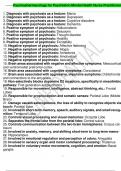
1. Diagnosis with psychosis as a feature: Mania
2. Diagnosis with psychosis as a feature: Depression
3. Diagnosis with psychosis as a feature: Cognitive disorders
4. Diagnosis with psychosis as a feature: Dementia
5. Positive symptom of psychosis: Hallucinations
6. Positive symptom of psychosis: Delusions
7. Positive symptom of psychosis: Thought disorder
8. Positive symptom of psychosis: Hostility
9. Positive symptom of psychosis: Excitability
10. Negative symptom of psychosis: Affective flattening
11. Negative symptom of psychosis: Alogia
12. Negative symptom of psychosis: Anhedonia
13. Negative symptom of psychosis: Amotivation
14. Negative symptom of psychosis: Asociality
15. Brain areas associated with negative and affective symptoms: Mesocortical
and ventromedial prefrontal cortex
16. Brain area associated with cognitive symptoms: Dorsolateral
17. Brain area associated with aggressive, impulsive symptoms: Orbitofrontal
and connections to the amygdala
18. Non-selectively blocks dopamine D2 receptors, specifically in mesolimbic
pathway: First generation antipsychotics
19. Responsible for movement, intelligence, abstract thinking, etc.: Frontal
Lobes
20. Responsible for proprioception and somatic senses: Parietal Lobe (Middle
Brain)
21. Damage causes asterogenesis, the loss of ability to recognize objects via
touch: Parietal Lobe
22. Involved in short-term memory, speech, auditory signals, and smell recog-
nition: Temporal Lobe
23. Controls visual processing and visual memories: Occipital Lobe
24. Separates the frontal lobe from the parietal lobe: Central sulcus
25. Controls communication between the two brain hemispheres: Corpus cal-
losum
26. Involved in anxiety, memory, and shifting short-term to long-term memo-
ry: Hippocampus
27. Involved in emotional regulation and perception of odors: Amygdala
28. Involved in sensory organ and motor command processing: Thalamus
29. Involved in voluntary motor movements, cognition, and emotion: Basal
ganglia
1/3
1. Diagnosis with psychosis as a feature: Mania
2. Diagnosis with psychosis as a feature: Depression
3. Diagnosis with psychosis as a feature: Cognitive disorders
4. Diagnosis with psychosis as a feature: Dementia
5. Positive symptom of psychosis: Hallucinations
6. Positive symptom of psychosis: Delusions
7. Positive symptom of psychosis: Thought disorder
8. Positive symptom of psychosis: Hostility
9. Positive symptom of psychosis: Excitability
10. Negative symptom of psychosis: Affective flattening
11. Negative symptom of psychosis: Alogia
12. Negative symptom of psychosis: Anhedonia
13. Negative symptom of psychosis: Amotivation
14. Negative symptom of psychosis: Asociality
15. Brain areas associated with negative and affective symptoms: Mesocortical
and ventromedial prefrontal cortex
16. Brain area associated with cognitive symptoms: Dorsolateral
17. Brain area associated with aggressive, impulsive symptoms: Orbitofrontal
and connections to the amygdala
18. Non-selectively blocks dopamine D2 receptors, specifically in mesolimbic
pathway: First generation antipsychotics
19. Responsible for movement, intelligence, abstract thinking, etc.: Frontal
Lobes
20. Responsible for proprioception and somatic senses: Parietal Lobe (Middle
Brain)
21. Damage causes asterogenesis, the loss of ability to recognize objects via
touch: Parietal Lobe
22. Involved in short-term memory, speech, auditory signals, and smell recog-
nition: Temporal Lobe
23. Controls visual processing and visual memories: Occipital Lobe
24. Separates the frontal lobe from the parietal lobe: Central sulcus
25. Controls communication between the two brain hemispheres: Corpus cal-
losum
26. Involved in anxiety, memory, and shifting short-term to long-term memo-
ry: Hippocampus
27. Involved in emotional regulation and perception of odors: Amygdala
28. Involved in sensory organ and motor command processing: Thalamus
29. Involved in voluntary motor movements, cognition, and emotion: Basal
ganglia
1/3