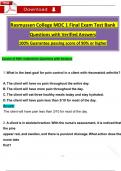
Rasmussen College MDC 1 Final Exam Test Bank
Questions with Verified Answers
100% Guarantee passing score of 90% or higher
Consist of 500+ multichoice Questions with Answers
1. What is the best goal for pain control in a client with rheumatoid arthritis?
A. The client will have no pain throughout the entire day.
B. The client will have more pain throughout the day.
C. The client will eat three healthy meals today and stay hydrated.
D. The client will have pain less than 3/10 for most of the day.
Answer
The client will have pain less than 3/10 for most of the day.
2. A client is in skeletal traction. With the nurse's assessment, it is noticed that
the pins
appear red, and swollen, and there is purulent drainage. What action does the
nurse take
first?
Jo
sh
ua
,A. Cleanse the skin around the pins.
B. Collect a culture of the purulent fluid.
C. Administer an antibiotic o Instruct the client to
D. Complete exercises of the affected extremity.
Answer
Collect a culture of the purulent fluid.
3. What nursing intervention is best to improve communication with a hear-
ing-impaired
client?
A. Write down the message
B. Talk loudly in the impaired ear
C. Speak slowly and clearly while
D. Facing the client
E. Talk in a regular voice in the good ear
Answer
Speak slowly and clearly while
D. Facing the client
4. A client just received a diagnosis of cancer. Which statement by the nurse
demonstrates empathy?
A. "Tomorrow will be better."
Jo
B. "This must be hard news to hear. Tell me about it."
sh
C. "What is your biggest fear about this diagnosis
ua
,D. "I believe you can overcome this because I've seen how strong you are."
Answer
"This must be hard news to hear. Tell me about it."
5. The nurse notices a new area of skin breakdown near the site of a dressing.
This would be an example of which phase of the nursing process.
A. Diagnosis
B. Assessment
C. Implementation
D. Evaluation
Answer
Assessment
6. A client is in the emergency room in critical condition and hypotensive. Her
spouse is distraught. What is the priority nursing action?
A. Call a chaplain
B. Maintain the client's blood pressure
C. Provide the spouse with a chair
D. Ask the client's spouse to explain what happened
Answer
Maintain the client's blood pressure
7. During a skin inspection at the outpatient clinic the nurse notices patches
Jo
of thick, red skin with silvery scales on the client's elbows and knees. What
sh
ua
,skin abnormality does the nurse suspect?
A. Psoriasis
B. Rosacea
C. Scables
D. Stasis dermatitis
Answer
Psoriasis
8. A client with lupus may experience Raynaud's phenomenon. What should
the nurse include when providing client education about this?
A. "In order to avoid flare-ups of Raynaud's, ensure to keep cool."
B. In order to avoid flare-ups of Raynaud's, ensure you wear
sunscreen."
C. "In order to avoid flare-ups of Raynaud's, ensure you wear gloves in
winter."
D. In order to avoid flare-ups of Raynaud s erasure you brush your teeth
for two minutes."
Answer
"In order to avoid flare-ups of Raynaud's, ensure you wear gloves in winter."
9. A nurse caring for an intubated and sedated geriatric client What interven-
tion is most appropriate for reducing the risk for friction and shear injury?
Jo
sh
A. Postpone daily bed bath
ua
,B. Elevate the client's head of the bed to 45 degrees
C. Caregiver independently slides the client up in bed
D. Use a mechanical lift to reposition the client every 2 hours
Answer
Use a mechan- ical lift to reposition the client every 2 hours
10. The 65-year-old male client who is complaining of blurred vision reports
he thinks his glasses need to be cleaned all the time, and he denies any type
of eye pain. Which eye disorder should the nurse suspect the client has?
A. Corneal dystrophy
B. Conjunctivitis
C. Diabetic retinopathy
D. Cataracts
Answer
Cataracts
11. The Client with rheumatoid arthritis complains of intensely dry eyes. What
does the nurse suspect?
A. Chron's disease
B. Discoid lupus
C. Systemic sclerosis
D. Sjogren's syndrome
Jo
Answer
sh
Sjogren's syndrome
ua
,12. The nurse assesses the client's pain prior to completing a dressing
change. The client says his current pain is 5/10, but he has a pain of 10/10
when his dressing is changed. What is the priority intervention for this client?
A. Remove the old dressing with clean gloves
B. Check medication administration record (MAR) for as-needed
orders (PRN)
C. Teach the client about nonpharmacological pain control methods
D. Offer the client protein with meals to promote healing
Answer
Check medication administration record (MAR) for as-needed orders (PRN)
13. The nurse is caring for four clients. Which of these clients will the
nurse see first?
A. A client with sudden and increasing pain in his fractured arm
B. A client with a fractured ankle who would like a glass of water
C. A client with rheumatoid arthritis and a scheduled pain medication
D. A client being discharged in two hours and needs to be taught how to use
his crutches
Answer
A client with sudden and increasing pain in his fractured arm
14. A wound has a blood-tinged liquid that is dripping from the surgical site.
Jo
How does the nurse document this finding?
sh
A. Purulent
ua
,B. Exudate
C. Creamy pus
D. Serous
E. Serosanguineous: E. Serosanguineous
15. What are some of the expected outcomes when medications are given for
rheumatoid arthritis? (Select all that apply)
A. Reduced inflammation
B. Increased range of motion
C. Cure the disease
D. Decreased pain
E. Increased quality of life
Answer
Reduced inflammation
B. Increased range of motion
D. Decreased pain
E. Increased quality of life
16. What is a priority nursing intervention for a client with lupus who is
receiving steroids for a flare-up?
A. The nurse washes their hands before entering the room.
B. Assist with the enhancement of soda well-being by providing
Jo
activities.
sh
C. Assess the client's support system.
ua
, D. Ensure privacy by keeping the door always closed.
Answer
The nurse washes their hands before entering the room.
17. The nurse is providing medication education for a client with osteoarthritis.
What teaching should the nurse include in the education?
A. The main side effect of acetaminophen is gastrointestinal (GI) bleeding.
B. You should not take more than 4000 mg of acetaminophen a day.
C. Nonsteroidal anti-inflammatory drugs (NSAIDs) are very safe and are known
to have no side effects.
D. The most common adverse effect of nonsteroidal anti-inflammatory drugs
(NSAIDs) are liver failure and tinnitus.
Answer
You should not take more than 4000 mg of acetaminophen a day.
18. A nurse is providing education for a client who has glaucoma. Which of the
following statements should the nurse include in the teaching?
A. "Without treatment, glaucoma can cause blindness."
B. Double vision is a common symptom of glaucoma."
C. "Glaucoma is caused by inadequate production of
fluid within the eye."
Jo
sh
ua
Questions with Verified Answers
100% Guarantee passing score of 90% or higher
Consist of 500+ multichoice Questions with Answers
1. What is the best goal for pain control in a client with rheumatoid arthritis?
A. The client will have no pain throughout the entire day.
B. The client will have more pain throughout the day.
C. The client will eat three healthy meals today and stay hydrated.
D. The client will have pain less than 3/10 for most of the day.
Answer
The client will have pain less than 3/10 for most of the day.
2. A client is in skeletal traction. With the nurse's assessment, it is noticed that
the pins
appear red, and swollen, and there is purulent drainage. What action does the
nurse take
first?
Jo
sh
ua
,A. Cleanse the skin around the pins.
B. Collect a culture of the purulent fluid.
C. Administer an antibiotic o Instruct the client to
D. Complete exercises of the affected extremity.
Answer
Collect a culture of the purulent fluid.
3. What nursing intervention is best to improve communication with a hear-
ing-impaired
client?
A. Write down the message
B. Talk loudly in the impaired ear
C. Speak slowly and clearly while
D. Facing the client
E. Talk in a regular voice in the good ear
Answer
Speak slowly and clearly while
D. Facing the client
4. A client just received a diagnosis of cancer. Which statement by the nurse
demonstrates empathy?
A. "Tomorrow will be better."
Jo
B. "This must be hard news to hear. Tell me about it."
sh
C. "What is your biggest fear about this diagnosis
ua
,D. "I believe you can overcome this because I've seen how strong you are."
Answer
"This must be hard news to hear. Tell me about it."
5. The nurse notices a new area of skin breakdown near the site of a dressing.
This would be an example of which phase of the nursing process.
A. Diagnosis
B. Assessment
C. Implementation
D. Evaluation
Answer
Assessment
6. A client is in the emergency room in critical condition and hypotensive. Her
spouse is distraught. What is the priority nursing action?
A. Call a chaplain
B. Maintain the client's blood pressure
C. Provide the spouse with a chair
D. Ask the client's spouse to explain what happened
Answer
Maintain the client's blood pressure
7. During a skin inspection at the outpatient clinic the nurse notices patches
Jo
of thick, red skin with silvery scales on the client's elbows and knees. What
sh
ua
,skin abnormality does the nurse suspect?
A. Psoriasis
B. Rosacea
C. Scables
D. Stasis dermatitis
Answer
Psoriasis
8. A client with lupus may experience Raynaud's phenomenon. What should
the nurse include when providing client education about this?
A. "In order to avoid flare-ups of Raynaud's, ensure to keep cool."
B. In order to avoid flare-ups of Raynaud's, ensure you wear
sunscreen."
C. "In order to avoid flare-ups of Raynaud's, ensure you wear gloves in
winter."
D. In order to avoid flare-ups of Raynaud s erasure you brush your teeth
for two minutes."
Answer
"In order to avoid flare-ups of Raynaud's, ensure you wear gloves in winter."
9. A nurse caring for an intubated and sedated geriatric client What interven-
tion is most appropriate for reducing the risk for friction and shear injury?
Jo
sh
A. Postpone daily bed bath
ua
,B. Elevate the client's head of the bed to 45 degrees
C. Caregiver independently slides the client up in bed
D. Use a mechanical lift to reposition the client every 2 hours
Answer
Use a mechan- ical lift to reposition the client every 2 hours
10. The 65-year-old male client who is complaining of blurred vision reports
he thinks his glasses need to be cleaned all the time, and he denies any type
of eye pain. Which eye disorder should the nurse suspect the client has?
A. Corneal dystrophy
B. Conjunctivitis
C. Diabetic retinopathy
D. Cataracts
Answer
Cataracts
11. The Client with rheumatoid arthritis complains of intensely dry eyes. What
does the nurse suspect?
A. Chron's disease
B. Discoid lupus
C. Systemic sclerosis
D. Sjogren's syndrome
Jo
Answer
sh
Sjogren's syndrome
ua
,12. The nurse assesses the client's pain prior to completing a dressing
change. The client says his current pain is 5/10, but he has a pain of 10/10
when his dressing is changed. What is the priority intervention for this client?
A. Remove the old dressing with clean gloves
B. Check medication administration record (MAR) for as-needed
orders (PRN)
C. Teach the client about nonpharmacological pain control methods
D. Offer the client protein with meals to promote healing
Answer
Check medication administration record (MAR) for as-needed orders (PRN)
13. The nurse is caring for four clients. Which of these clients will the
nurse see first?
A. A client with sudden and increasing pain in his fractured arm
B. A client with a fractured ankle who would like a glass of water
C. A client with rheumatoid arthritis and a scheduled pain medication
D. A client being discharged in two hours and needs to be taught how to use
his crutches
Answer
A client with sudden and increasing pain in his fractured arm
14. A wound has a blood-tinged liquid that is dripping from the surgical site.
Jo
How does the nurse document this finding?
sh
A. Purulent
ua
,B. Exudate
C. Creamy pus
D. Serous
E. Serosanguineous: E. Serosanguineous
15. What are some of the expected outcomes when medications are given for
rheumatoid arthritis? (Select all that apply)
A. Reduced inflammation
B. Increased range of motion
C. Cure the disease
D. Decreased pain
E. Increased quality of life
Answer
Reduced inflammation
B. Increased range of motion
D. Decreased pain
E. Increased quality of life
16. What is a priority nursing intervention for a client with lupus who is
receiving steroids for a flare-up?
A. The nurse washes their hands before entering the room.
B. Assist with the enhancement of soda well-being by providing
Jo
activities.
sh
C. Assess the client's support system.
ua
, D. Ensure privacy by keeping the door always closed.
Answer
The nurse washes their hands before entering the room.
17. The nurse is providing medication education for a client with osteoarthritis.
What teaching should the nurse include in the education?
A. The main side effect of acetaminophen is gastrointestinal (GI) bleeding.
B. You should not take more than 4000 mg of acetaminophen a day.
C. Nonsteroidal anti-inflammatory drugs (NSAIDs) are very safe and are known
to have no side effects.
D. The most common adverse effect of nonsteroidal anti-inflammatory drugs
(NSAIDs) are liver failure and tinnitus.
Answer
You should not take more than 4000 mg of acetaminophen a day.
18. A nurse is providing education for a client who has glaucoma. Which of the
following statements should the nurse include in the teaching?
A. "Without treatment, glaucoma can cause blindness."
B. Double vision is a common symptom of glaucoma."
C. "Glaucoma is caused by inadequate production of
fluid within the eye."
Jo
sh
ua