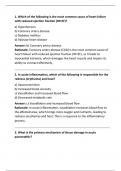
1. Which of the following is the most common cause of heart failure
with reduced ejection fraction (HFrEF)?
a) Hypertension
b) Coronary artery disease
c) Diabetes mellitus
d) Valvular heart disease
Answer: b) Coronary artery disease
Rationale: Coronary artery disease (CAD) is the most common cause of
heart failure with reduced ejection fraction (HFrEF), as it leads to
myocardial ischemia, which damages the heart muscle and impairs its
ability to contract effectively.
2. In acute inflammation, which of the following is responsible for the
redness (erythema) and heat?
a) Vasoconstriction
b) Increased blood viscosity
c) Vasodilation and increased blood flow
d) Decreased metabolic rate
Answer: c) Vasodilation and increased blood flow
Rationale: In acute inflammation, vasodilation increases blood flow to
the affected area, which brings more oxygen and nutrients, leading to
redness (erythema) and heat. This is a response to the inflammatory
process.
3. What is the primary mechanism of tissue damage in acute
pancreatitis?
,a) Hypoxia
b) Auto-digestion by pancreatic enzymes
c) Ischemia
d) Bacterial infection
Answer: b) Auto-digestion by pancreatic enzymes
Rationale: In acute pancreatitis, pancreatic enzymes become
prematurely activated inside the pancreas, leading to auto-digestion of
pancreatic tissue and surrounding structures. This results in
inflammation, edema, and cellular damage.
4. Which of the following is a key feature of nephrotic syndrome?
a) Hematuria
b) Proteinuria >3.5 g/day
c) Hyperkalemia
d) Azotemia
Answer: b) Proteinuria >3.5 g/day
Rationale: Nephrotic syndrome is characterized by massive proteinuria
(>3.5 g/day), hypoalbuminemia, edema, and hyperlipidemia. The
primary issue is glomerular damage, leading to excessive loss of
proteins through the urine.
5. What is the underlying pathophysiological mechanism of chronic
obstructive pulmonary disease (COPD)?
a) Pulmonary vasoconstriction
b) Bronchial smooth muscle spasm
c) Chronic inflammation and airway remodeling
d) Hypoventilation
, Answer: c) Chronic inflammation and airway remodeling
Rationale: COPD is primarily caused by chronic inflammation of the
airways, often due to smoking, leading to airway remodeling, mucus
hypersecretion, and decreased airflow. Over time, this results in
irreversible airflow obstruction.
6. Which of the following is the most common cause of hepatic
cirrhosis worldwide?
a) Alcoholic liver disease
b) Hepatitis B
c) Hepatitis C
d) Non-alcoholic fatty liver disease (NAFLD)
Answer: c) Hepatitis C
Rationale: Hepatitis C is one of the most common causes of cirrhosis
globally. Chronic infection with the hepatitis C virus leads to liver
inflammation, fibrosis, and eventually cirrhosis. Alcoholic liver disease
and NAFLD are also common, but hepatitis C has the highest worldwide
prevalence.
7. In which of the following conditions is the process of apoptosis
significantly impaired?
a) Alzheimer’s disease
b) Hypertension
c) Asthma
d) Type 1 diabetes
Answer: a) Alzheimer’s disease
Rationale: In Alzheimer's disease, the normal process of apoptosis
with reduced ejection fraction (HFrEF)?
a) Hypertension
b) Coronary artery disease
c) Diabetes mellitus
d) Valvular heart disease
Answer: b) Coronary artery disease
Rationale: Coronary artery disease (CAD) is the most common cause of
heart failure with reduced ejection fraction (HFrEF), as it leads to
myocardial ischemia, which damages the heart muscle and impairs its
ability to contract effectively.
2. In acute inflammation, which of the following is responsible for the
redness (erythema) and heat?
a) Vasoconstriction
b) Increased blood viscosity
c) Vasodilation and increased blood flow
d) Decreased metabolic rate
Answer: c) Vasodilation and increased blood flow
Rationale: In acute inflammation, vasodilation increases blood flow to
the affected area, which brings more oxygen and nutrients, leading to
redness (erythema) and heat. This is a response to the inflammatory
process.
3. What is the primary mechanism of tissue damage in acute
pancreatitis?
,a) Hypoxia
b) Auto-digestion by pancreatic enzymes
c) Ischemia
d) Bacterial infection
Answer: b) Auto-digestion by pancreatic enzymes
Rationale: In acute pancreatitis, pancreatic enzymes become
prematurely activated inside the pancreas, leading to auto-digestion of
pancreatic tissue and surrounding structures. This results in
inflammation, edema, and cellular damage.
4. Which of the following is a key feature of nephrotic syndrome?
a) Hematuria
b) Proteinuria >3.5 g/day
c) Hyperkalemia
d) Azotemia
Answer: b) Proteinuria >3.5 g/day
Rationale: Nephrotic syndrome is characterized by massive proteinuria
(>3.5 g/day), hypoalbuminemia, edema, and hyperlipidemia. The
primary issue is glomerular damage, leading to excessive loss of
proteins through the urine.
5. What is the underlying pathophysiological mechanism of chronic
obstructive pulmonary disease (COPD)?
a) Pulmonary vasoconstriction
b) Bronchial smooth muscle spasm
c) Chronic inflammation and airway remodeling
d) Hypoventilation
, Answer: c) Chronic inflammation and airway remodeling
Rationale: COPD is primarily caused by chronic inflammation of the
airways, often due to smoking, leading to airway remodeling, mucus
hypersecretion, and decreased airflow. Over time, this results in
irreversible airflow obstruction.
6. Which of the following is the most common cause of hepatic
cirrhosis worldwide?
a) Alcoholic liver disease
b) Hepatitis B
c) Hepatitis C
d) Non-alcoholic fatty liver disease (NAFLD)
Answer: c) Hepatitis C
Rationale: Hepatitis C is one of the most common causes of cirrhosis
globally. Chronic infection with the hepatitis C virus leads to liver
inflammation, fibrosis, and eventually cirrhosis. Alcoholic liver disease
and NAFLD are also common, but hepatitis C has the highest worldwide
prevalence.
7. In which of the following conditions is the process of apoptosis
significantly impaired?
a) Alzheimer’s disease
b) Hypertension
c) Asthma
d) Type 1 diabetes
Answer: a) Alzheimer’s disease
Rationale: In Alzheimer's disease, the normal process of apoptosis