1
Fubini’s Theorem
Suppose 𝑓: [𝑎, 𝑏] × [𝑐, 𝑑] → ℝ is continuous and 𝑓 (𝑥, 𝑦) ≥ 0.
Let 𝑡0 , … , 𝑡𝑛 be a partition of [𝑎, 𝑏].
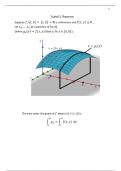
Define 𝑔𝑥 (𝑦) = 𝑓(𝑥, 𝑦) (that is, fix 𝑥 ∈ [𝑎, 𝑏]).
𝑧
𝑧 = 𝑔𝑥 (𝑦)
𝑧 = 𝑓(𝑥, 𝑦)
𝑐 𝑎
𝑥
𝑏
𝑥
The area under the graph of 𝑓 above {𝑥} × [𝑐, 𝑑] is:
𝑑 𝑑
∫ 𝑔𝑥 = ∫ 𝑓(𝑥, 𝑦) 𝑑𝑦.
𝑐 𝑐
, 2
𝑧
𝑧 = 𝑓(𝑥, 𝑦)
𝑦
𝑑
𝑡𝑖−1
𝑎 𝑥
𝑐 𝑡𝑖 𝑏
The volume of the region under the graph of 𝑓 and above
[𝑡𝑖−1 , 𝑡𝑖 ] × [𝑐, 𝑑] is approximately equal to:
𝑑
(𝑡𝑖 − 𝑡𝑖−1 ) ∫ 𝑓(𝑥, 𝑦) 𝑑𝑦
𝑐
for any 𝑥 ∈ [𝑡𝑖−1 , 𝑡𝑖 ].
Thus:
𝑛
∫ 𝑓=∑ ∫ 𝑓
[𝑎,𝑏 ] × [𝑐,𝑑] 𝑖=1 [𝑡𝑖−1,𝑡𝑖] × [𝑐,𝑑]
is approximately equal to:
𝑛 𝑑
∑(𝑡𝑖 − 𝑡𝑖−1 ) ∫ 𝑓 (𝑥𝑖 , 𝑦) 𝑑𝑦
𝑖=1 𝑐
where 𝑥𝑖 ∈ [𝑡𝑖−1 , 𝑡𝑖 ].
Fubini’s Theorem
Suppose 𝑓: [𝑎, 𝑏] × [𝑐, 𝑑] → ℝ is continuous and 𝑓 (𝑥, 𝑦) ≥ 0.
Let 𝑡0 , … , 𝑡𝑛 be a partition of [𝑎, 𝑏].
Define 𝑔𝑥 (𝑦) = 𝑓(𝑥, 𝑦) (that is, fix 𝑥 ∈ [𝑎, 𝑏]).
𝑧
𝑧 = 𝑔𝑥 (𝑦)
𝑧 = 𝑓(𝑥, 𝑦)
𝑐 𝑎
𝑥
𝑏
𝑥
The area under the graph of 𝑓 above {𝑥} × [𝑐, 𝑑] is:
𝑑 𝑑
∫ 𝑔𝑥 = ∫ 𝑓(𝑥, 𝑦) 𝑑𝑦.
𝑐 𝑐
, 2
𝑧
𝑧 = 𝑓(𝑥, 𝑦)
𝑦
𝑑
𝑡𝑖−1
𝑎 𝑥
𝑐 𝑡𝑖 𝑏
The volume of the region under the graph of 𝑓 and above
[𝑡𝑖−1 , 𝑡𝑖 ] × [𝑐, 𝑑] is approximately equal to:
𝑑
(𝑡𝑖 − 𝑡𝑖−1 ) ∫ 𝑓(𝑥, 𝑦) 𝑑𝑦
𝑐
for any 𝑥 ∈ [𝑡𝑖−1 , 𝑡𝑖 ].
Thus:
𝑛
∫ 𝑓=∑ ∫ 𝑓
[𝑎,𝑏 ] × [𝑐,𝑑] 𝑖=1 [𝑡𝑖−1,𝑡𝑖] × [𝑐,𝑑]
is approximately equal to:
𝑛 𝑑
∑(𝑡𝑖 − 𝑡𝑖−1 ) ∫ 𝑓 (𝑥𝑖 , 𝑦) 𝑑𝑦
𝑖=1 𝑐
where 𝑥𝑖 ∈ [𝑡𝑖−1 , 𝑡𝑖 ].