1
Vector Fields and Differential Forms on ℝ𝑛
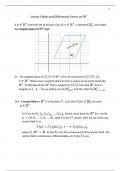
If 𝑝 ∈ ℝ𝑛 , then the set of all pairs (𝑝, 𝑣 ), 𝑣 ∈ ℝ𝑛 , is denoted ℝ𝑛
𝑝 , and called
the tangent space of ℝ𝒏 at 𝒑.
𝑣
𝑝
ℝ𝑛𝑝
Ex. The tangent plane to (2, 5) ∈ ℝ2 is the set of all points ((2, 5), 𝑣),
𝑣 ∈ ℝ2 . Notice every tangent plane to the 𝑥𝑦 plane at any point looks like
ℝ2 . To distinguish the ℝ2 that is tangent to (2, 5) from the ℝ2 that is
tangent to (−1, −3) we define one by ℝ2(2,5) and the other by ℝ2(−1,−3).
Def. A vector field on ℝ𝑛 is a function, 𝐹, such that 𝐹(𝑝) ∈ ℝ𝑛
𝑝 , for each
𝑝 ∈ ℝ𝑛 .
So if we let (𝑒1 )𝑝 , (𝑒2 )𝑝 , … , (𝑒𝑛 )𝑝 be the usual basis for ℝ𝑛 (i.e. we let
𝑒𝑖 = (0, 0, … , 1, 0, … , 0), with 1 in the 𝑖𝑡ℎ place), then we can write any
vector field 𝐹 as:
𝐹(𝑝) = 𝐹1 (𝑝)(𝑒1 )𝑝 + ⋯ + 𝐹𝑛 (𝑝)(𝑒𝑛 )𝑝
where 𝐹𝑖 : ℝ𝑛 → ℝ. So the 𝐹𝑖 s are the components of the vector field. The
vector field is continuous, differentiable, etc if the 𝐹𝑖 s are.
, 2
Given any two vector fields 𝐹, 𝐺 and 𝑓: ℝ𝑛 → ℝ, we define:
(𝐹 + 𝐺 )(𝑝) = 𝐹 (𝑝) + 𝐺(𝑝)
(𝐹 ⋅ 𝐺 )(𝑝) = 𝐹 (𝑝) ⋅ 𝐺(𝑝)
(𝑓𝐹 )(𝑝) = (𝑓 (𝑝))(𝐹 (𝑝)).
We define the divergence of 𝑭 by:
𝑛
𝜕𝐹𝑖
𝑑𝑖𝑣 (𝐹 ) = ∑
𝜕𝑥𝑖
𝑖=1
or we can write ∇ ⋅ 𝐹, where:
∂ ∂ ∂
∇= ( , ,…, ).
∂𝑥1 ∂𝑥2 ∂𝑥𝑛
If 𝑛 = 3 we define ∇ × 𝐹 = 𝒄𝒖𝒓𝒍(𝑭) as:
𝑖 𝑗 𝑘
∂ ∂ ∂
∇ × 𝐹=| |
∂𝑥 ∂𝑦 ∂𝑧
𝐹1 𝐹2 𝐹3
At each point 𝑝 ∈ ℝ3 , ∇ × 𝐹 is a vector in ℝ3𝑝 .
Vector Fields and Differential Forms on ℝ𝑛
If 𝑝 ∈ ℝ𝑛 , then the set of all pairs (𝑝, 𝑣 ), 𝑣 ∈ ℝ𝑛 , is denoted ℝ𝑛
𝑝 , and called
the tangent space of ℝ𝒏 at 𝒑.
𝑣
𝑝
ℝ𝑛𝑝
Ex. The tangent plane to (2, 5) ∈ ℝ2 is the set of all points ((2, 5), 𝑣),
𝑣 ∈ ℝ2 . Notice every tangent plane to the 𝑥𝑦 plane at any point looks like
ℝ2 . To distinguish the ℝ2 that is tangent to (2, 5) from the ℝ2 that is
tangent to (−1, −3) we define one by ℝ2(2,5) and the other by ℝ2(−1,−3).
Def. A vector field on ℝ𝑛 is a function, 𝐹, such that 𝐹(𝑝) ∈ ℝ𝑛
𝑝 , for each
𝑝 ∈ ℝ𝑛 .
So if we let (𝑒1 )𝑝 , (𝑒2 )𝑝 , … , (𝑒𝑛 )𝑝 be the usual basis for ℝ𝑛 (i.e. we let
𝑒𝑖 = (0, 0, … , 1, 0, … , 0), with 1 in the 𝑖𝑡ℎ place), then we can write any
vector field 𝐹 as:
𝐹(𝑝) = 𝐹1 (𝑝)(𝑒1 )𝑝 + ⋯ + 𝐹𝑛 (𝑝)(𝑒𝑛 )𝑝
where 𝐹𝑖 : ℝ𝑛 → ℝ. So the 𝐹𝑖 s are the components of the vector field. The
vector field is continuous, differentiable, etc if the 𝐹𝑖 s are.
, 2
Given any two vector fields 𝐹, 𝐺 and 𝑓: ℝ𝑛 → ℝ, we define:
(𝐹 + 𝐺 )(𝑝) = 𝐹 (𝑝) + 𝐺(𝑝)
(𝐹 ⋅ 𝐺 )(𝑝) = 𝐹 (𝑝) ⋅ 𝐺(𝑝)
(𝑓𝐹 )(𝑝) = (𝑓 (𝑝))(𝐹 (𝑝)).
We define the divergence of 𝑭 by:
𝑛
𝜕𝐹𝑖
𝑑𝑖𝑣 (𝐹 ) = ∑
𝜕𝑥𝑖
𝑖=1
or we can write ∇ ⋅ 𝐹, where:
∂ ∂ ∂
∇= ( , ,…, ).
∂𝑥1 ∂𝑥2 ∂𝑥𝑛
If 𝑛 = 3 we define ∇ × 𝐹 = 𝒄𝒖𝒓𝒍(𝑭) as:
𝑖 𝑗 𝑘
∂ ∂ ∂
∇ × 𝐹=| |
∂𝑥 ∂𝑦 ∂𝑧
𝐹1 𝐹2 𝐹3
At each point 𝑝 ∈ ℝ3 , ∇ × 𝐹 is a vector in ℝ3𝑝 .