1
Stereographic Projections of Spheres
In a homework problem (Manifolds #1) you’re asked to show that the following two
sets and their coordinate systems form an atlas on 𝑆 2 :
𝑊1 = 𝑆 2 − (0, 0, 1)
𝑥 𝑦
𝜋1 : 𝑊1 → ℝ2 by 𝜋1 (𝑥, 𝑦, 𝑧) = (1−𝑧 , 1−𝑧)
𝑊2 = 𝑆 2 − (0, 0, −1)
𝑥 𝑦
𝜋2 : 𝑊2 → ℝ2 by 𝜋2 (𝑥, 𝑦, 𝑧) = (1+𝑧 , 1+𝑧)
First let’s see where the mapping 𝜋1 and 𝜋2 come from and then generalize this
approach to show that:
𝑆 3 = {(𝑥1 , 𝑥2 , 𝑥3 , 𝑥4 ) ∈ ℝ4 |𝑥12 + 𝑥22 + 𝑥32 + 𝑥42 = 1} is a manifold (this
approach will also work for 𝑆 𝑛 ).
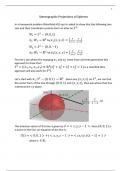
Let’s start with 𝜋1 : 𝑆 2 − (0, 0, 1) → ℝ2 . Given any (𝑥, 𝑦, 𝑧) on 𝑆 2 , we can find
the vector form of the line through (0, 0, 1) and (𝑥, 𝑦, 𝑧), then ask where that line
intersects the 𝑥𝑦-plane.
(0,0,1)
(𝑥, 𝑦, 𝑧)
𝑥 𝑦
( , , 0)
1−𝑧 1−𝑧
The direction vector of this line is given by 𝑣⃗ = < 𝑥, 𝑦, 𝑧 − 1 >. Since (0, 0, 1) is
a point on the line, an equation of the line is:
𝑙 (𝑡 ) = < 0, 0, 1 > +𝑡 < 𝑥, 𝑦, 𝑧 − 1 > = < 𝑡𝑥, 𝑡𝑦, 𝑡(𝑧 − 1) + 1 >
where 𝑡 ∈ ℝ.
, 2
1
This line intersects the 𝑥𝑦-plane when 𝑡 (𝑧 − 1) + 1 = 0 or 𝑡 = .
1−𝑧
So the point of intersection between 𝑙(𝑡) and the 𝑥𝑦-plane is the point:
𝑥 𝑦
( , , 0).
1−𝑧 1−𝑧
𝑥 𝑦
Thus 𝜋1 (𝑥, 𝑦, 𝑧) = ( , ) and by a similar argument we get:
1−𝑧 1−𝑧
𝑥 𝑦
𝜋2 (𝑥, 𝑦, 𝑧) = (1+𝑧 , 1+𝑧). 𝜋1 and 𝜋2 are called stereographic projections of 𝑆 2
onto ℝ2 .
Let’s take the same approach for:
𝑆 3 = {(𝑥1 , 𝑥2 , 𝑥3 , 𝑥4 ) ∈ ℝ4 | 𝑥12 + 𝑥22 + 𝑥32 + 𝑥42 = 1}
Let 𝑊1 = 𝑆 3 − (0, 0, 0, 1) and 𝜋1 : 𝑊1 → ℝ3 .
𝜋1 will take a point on 𝑆 3 − (0, 0, 0, 1) and map it to the point of intersection of
the line through (0, 0, 0, 1) and (𝑥1 , 𝑥2 , 𝑥3 , 𝑥4 ) ∈ 𝑆 3 with the 3-space :
ℝ3 = {(𝑥1 , 𝑥2 , 𝑥3 , 𝑥4 ) ∈ ℝ4 |𝑥4 = 0}.
(0,0,0,1) (𝑥1 , 𝑥2 , 𝑥3 , 𝑥4 )
𝑥1 𝑥2 𝑥3
( , , , 0)
1 − 𝑥4 1 − 𝑥4 1 − 𝑥4
Stereographic Projections of Spheres
In a homework problem (Manifolds #1) you’re asked to show that the following two
sets and their coordinate systems form an atlas on 𝑆 2 :
𝑊1 = 𝑆 2 − (0, 0, 1)
𝑥 𝑦
𝜋1 : 𝑊1 → ℝ2 by 𝜋1 (𝑥, 𝑦, 𝑧) = (1−𝑧 , 1−𝑧)
𝑊2 = 𝑆 2 − (0, 0, −1)
𝑥 𝑦
𝜋2 : 𝑊2 → ℝ2 by 𝜋2 (𝑥, 𝑦, 𝑧) = (1+𝑧 , 1+𝑧)
First let’s see where the mapping 𝜋1 and 𝜋2 come from and then generalize this
approach to show that:
𝑆 3 = {(𝑥1 , 𝑥2 , 𝑥3 , 𝑥4 ) ∈ ℝ4 |𝑥12 + 𝑥22 + 𝑥32 + 𝑥42 = 1} is a manifold (this
approach will also work for 𝑆 𝑛 ).
Let’s start with 𝜋1 : 𝑆 2 − (0, 0, 1) → ℝ2 . Given any (𝑥, 𝑦, 𝑧) on 𝑆 2 , we can find
the vector form of the line through (0, 0, 1) and (𝑥, 𝑦, 𝑧), then ask where that line
intersects the 𝑥𝑦-plane.
(0,0,1)
(𝑥, 𝑦, 𝑧)
𝑥 𝑦
( , , 0)
1−𝑧 1−𝑧
The direction vector of this line is given by 𝑣⃗ = < 𝑥, 𝑦, 𝑧 − 1 >. Since (0, 0, 1) is
a point on the line, an equation of the line is:
𝑙 (𝑡 ) = < 0, 0, 1 > +𝑡 < 𝑥, 𝑦, 𝑧 − 1 > = < 𝑡𝑥, 𝑡𝑦, 𝑡(𝑧 − 1) + 1 >
where 𝑡 ∈ ℝ.
, 2
1
This line intersects the 𝑥𝑦-plane when 𝑡 (𝑧 − 1) + 1 = 0 or 𝑡 = .
1−𝑧
So the point of intersection between 𝑙(𝑡) and the 𝑥𝑦-plane is the point:
𝑥 𝑦
( , , 0).
1−𝑧 1−𝑧
𝑥 𝑦
Thus 𝜋1 (𝑥, 𝑦, 𝑧) = ( , ) and by a similar argument we get:
1−𝑧 1−𝑧
𝑥 𝑦
𝜋2 (𝑥, 𝑦, 𝑧) = (1+𝑧 , 1+𝑧). 𝜋1 and 𝜋2 are called stereographic projections of 𝑆 2
onto ℝ2 .
Let’s take the same approach for:
𝑆 3 = {(𝑥1 , 𝑥2 , 𝑥3 , 𝑥4 ) ∈ ℝ4 | 𝑥12 + 𝑥22 + 𝑥32 + 𝑥42 = 1}
Let 𝑊1 = 𝑆 3 − (0, 0, 0, 1) and 𝜋1 : 𝑊1 → ℝ3 .
𝜋1 will take a point on 𝑆 3 − (0, 0, 0, 1) and map it to the point of intersection of
the line through (0, 0, 0, 1) and (𝑥1 , 𝑥2 , 𝑥3 , 𝑥4 ) ∈ 𝑆 3 with the 3-space :
ℝ3 = {(𝑥1 , 𝑥2 , 𝑥3 , 𝑥4 ) ∈ ℝ4 |𝑥4 = 0}.
(0,0,0,1) (𝑥1 , 𝑥2 , 𝑥3 , 𝑥4 )
𝑥1 𝑥2 𝑥3
( , , , 0)
1 − 𝑥4 1 − 𝑥4 1 − 𝑥4