1
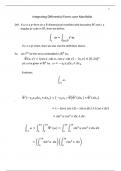
Integrating Differential Forms over Manifolds
Def. If 𝜔 is a 𝑝-form on a 𝑘-dimensional manifold with boundary 𝑀 and 𝑐 a
singular 𝑝-cube in 𝑀, then we define:
∫ 𝝎=∫ 𝒄∗ 𝝎.
𝒄 [𝟎,𝟏]𝒌
If 𝑐 is a 𝑝-chain, then we also use the definition above.
Ex. Let 𝑇 2 be the torus embedded in ℝ4 by:
⃗Φ
⃗⃗ (𝑢, 𝑣 ) = (cos 𝑢 , sin 𝑢 , cos 𝑣 , sin 𝑣 ) ; (𝑢, 𝑣 ) ∈ [0, 2𝜋]2
Let 𝜔 be given in ℝ4 by 𝜔 = −𝑥2 𝑥3 𝑑𝑥1 ∧ 𝑑𝑥4 .
Evaluate:
∫ 𝜔.
𝑇2
⃗Φ
⃗ ∗ (−𝑥2 𝑥3 𝑑𝑥1 ∧ 𝑑𝑥4 ) = (−𝑥2 𝑥3 ∘ ⃗Φ
⃗ )Φ
⃗⃗ ∗ (𝑑𝑥1 ) ∧ ⃗Φ
⃗ ∗ (𝑑𝑥4 )
]
= (− sin 𝑢 cos 𝑣)(− sin 𝑢 𝑑𝑢) ∧ (cos 𝑣 𝑑𝑣 )
= sin2 𝑢 cos 2 𝑣 𝑑𝑢 ∧ 𝑑𝑣.
2𝜋 2𝜋 2𝜋 2𝜋
∫ 𝜔=∫ ∫ ⃗⃗ ∗ (𝜔)
Φ =∫ ∫ sin2 𝑢 cos 2 𝑣 𝑑𝑢 𝑑𝑣
𝑇2 0 0 0 0
2𝜋 2𝜋
= (∫ sin 𝑢 𝑑𝑢) (∫ cos 2 𝑣 𝑑𝑣 )
2
0 0
, 2
2𝜋 2𝜋
1 1 1 1
= (∫ ( − cos 2𝑢) 𝑑𝑢) (∫ ( + cos 2𝑣) 𝑑𝑣 )
0 2 2 0 2 2
1 1 2𝜋 1 1 2𝜋
= ((2 𝑢 − 4 sin 2𝑢)| ) ((2 𝑣 + 4 sin 2𝑣)| ) = 𝜋 2 .
0 0
Theorem: If 𝑐1 , 𝑐2 : [0, 1]𝑘 → 𝑀 are two orientation preserving
(i.e. det((𝑐2−1 𝑐1 )′ ) > 0) singular 𝑘-cubes on the oriented
𝑘-dimensional manifold 𝑀 and 𝜔 is a 𝑘-form on 𝑀 such that
𝜔 = 0 outside of 𝑐1 ([0, 1]𝑘 ) ∩ 𝑐2 ([0, 1]𝑘 ), then:
∫ 𝜔=∫ 𝜔.
𝑐1 𝑐2
𝑐1 ∩ 𝑐2 𝑐2 ([0, 1]𝑘 )
𝑐1 ([0, 1]𝑘 )
𝑐2
𝑐1
1 1
[0, 1]𝑘 [0, 1]𝑘
0 1 0 1
Integrating Differential Forms over Manifolds
Def. If 𝜔 is a 𝑝-form on a 𝑘-dimensional manifold with boundary 𝑀 and 𝑐 a
singular 𝑝-cube in 𝑀, then we define:
∫ 𝝎=∫ 𝒄∗ 𝝎.
𝒄 [𝟎,𝟏]𝒌
If 𝑐 is a 𝑝-chain, then we also use the definition above.
Ex. Let 𝑇 2 be the torus embedded in ℝ4 by:
⃗Φ
⃗⃗ (𝑢, 𝑣 ) = (cos 𝑢 , sin 𝑢 , cos 𝑣 , sin 𝑣 ) ; (𝑢, 𝑣 ) ∈ [0, 2𝜋]2
Let 𝜔 be given in ℝ4 by 𝜔 = −𝑥2 𝑥3 𝑑𝑥1 ∧ 𝑑𝑥4 .
Evaluate:
∫ 𝜔.
𝑇2
⃗Φ
⃗ ∗ (−𝑥2 𝑥3 𝑑𝑥1 ∧ 𝑑𝑥4 ) = (−𝑥2 𝑥3 ∘ ⃗Φ
⃗ )Φ
⃗⃗ ∗ (𝑑𝑥1 ) ∧ ⃗Φ
⃗ ∗ (𝑑𝑥4 )
]
= (− sin 𝑢 cos 𝑣)(− sin 𝑢 𝑑𝑢) ∧ (cos 𝑣 𝑑𝑣 )
= sin2 𝑢 cos 2 𝑣 𝑑𝑢 ∧ 𝑑𝑣.
2𝜋 2𝜋 2𝜋 2𝜋
∫ 𝜔=∫ ∫ ⃗⃗ ∗ (𝜔)
Φ =∫ ∫ sin2 𝑢 cos 2 𝑣 𝑑𝑢 𝑑𝑣
𝑇2 0 0 0 0
2𝜋 2𝜋
= (∫ sin 𝑢 𝑑𝑢) (∫ cos 2 𝑣 𝑑𝑣 )
2
0 0
, 2
2𝜋 2𝜋
1 1 1 1
= (∫ ( − cos 2𝑢) 𝑑𝑢) (∫ ( + cos 2𝑣) 𝑑𝑣 )
0 2 2 0 2 2
1 1 2𝜋 1 1 2𝜋
= ((2 𝑢 − 4 sin 2𝑢)| ) ((2 𝑣 + 4 sin 2𝑣)| ) = 𝜋 2 .
0 0
Theorem: If 𝑐1 , 𝑐2 : [0, 1]𝑘 → 𝑀 are two orientation preserving
(i.e. det((𝑐2−1 𝑐1 )′ ) > 0) singular 𝑘-cubes on the oriented
𝑘-dimensional manifold 𝑀 and 𝜔 is a 𝑘-form on 𝑀 such that
𝜔 = 0 outside of 𝑐1 ([0, 1]𝑘 ) ∩ 𝑐2 ([0, 1]𝑘 ), then:
∫ 𝜔=∫ 𝜔.
𝑐1 𝑐2
𝑐1 ∩ 𝑐2 𝑐2 ([0, 1]𝑘 )
𝑐1 ([0, 1]𝑘 )
𝑐2
𝑐1
1 1
[0, 1]𝑘 [0, 1]𝑘
0 1 0 1