1
Trigonometric Polynomials
Def. A trigonometric polynomnial is a function of the form:
𝑇(𝑥 ) = 𝑎0 + ∑𝑛𝑘=1(𝑎𝑘 cos(𝑘𝑥 ) + 𝑏𝑘 sin(𝑘𝑥 ))
where 𝑎𝑘 and 𝑏𝑘 are real numbers.
The degree of a trigonometric polynomial (trig polynomial) is the order, 𝑘, of the
highest nonzero coefficient.
When working with trig polynomials it is useful to remember that :
sin(−𝑥) = −sin(𝑥) and 𝑐𝑜𝑠(−𝑥) = cos(𝑥).
That is, sin(𝑥) is an odd function and cos(𝑥) is an even function.
Def. we say a function, 𝑓(𝑥), is periodic of period 𝒑, if 𝑓(𝑥 + 𝑝) = 𝑓(𝑥) for all
𝑥 ∈ ℝ, and 𝑝 is the smallest such number where that is true.
, 2
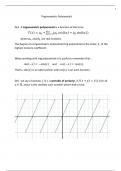
Ex. 𝑓 (𝑥 ) = cos(2𝑥) has a period of 𝜋.
𝑦 = cos(2𝑥)
−2𝜋 −𝜋 0 𝜋 2𝜋
Def. 𝐶 2𝜋 = {𝑐𝑜𝑛𝑡𝑖𝑛𝑢𝑜𝑢𝑠 𝑓𝑢𝑛𝑐𝑡𝑖𝑜𝑛𝑠 𝑜𝑛 ℝ 𝑠𝑢𝑐ℎ 𝑡ℎ𝑎𝑡 𝑓(𝑥 + 2𝜋) = 𝑓 (𝑥), 𝑥 ∈ ℝ}.
𝑓(𝑥 + 2𝜋 ) = 𝑓 (𝑥)
−2𝜋 −𝜋 𝜋 2𝜋
Notice that every trig polynomial belongs to 𝐶 2𝜋 .
𝐶 2𝜋 is a vector space and a metric subspace of 𝐶(ℝ), bounded continuous functions
on ℝ. 𝐶 2𝜋 is complete with respect to the metric given by
𝑑 (𝑓, 𝑔) = sup |𝑓(𝑥 ) − 𝑔(𝑥 )|.
𝑥∈ℝ
Trigonometric Polynomials
Def. A trigonometric polynomnial is a function of the form:
𝑇(𝑥 ) = 𝑎0 + ∑𝑛𝑘=1(𝑎𝑘 cos(𝑘𝑥 ) + 𝑏𝑘 sin(𝑘𝑥 ))
where 𝑎𝑘 and 𝑏𝑘 are real numbers.
The degree of a trigonometric polynomial (trig polynomial) is the order, 𝑘, of the
highest nonzero coefficient.
When working with trig polynomials it is useful to remember that :
sin(−𝑥) = −sin(𝑥) and 𝑐𝑜𝑠(−𝑥) = cos(𝑥).
That is, sin(𝑥) is an odd function and cos(𝑥) is an even function.
Def. we say a function, 𝑓(𝑥), is periodic of period 𝒑, if 𝑓(𝑥 + 𝑝) = 𝑓(𝑥) for all
𝑥 ∈ ℝ, and 𝑝 is the smallest such number where that is true.
, 2
Ex. 𝑓 (𝑥 ) = cos(2𝑥) has a period of 𝜋.
𝑦 = cos(2𝑥)
−2𝜋 −𝜋 0 𝜋 2𝜋
Def. 𝐶 2𝜋 = {𝑐𝑜𝑛𝑡𝑖𝑛𝑢𝑜𝑢𝑠 𝑓𝑢𝑛𝑐𝑡𝑖𝑜𝑛𝑠 𝑜𝑛 ℝ 𝑠𝑢𝑐ℎ 𝑡ℎ𝑎𝑡 𝑓(𝑥 + 2𝜋) = 𝑓 (𝑥), 𝑥 ∈ ℝ}.
𝑓(𝑥 + 2𝜋 ) = 𝑓 (𝑥)
−2𝜋 −𝜋 𝜋 2𝜋
Notice that every trig polynomial belongs to 𝐶 2𝜋 .
𝐶 2𝜋 is a vector space and a metric subspace of 𝐶(ℝ), bounded continuous functions
on ℝ. 𝐶 2𝜋 is complete with respect to the metric given by
𝑑 (𝑓, 𝑔) = sup |𝑓(𝑥 ) − 𝑔(𝑥 )|.
𝑥∈ℝ