1
Taylor Series
Starting with a function 𝑓(𝑥) which has infinitely many derivatives we can form a
Taylor Polynomial of degree 𝑛 about a point 𝑥 = 𝑎.
𝑓 ′′ (𝑎)
𝑇𝑛 (𝑥 ) = 𝑓(𝑎) + 𝑓 ′ (𝑎)(𝑥 − 𝑎) + (𝑥 − 𝑎)2
2!
𝑓 ′′′ (𝑎) 3 𝑓 𝑛 (𝑎)
+ (𝑥 − 𝑎) + ⋯ + (𝑥 − 𝑎)𝑛 .
3! 𝑛!
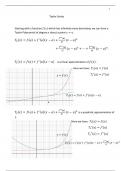
𝑇1 (𝑥 ) = 𝑓 (𝑎) + 𝑓 ′ (𝑎)(𝑥 − 𝑎) is a linear approximation of 𝑓(𝑥).
Here we have: 𝑇1 (𝑎) = 𝑓(𝑎)
𝑦 = 𝑓(𝑥) 𝑇1 ′(𝑎) = 𝑓′(𝑎)
𝑇1 (𝑥) = 𝑓(𝑎) + 𝑓′(𝑎)(𝑥 − 𝑎)
a
′( 𝑓 ′′ (𝑎)
𝑇2 (𝑥 ) = 𝑓 (𝑎) + 𝑓 𝑎)(𝑥 − 𝑎) + (𝑥 − 𝑎)2 is a quadratic approximation of
2!
𝑓.
Here we have: 𝑇2 (𝑎) = 𝑓(𝑎)
𝑇2 ′(𝑎) = 𝑓′(𝑎)
𝑦 = 𝑓(𝑥) 𝑇2 ′′(𝑎) = 𝑓′′(𝑎)
𝑓′′ (𝑎)
𝑇2 (𝑥) = 𝑓(𝑎) + 𝑓 ′ (𝑎)(𝑥 − 𝑎) + (𝑥 − 𝑎)2
2!
, 2
𝑇𝑛 (𝑥 ) is an approximation of the function 𝑓(𝑥) which has:
𝑇𝑛 (𝑎) = 𝑓(𝑎) , 𝑇𝑛 ′(𝑎) = 𝑓′(𝑎), 𝑇𝑛 ′′(𝑎) = 𝑓′′(𝑎), …, 𝑇𝑛 (𝑛) (𝑎) = 𝑓 (𝑛) (𝑎).
The question is, how “good” an approximation is 𝑇𝑛 (𝑥 ) of 𝑓(𝑥) when 𝑥 ≠ 𝑎?
Can we put some kind of bound on how large the error is?
Theorem (Taylor’s Formula); If 𝑓 has 𝑛 + 1 derivatives in an interval 𝐼 that
contains “a” , then for 𝑥𝜖𝐼 there is a number 𝑐, where 𝑐 is strictly between 𝑥 and
𝑎, such that
𝑓′′ (𝑎) 𝑓′′′ (𝑎)
𝑓 (𝑥 ) = 𝑓 (𝑎) + 𝑓 ′ (𝑎)(𝑥 − 𝑎) + (𝑥 − 𝑎 )2 + (𝑥 − 𝑎 )3 + ⋯
2! 3!
𝑓𝑛 (𝑎)
+ (𝑥 − 𝑎)𝑛 + 𝑅𝑛 (𝑥, 𝑎).
𝑛!
𝑓 (𝑛+1) (𝑐)
where the error after the 𝑛th degree term, 𝑅𝑛 (𝑥, 𝑎) = (𝑥 − 𝑎)𝑛+1 .
(𝑛+1)!
𝑦 = 𝑓(𝑥)
𝑅𝑛 (𝑥, 𝑎)
𝑦 = 𝑇𝑛 (𝑥)
𝑎 𝑥
, 3
Note 1: “𝑐” depends on 𝑥 and 𝑎.
Note 2: When 𝑛 = 0 we have:
𝑓(𝑥)−𝑓(𝑎)
𝑓(𝑥 ) = 𝑓(𝑎) + 𝑓 ′ (𝑐 )(𝑥 − 𝑎) or = 𝑓 ′ (𝑐);
𝑥−𝑎
with 𝑐 between 𝑥 and 𝑎, which is just the Mean Value Theorem.
Note 3: Taylor’s formula is important because it allows us to explicitly estimate
how big the error is.
Proof: We will create a function that satisfies the Mean Value Theorem and the
𝑓 (𝑛+1) (𝑐)
expression 𝑅𝑛 (𝑥, 𝑎) = (𝑥 − 𝑎)𝑛+1 , will follow from the M.V.T.
(𝑛+1)!
Let’s start by fixing 𝑥 and 𝑎, i.e. 𝑥 and 𝑎 are now constants where 𝑥 ≠ 𝑎.
We define a function 𝑔(𝑡) by:
′( 𝑓 ′′ (𝑡)
𝑔(𝑡) = 𝑓(𝑥 ) − [𝑓(𝑡) + 𝑓 𝑡)(𝑥 − 𝑡) + (𝑥 − 𝑡)2 + ⋯
2!
𝑓 𝑛 (𝑡) (𝑥−𝑡)𝑛+1
+ (𝑥 − 𝑡)𝑛 + 𝑅𝑛 (𝑥, 𝑎) ]
𝑛! (𝑥−𝑎)𝑛+1
Notice that:
𝑓 ′′ (𝑥)
𝑔(𝑥 ) = 𝑓(𝑥 ) − [𝑓(𝑥 ) + 𝑓 ′ (𝑥 )(𝑥 − 𝑥 ) + (𝑥 − 𝑥 )2 + ⋯ +
2!
𝑓 𝑛 (𝑥) (𝑥−𝑥)𝑛+1
(𝑥 − 𝑥 )𝑛 + 𝑅𝑛 (𝑥, 𝑎) ]=0
𝑛! (𝑥−𝑎)𝑛+1
𝑓 ′′ (𝑎)
𝑔(𝑎) = 𝑓(𝑥 ) − [𝑓(𝑎) + 𝑓 ′ (𝑎)(𝑥 − 𝑎) + (𝑥 − 𝑎)2 + ⋯ +
2!
𝑓 𝑛 (𝑎) (𝑥−𝑎)𝑛+1
(𝑥 − 𝑎)𝑛 + 𝑅𝑛 (𝑥, 𝑎) ]
𝑛! (𝑥−𝑎)𝑛+1
= 𝑓(𝑥 ) − 𝑓(𝑥 ) = 0.
Taylor Series
Starting with a function 𝑓(𝑥) which has infinitely many derivatives we can form a
Taylor Polynomial of degree 𝑛 about a point 𝑥 = 𝑎.
𝑓 ′′ (𝑎)
𝑇𝑛 (𝑥 ) = 𝑓(𝑎) + 𝑓 ′ (𝑎)(𝑥 − 𝑎) + (𝑥 − 𝑎)2
2!
𝑓 ′′′ (𝑎) 3 𝑓 𝑛 (𝑎)
+ (𝑥 − 𝑎) + ⋯ + (𝑥 − 𝑎)𝑛 .
3! 𝑛!
𝑇1 (𝑥 ) = 𝑓 (𝑎) + 𝑓 ′ (𝑎)(𝑥 − 𝑎) is a linear approximation of 𝑓(𝑥).
Here we have: 𝑇1 (𝑎) = 𝑓(𝑎)
𝑦 = 𝑓(𝑥) 𝑇1 ′(𝑎) = 𝑓′(𝑎)
𝑇1 (𝑥) = 𝑓(𝑎) + 𝑓′(𝑎)(𝑥 − 𝑎)
a
′( 𝑓 ′′ (𝑎)
𝑇2 (𝑥 ) = 𝑓 (𝑎) + 𝑓 𝑎)(𝑥 − 𝑎) + (𝑥 − 𝑎)2 is a quadratic approximation of
2!
𝑓.
Here we have: 𝑇2 (𝑎) = 𝑓(𝑎)
𝑇2 ′(𝑎) = 𝑓′(𝑎)
𝑦 = 𝑓(𝑥) 𝑇2 ′′(𝑎) = 𝑓′′(𝑎)
𝑓′′ (𝑎)
𝑇2 (𝑥) = 𝑓(𝑎) + 𝑓 ′ (𝑎)(𝑥 − 𝑎) + (𝑥 − 𝑎)2
2!
, 2
𝑇𝑛 (𝑥 ) is an approximation of the function 𝑓(𝑥) which has:
𝑇𝑛 (𝑎) = 𝑓(𝑎) , 𝑇𝑛 ′(𝑎) = 𝑓′(𝑎), 𝑇𝑛 ′′(𝑎) = 𝑓′′(𝑎), …, 𝑇𝑛 (𝑛) (𝑎) = 𝑓 (𝑛) (𝑎).
The question is, how “good” an approximation is 𝑇𝑛 (𝑥 ) of 𝑓(𝑥) when 𝑥 ≠ 𝑎?
Can we put some kind of bound on how large the error is?
Theorem (Taylor’s Formula); If 𝑓 has 𝑛 + 1 derivatives in an interval 𝐼 that
contains “a” , then for 𝑥𝜖𝐼 there is a number 𝑐, where 𝑐 is strictly between 𝑥 and
𝑎, such that
𝑓′′ (𝑎) 𝑓′′′ (𝑎)
𝑓 (𝑥 ) = 𝑓 (𝑎) + 𝑓 ′ (𝑎)(𝑥 − 𝑎) + (𝑥 − 𝑎 )2 + (𝑥 − 𝑎 )3 + ⋯
2! 3!
𝑓𝑛 (𝑎)
+ (𝑥 − 𝑎)𝑛 + 𝑅𝑛 (𝑥, 𝑎).
𝑛!
𝑓 (𝑛+1) (𝑐)
where the error after the 𝑛th degree term, 𝑅𝑛 (𝑥, 𝑎) = (𝑥 − 𝑎)𝑛+1 .
(𝑛+1)!
𝑦 = 𝑓(𝑥)
𝑅𝑛 (𝑥, 𝑎)
𝑦 = 𝑇𝑛 (𝑥)
𝑎 𝑥
, 3
Note 1: “𝑐” depends on 𝑥 and 𝑎.
Note 2: When 𝑛 = 0 we have:
𝑓(𝑥)−𝑓(𝑎)
𝑓(𝑥 ) = 𝑓(𝑎) + 𝑓 ′ (𝑐 )(𝑥 − 𝑎) or = 𝑓 ′ (𝑐);
𝑥−𝑎
with 𝑐 between 𝑥 and 𝑎, which is just the Mean Value Theorem.
Note 3: Taylor’s formula is important because it allows us to explicitly estimate
how big the error is.
Proof: We will create a function that satisfies the Mean Value Theorem and the
𝑓 (𝑛+1) (𝑐)
expression 𝑅𝑛 (𝑥, 𝑎) = (𝑥 − 𝑎)𝑛+1 , will follow from the M.V.T.
(𝑛+1)!
Let’s start by fixing 𝑥 and 𝑎, i.e. 𝑥 and 𝑎 are now constants where 𝑥 ≠ 𝑎.
We define a function 𝑔(𝑡) by:
′( 𝑓 ′′ (𝑡)
𝑔(𝑡) = 𝑓(𝑥 ) − [𝑓(𝑡) + 𝑓 𝑡)(𝑥 − 𝑡) + (𝑥 − 𝑡)2 + ⋯
2!
𝑓 𝑛 (𝑡) (𝑥−𝑡)𝑛+1
+ (𝑥 − 𝑡)𝑛 + 𝑅𝑛 (𝑥, 𝑎) ]
𝑛! (𝑥−𝑎)𝑛+1
Notice that:
𝑓 ′′ (𝑥)
𝑔(𝑥 ) = 𝑓(𝑥 ) − [𝑓(𝑥 ) + 𝑓 ′ (𝑥 )(𝑥 − 𝑥 ) + (𝑥 − 𝑥 )2 + ⋯ +
2!
𝑓 𝑛 (𝑥) (𝑥−𝑥)𝑛+1
(𝑥 − 𝑥 )𝑛 + 𝑅𝑛 (𝑥, 𝑎) ]=0
𝑛! (𝑥−𝑎)𝑛+1
𝑓 ′′ (𝑎)
𝑔(𝑎) = 𝑓(𝑥 ) − [𝑓(𝑎) + 𝑓 ′ (𝑎)(𝑥 − 𝑎) + (𝑥 − 𝑎)2 + ⋯ +
2!
𝑓 𝑛 (𝑎) (𝑥−𝑎)𝑛+1
(𝑥 − 𝑎)𝑛 + 𝑅𝑛 (𝑥, 𝑎) ]
𝑛! (𝑥−𝑎)𝑛+1
= 𝑓(𝑥 ) − 𝑓(𝑥 ) = 0.