100% satisfaction guarantee Immediately available after payment Both online and in PDF No strings attached 4.2 TrustPilot
logo-home
Exam (elaborations)

Biblical Tradition- Test #2

Rating
-
Sold
-
Pages
9
Grade
A+
Uploaded on
01-01-2025
Written in
2024/2025

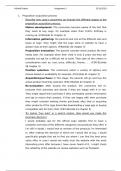
Biblical Tradition- Test #2 Murphy on "Gospel Texts" (CP 70-107) **************** Why study the Gospels historically? -take in consideration the historical context at the time in which the gospels were written. The Gospels were written a long time ago, -Gospels are foreign literature -Meaning= contextual Why does a NT reader/interpreter need to know "the biblical story", i.e., the OT? -Everything in the NT draws on the biblical story in the OT -You need to know the OT to understand the NT -Jesus uses references from the OT to tell stories in the NT Overall, what was the experience of first c. Jews under Roman imperial rule? -Oppressive -Empire were heavily militaristic -Had to pay taxes by giving of flocks, crops, money. However these taxes weren't collected for the good of everybody- everything went to the emperor -Taxes for the temple ->Slaughtering of animals -Crucification- brutal, public death -Led to resentment of the Roman Empire Historically, what was Pontius Pilate like? Historically Pilate was very brutal. So much so that he was eventually removed and exiled. (This is interesting as in the gospels he seems to be portrayed as a "good" guy, who didn't really want to crucify Jesus) Because the Gospels look like history, Christians tend to assume they are historically accurate and to read them as though they are. Why is this a dangerous assumption and procedure? -This is a dangerous process because these are texts that have influenced relations between Jews and Christians over centuries and continue to do so. Their purpose is to support Christians in their belief that Jesus is the Jewish Messiah, whom the majority of Jews did not accept. The gospels tend to blame Jewish unbelief on their leadership. One cannot expect to a balanced, fair view of Jesus's fellow Jews from these writings. Although Judaism in the first c. was diverse, all Jews shared some basic beliefs. Identify those shared beliefs. -monotheistic -Descendants of Abraham -Importance of the Torah, Temple, & Land -Election --> God chose them to be His people Define "cult." What was required of a Jew in order to participate in the temple cult? -cult= any people's system of worship -Jewish cult --> worship in the Temple -What was required? - A certain level of ritual purity (laws of clean & unclean, or pure & unpure) What is "purity'"? Why was deliberate transgression of purity rules considered serious? -Purity= worthiness to worship the Holy God (inpurity does not equal sin) -Deliberate transgression of purity rules was considered serious due to fear that inpurity could spread & danger the entire community What is the meaning of circumcision as practiced by Jews? - It was a sign of the covenant. (The Jews were God's chosen people) In first c. Judaism, what is the difference between temple and synagogue? -Temple= one temple, the place where God's glory dwelt, animal sacrifices occurred here, run by the priests (the temple was very important to the Jews bc it was a symbol of their identity) -Synagogue= many synagogues, places of teaching of the Torah, Prayer services, run by the Pharises What is the Sanhedrin? - The greek word synedrion means "council" -The Sanhedrin or Council in the Gospels is the aristocratic council of Jerusalem What is apocalypticism? an apocalypse? What is the central conviction of apocalyptic thought? -Apocalypticism= a worldview prominent in Jewish Palestine in the latter centuries before the Common Era and in the first few centuries if the Common Era. --> This is the worldview that is found in apocalypses -Apocalypses= revolutionary literature in which a superhuman figure, often an angel, imparts a vision or spoken revelation to a human, often referred to as a seer, since he or she often sees visions. - Central to this form of apocalypticism is the conviction that the world is not as it should be. What was the function of priests? How did one become a priest? -Function= carry out all practices in the temple; leaders of the temple; offer up sacrifices -Became a priest by hereditary line (who you descended from) Who were the Sadducees? What did they believe (or not believe)? -Sadducees= wealthy, powerful, elite priests -They did not believe in the afterlife/ resurrection of the body -Accepted only the written Torah Who were the Pharisees? What were some of their beliefs? Why are they portrayed in the NT as villians? -Pharisees= Scholars of the Torah, modern day Rabbis -Accepted the written law and oral law -Believed in Resurrection -In the Gospels, the Pharisees are portrayed as enemies of Jesus What is a scribe? an elder? -Scribes= read and wrote for a living -Elders= leaders of the Jewish community; generally the eldest males What are some of the Christian misconceptions about messiahship in the time of Jesus? 1) If Jesus clearly was the Messiah, then a reasonable explanation that the past and present Jews would refuse to believe in him would be that they oppose God and God's plans for the world and for themselves. And that is precisely what many Christians down through the ages have concluded, beginning with the NT writers themselves 2) Christians often assume that the Jews as a whole has a single concept of messiah, which Jesus fit, and that despite the obviousness of his messiahship, the Jews deliberately opted to reject him 3) It comes from Christian faith, which constructs a picture of what Messiah means based on Christian conceptions of Jesus, then assumes that this constructed figure is in fact what Jews expected. What did "Son of God" mean in ancient Judaism? -In the OT, "Son of God" is used for a variety of human beings 1) People of Israel 2)Kings were considered Sons of Gods 3)A right & just person (DOES NOT REFER TO THE TRINITY/DIVINITY OF JESUS) What did "Son of Man" mean in ancient Judaism? Use of the term "Son of Man" in the Gospels is influenced by its meaning in which OT book? - "Son of Man" is used to refer to a human being or to suggest a heavenly being -The gospels are influenced by Daniel 7 How do modern Western societies and ancient people (Jews, Greeks, Romans) differ regarding religion and politics? individualism? economics? 1)Religion and Politics -Modern societies draw a line between politics and religion, between economics and religion, and between kinship and religion. -Separation of church and state is a mantra in American politics -Jews, Greeks, and Romans all found a place for the divine in public life. Divine beings took an active interest in politics. -We see "religious" figures such as priests and scribes involved in politics or economics 2) Individualism - Modern Westerns tend to think in individualistic terms, while the ancients and many societies in other parts of the world today think groups 3) Economics - Another source of misconception is economics. We assume much about how the economy works , and we tend to transfer those assumptions to the ancient world. However the ancient society consisted of three strata: 1) a very small ruling class, 2) a class that existed to serve the ruling class in positions such as stewards, soldiers, and priests, and some artisans, and 3) those who worked the land (peasants) comprising as much as 85 to 90 percent of the population. Hoppe on "The Economy of Ancient Israel" and "The Economy of Roman Palestine" (CP 112-117) **************** Describe the circumstances of Israel's agriculture-based economy. -Each family had plot of land to raise crops and livestock (sheep or goats) -Economy vulnerable to weather -Topography of plot of land determines success -Subsistence farmers--> no surpluses (low yield) -Reliable on rain- not near a river -Injury and sickness affect productivity How did the Canaanite city-state system contribute to poverty among the populace? - The governments of the Canaanite city-states supported themselves by taxing the peasants. These taxes took the form of payment in kind and conscripted labor. -Forced to work on projects for the state or severe in the military, they could not work on their own land -Requiring peasants to hand over a portion of their harvest was a huge burden bc they were subsistence farmers - They became debtors --> some had to sell their children into slavery and sell their land to satisfy their creditors How did the Israelite understanding of their God differ from that of the Canaanites? -The gods of Canaan sustained the political, social, and economic status quo, while the God of ancient Israel took the side of the peasants against the rulers who oppressed them What was the Israelite understanding of the land? -Saw land as a gift from God -Perpetual inheritance in the family (passed down for generations) -See their land as a blessing How did early Israelite society protect its land in the absence of a centralized government (state structure) such as a monarchy or imperial power? What was their God's role in this? -Defended land by calling on other tribes for help to fight off the enemy -God was behind the success Describe the external & internal pressures that led to the establishment of a monarchy in ancient Israel -External= Threat of the Philistines --> believed standing army was necessary; Philistines had iron weapons (superior weaponry) -Internal= Some prosperous families thought having a king would benefit them and allow them to get richer How did the establishment of the monarchy change the average person's relationship with the land? - The land was no longer seen as God's gift to Israel but as the king's possession. The peasants were able to live on the land as long as they were able to pay their taxes. "Poverty was a deliberate creation of the people of means." Explain the basis of this conclusion. -The estates of the wealthy devoted much of their land to the cultivation of grapes and olives. Wine and olive oil were export crops that brought a good price. With less land devoted to the production of cereals, grain prices rose. (*Grains were the staple in peasants diet) This put added pressure on those without land, driving them deeper into debt, which helped create a permanent debtor class in Israel What did the ideology of the monarchy claim? (ideology= a set of ideas that explains and "justifies"/legitimates a group's perspectives and privileges) Why was the ideal not achieved? -The ideology of the monarchy in the ancient Near East presented the king as the protector of the poor and promoter of justice. -Of course, the realities of maintaining a monarchy made attaining this ideal impossible since the economic support needed to support the monarchy is precisely what engendered social inequalities that created poverty. Beginning in the 8th c. BCE, Israel/Judah fell under the rule of successive empires: Assyria, Egypt, and Babylon, culminating with the Babylonian exile. What was the overall impact of these political realities on the economic life of the masses of Israelite peasants? - The peasants of Judah had to bear the economic burdens of vassalage. -They supplied the goods and the labor that were required to pay the indemnity owed to the empires by the Judahite state. -The peasants had to support two monarchies. -The result was the even more were driven into the permanent underclass that the Bible terms "poor" and the "oppressed." -The increased levels of taxation naturally led to increased levels of indebtedness.

Show more Read less
Institution
CPHON
Course
CPHON


Whoops! We can’t load your doc right now. Try again or contact support.

Written for

Institution
CPHON
Course
CPHON

Document information

Uploaded on
January 1, 2025
Number of pages
9
Written in
2024/2025
Type
Exam (elaborations)
Contains
Questions & answers

Subjects

Content preview

Biblical Tradition- Test #2
Murphy on "Gospel Texts" (CP 70-107) - answer ****************

Why study the Gospels historically? - answer -take in consideration the historical
context at the time in which the gospels were written. The Gospels were written a long
time ago,
-Gospels are foreign literature
-Meaning= contextual

Why does a NT reader/interpreter need to know "the biblical story", i.e., the OT? -
answer -Everything in the NT draws on the biblical story in the OT
-You need to know the OT to understand the NT
-Jesus uses references from the OT to tell stories in the NT

Overall, what was the experience of first c. Jews under Roman imperial rule? - answer
-Oppressive
-Empire were heavily militaristic
-Had to pay taxes by giving of flocks, crops, money. However these taxes weren't
collected for the good of everybody- everything went to the emperor
-Taxes for the temple ->Slaughtering of animals
-Crucification- brutal, public death
-Led to resentment of the Roman Empire

Historically, what was Pontius Pilate like? - answer Historically Pilate was very brutal.
So much so that he was eventually removed and exiled. (This is interesting as in the
gospels he seems to be portrayed as a "good" guy, who didn't really want to crucify
Jesus)

Because the Gospels look like history, Christians tend to assume they are historically
accurate and to read them as though they are. Why is this a dangerous assumption and
procedure? - answer -This is a dangerous process because these are texts that have
influenced relations between Jews and Christians over centuries and continue to do so.
Their purpose is to support Christians in their belief that Jesus is the Jewish Messiah,
whom the majority of Jews did not accept. The gospels tend to blame Jewish unbelief
on their leadership. One cannot expect to a balanced, fair view of Jesus's fellow Jews
from these writings.

Although Judaism in the first c. was diverse, all Jews shared some basic beliefs. Identify
those shared beliefs. - answer -monotheistic
-Descendants of Abraham
-Importance of the Torah, Temple, & Land
-Election --> God chose them to be His people

, Define "cult." What was required of a Jew in order to participate in the temple cult? -
answer -cult= any people's system of worship
-Jewish cult --> worship in the Temple
-What was required? - A certain level of ritual purity (laws of clean & unclean, or pure &
unpure)

What is "purity'"? Why was deliberate transgression of purity rules considered serious? -
answer -Purity= worthiness to worship the Holy God (inpurity does not equal sin)
-Deliberate transgression of purity rules was considered serious due to fear that inpurity
could spread & danger the entire community

What is the meaning of circumcision as practiced by Jews? - answer - It was a sign
of the covenant. (The Jews were God's chosen people)

In first c. Judaism, what is the difference between temple and synagogue? - answer -
Temple= one temple, the place where God's glory dwelt, animal sacrifices occurred
here, run by the priests (the temple was very important to the Jews bc it was a symbol
of their identity)

-Synagogue= many synagogues, places of teaching of the Torah, Prayer services, run
by the Pharises

What is the Sanhedrin? - answer - The greek word synedrion means "council"
-The Sanhedrin or Council in the Gospels is the aristocratic council of Jerusalem

What is apocalypticism? an apocalypse? What is the central conviction of apocalyptic
thought? - answer -Apocalypticism= a worldview prominent in Jewish Palestine in the
latter centuries before the Common Era and in the first few centuries if the Common
Era.
--> This is the worldview that is found in apocalypses

-Apocalypses= revolutionary literature in which a superhuman figure, often an angel,
imparts a vision or spoken revelation to a human, often referred to as a seer, since he
or she often sees visions.

- Central to this form of apocalypticism is the conviction that the world is not as it should
be.

What was the function of priests? How did one become a priest? - answer -
Function= carry out all practices in the temple; leaders of the temple; offer up sacrifices
-Became a priest by hereditary line (who you descended from)

Who were the Sadducees? What did they believe (or not believe)? - answer -
Sadducees= wealthy, powerful, elite priests

-They did not believe in the afterlife/ resurrection of the body
Get to know the seller

Seller avatar
Reputation scores are based on the amount of documents a seller has sold for a fee and the reviews they have received for those documents. There are three levels: Bronze, Silver and Gold. The better the reputation, the more your can rely on the quality of the sellers work.
Pogba119 Harvard University
View profile
Follow You need to be logged in order to follow users or courses
Sold
48
Member since
1 year
Number of followers
2
Documents
4862
Last sold
3 weeks ago
NURSING TEST

BEST EDUCATIONAL RESOURCES FOR STUDENTS

3.9

9 reviews

5
4
4
2
3
2
2
0
1
1

Recently viewed by you

Why students choose Stuvia

Created by fellow students, verified by reviews

Quality you can trust: written by students who passed their tests and reviewed by others who've used these notes.

Didn't get what you expected? Choose another document

No worries! You can instantly pick a different document that better fits what you're looking for.

Pay as you like, start learning right away

No subscription, no commitments. Pay the way you're used to via credit card and download your PDF document instantly.

Student with book image

“Bought, downloaded, and aced it. It really can be that simple.”

Alisha Student

Frequently asked questions