Lady Macbeth
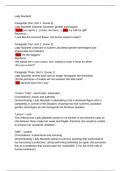
Paragraph One: (Act 1, Scene 5)
Lady Macbeth subverts Jacobean gender stereotypes.
“Come you spirits [...] unsex me here [...] take my milk for gall”
Reinforce:
“Look like the innocent flower, but be the serpent under’t”
Paragraph Two: (Act 2, Scene 2)
Lady Macbeth continues to subvert Jacobean gender stereotypes and
emasculate her husband.
“Give me the daggers”
Reinforce:
“My hands are o your colour, but I shame to wear a heart so white”
“Are you a man?”
Paragraph Three: (Act 5, Scene 1)
Lady Macbeth reverts back and no longer disregards her femininity.
“All the perfumes of Arabia will not sweeten this little hand”
“Out damned spot! Out I say”
“Come / Take” - word class: imperative
Connotations: power and authority
Demonstrating: Lady Macbeth is attempting to be a dominant figure who is
completely in control of the situation; showing how she subverts Jacobean
gender stereotypes as she disregards her feminine qualities.
“Unsex” - verb
This reflects how Lady Macbeth wishes to rid herself of any feminine traits as
she believes these make her weak and fragile; therefore she would be unable
to achieve her unnatural “ambition”.
“Milk” - symbol
Connotations: motherhood and nurturing
Demonstrating: Lady Macbeth wishes to remove anything that would lead to
her becoming a protective, caring and loving individual as again she perceives
this as a weakness that would make her vulnerable. (“Too full of the milk of
human kindness”).
Paragraph One: (Act 1, Scene 5)
Lady Macbeth subverts Jacobean gender stereotypes.
“Come you spirits [...] unsex me here [...] take my milk for gall”
Reinforce:
“Look like the innocent flower, but be the serpent under’t”
Paragraph Two: (Act 2, Scene 2)
Lady Macbeth continues to subvert Jacobean gender stereotypes and
emasculate her husband.
“Give me the daggers”
Reinforce:
“My hands are o your colour, but I shame to wear a heart so white”
“Are you a man?”
Paragraph Three: (Act 5, Scene 1)
Lady Macbeth reverts back and no longer disregards her femininity.
“All the perfumes of Arabia will not sweeten this little hand”
“Out damned spot! Out I say”
“Come / Take” - word class: imperative
Connotations: power and authority
Demonstrating: Lady Macbeth is attempting to be a dominant figure who is
completely in control of the situation; showing how she subverts Jacobean
gender stereotypes as she disregards her feminine qualities.
“Unsex” - verb
This reflects how Lady Macbeth wishes to rid herself of any feminine traits as
she believes these make her weak and fragile; therefore she would be unable
to achieve her unnatural “ambition”.
“Milk” - symbol
Connotations: motherhood and nurturing
Demonstrating: Lady Macbeth wishes to remove anything that would lead to
her becoming a protective, caring and loving individual as again she perceives
this as a weakness that would make her vulnerable. (“Too full of the milk of
human kindness”).