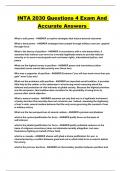
INTA 2030 Questions 4 Exam And
Accurate Answers
What is soft power - ANSWER co-optive strategies that induce desired outcomes
What is hard power - ANSWER strategies that compel through military coercion. applied
through force
What is the theory of pacifism - ANSWER in accordance with a rule-based ethic, it
assumes that violence can never be a morally legitimate means to provide national
security or to secure moral goods such as human rights, international justice, and
peace
What are the highest norms in pacifism - ANSWER peace and nonviolence (other
important norms cannot take priority over these two)
Who was a supporter of pacifism - ANSWER Erasmus ("you will lose much more than you
gain" even if you win)
What are the problems with pacifism - ANSWER an important moral tradition, it provides
little help to the soldier or the statesman in structuring moral reasoning about the
defense and protection of vital interests in global society. Because the highest priorities
are life and peace, this tradition does not allow for the possibility of using force to
pursue other moral objective
What is amoral realism - ANSWER assumes not only that war is a legitimate instrument
of policy but also that morality does not constrain war. Indeed, assuming the legitimacy
of war's ends, amoral realism believes that the only norm governing the conduct of war
is military victory
What are the two perspectives of amoral realism - ANSWER cynicism and jihadism
what is the cynical justification for force - ANSWER justify force on the basis of
self-interest,
what is the jihadist justification for force - ANSWER justify unlimited violence on the
basis of religious convictions (does not eliminate morality altogether, but sees
themselves fighting on behalf of their God)
what is a crusade - ANSWER shares with jihad a divine justification for war, is
characterized by a conflict between good and evil in which total force is used to defeat
the enemy
what is the just war doctrine - ANSWER an intermediary position between pacifism and
, amoral realism. It assumes that all interstate relations, including war, are subject to
widely acknowledged moral standards. Because power and force are fundamental
realities of the international community, the quest for peace and justice among states
can be only imperfectly realized, and then only when power and force are incorporated
into the calculus of decision making.
How does just war approach violence - ANSWER violence is regarded as evil, it is not
necessarily the greatest evil. As a result, some moral values—such as the protection of
the innocent, the recovery of something wrongfully taken, the punishment of criminal
behavior, and the defense against aggression—may justify the use of force.
What is just cause - ANSWER The only legitimate justification for war is to deter
aggression, to defend against unjust attack, or to right a grievous wrong. Although the
theory does not specify what constitutes a just global order, the effort to alter territorial
boundaries by force or to extend political and economic control in foreign lands is
considered unjust. Aggression is immoral and gives rise to a just cause to resist by
force
what is competent authority - ANSWER The use of force is morally permissible only
when it is legitimate, that is, authorized by governmen
what is right intention - ANSWER A war is just only if its goals are limited. An
unconditional, unlimited war of attrition is morally unacceptable. Not only must the
purposes of war be limited but the goals and means must be proportionate to the ends
being pursued.
What is last resort - ANSWER Before a state can legitimately resort to war, it must
exhaust all peaceful means. War can be morally legitimate only when a state has made
every effort through measures short of war (e.g., diplomacy, multilateral negotiations,
and sanctions) to seek to redress the evil
what is reasonable hope of success - ANSWER The use of force against an aggressor
must have a reasonable chance of success. Good intentions are not sufficient. A war
that is unlikely to achieve its limited goals is immoral.
What is discrimination - ANSWER Military force must be applied only against the political
leadership and military forces of the state. Every
effort must be made to discriminate between combatants and noncombatants, soldiers
and civilians, to minimize civilian
casualties.
what is proportionality - ANSWER The destruction inflicted by military forces in war
must be proportional to the goals they are seeking to realize. An indiscriminate war of
attrition that seeks to eliminate the enemy society altogether is not morally justified. The
goal should be to use the minimum level of violence to achieve the limited aims of a war.
what is restoration of a just order - ANSWER Once war is over, the victor must restore
Accurate Answers
What is soft power - ANSWER co-optive strategies that induce desired outcomes
What is hard power - ANSWER strategies that compel through military coercion. applied
through force
What is the theory of pacifism - ANSWER in accordance with a rule-based ethic, it
assumes that violence can never be a morally legitimate means to provide national
security or to secure moral goods such as human rights, international justice, and
peace
What are the highest norms in pacifism - ANSWER peace and nonviolence (other
important norms cannot take priority over these two)
Who was a supporter of pacifism - ANSWER Erasmus ("you will lose much more than you
gain" even if you win)
What are the problems with pacifism - ANSWER an important moral tradition, it provides
little help to the soldier or the statesman in structuring moral reasoning about the
defense and protection of vital interests in global society. Because the highest priorities
are life and peace, this tradition does not allow for the possibility of using force to
pursue other moral objective
What is amoral realism - ANSWER assumes not only that war is a legitimate instrument
of policy but also that morality does not constrain war. Indeed, assuming the legitimacy
of war's ends, amoral realism believes that the only norm governing the conduct of war
is military victory
What are the two perspectives of amoral realism - ANSWER cynicism and jihadism
what is the cynical justification for force - ANSWER justify force on the basis of
self-interest,
what is the jihadist justification for force - ANSWER justify unlimited violence on the
basis of religious convictions (does not eliminate morality altogether, but sees
themselves fighting on behalf of their God)
what is a crusade - ANSWER shares with jihad a divine justification for war, is
characterized by a conflict between good and evil in which total force is used to defeat
the enemy
what is the just war doctrine - ANSWER an intermediary position between pacifism and
, amoral realism. It assumes that all interstate relations, including war, are subject to
widely acknowledged moral standards. Because power and force are fundamental
realities of the international community, the quest for peace and justice among states
can be only imperfectly realized, and then only when power and force are incorporated
into the calculus of decision making.
How does just war approach violence - ANSWER violence is regarded as evil, it is not
necessarily the greatest evil. As a result, some moral values—such as the protection of
the innocent, the recovery of something wrongfully taken, the punishment of criminal
behavior, and the defense against aggression—may justify the use of force.
What is just cause - ANSWER The only legitimate justification for war is to deter
aggression, to defend against unjust attack, or to right a grievous wrong. Although the
theory does not specify what constitutes a just global order, the effort to alter territorial
boundaries by force or to extend political and economic control in foreign lands is
considered unjust. Aggression is immoral and gives rise to a just cause to resist by
force
what is competent authority - ANSWER The use of force is morally permissible only
when it is legitimate, that is, authorized by governmen
what is right intention - ANSWER A war is just only if its goals are limited. An
unconditional, unlimited war of attrition is morally unacceptable. Not only must the
purposes of war be limited but the goals and means must be proportionate to the ends
being pursued.
What is last resort - ANSWER Before a state can legitimately resort to war, it must
exhaust all peaceful means. War can be morally legitimate only when a state has made
every effort through measures short of war (e.g., diplomacy, multilateral negotiations,
and sanctions) to seek to redress the evil
what is reasonable hope of success - ANSWER The use of force against an aggressor
must have a reasonable chance of success. Good intentions are not sufficient. A war
that is unlikely to achieve its limited goals is immoral.
What is discrimination - ANSWER Military force must be applied only against the political
leadership and military forces of the state. Every
effort must be made to discriminate between combatants and noncombatants, soldiers
and civilians, to minimize civilian
casualties.
what is proportionality - ANSWER The destruction inflicted by military forces in war
must be proportional to the goals they are seeking to realize. An indiscriminate war of
attrition that seeks to eliminate the enemy society altogether is not morally justified. The
goal should be to use the minimum level of violence to achieve the limited aims of a war.
what is restoration of a just order - ANSWER Once war is over, the victor must restore