1
Partial Derivatives
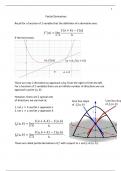
Recall for a function of 1 variable that the definition of a derivative was:
𝑓 (𝑎 + ℎ) − 𝑓(𝑎)
𝑓 ′ (𝑎) = lim
ℎ→0 ℎ
If the limit exists.
(𝑎, 𝑓(𝑎)) (𝑎 + ℎ, 𝑓(𝑎 + ℎ))
𝑎 𝑎+ℎ
There are only 2 directions to approach 𝑎 by, from the right or from the left.
For a function of 2 variables there are an infinite number of directions we can
approach a point (𝑎, 𝑏).
However, there are 2 special sets
of directions we can look at: Line has slope Line has slop
of 𝑓𝑥 (𝑎, 𝑏) of 𝑓𝑦 (𝑎, 𝑏)
1. Let 𝑦 = 𝑏 and let 𝑥 approach 𝑎
2. Let 𝑥 = 𝑎 and let 𝑦 approach 𝑏.
𝑓(𝑎 + ℎ, 𝑏) − 𝑓(𝑎, 𝑏) 𝑥
𝑓𝑥 (𝑎, 𝑏) = lim 𝑦
ℎ→0 ℎ
𝑓(𝑎, 𝑏 + ℎ) − 𝑓(𝑎, 𝑏)
𝑓𝑦 (𝑎, 𝑏) = lim .
ℎ→0 ℎ
These are called partial derivatives of 𝑓 with respect to 𝑥 and 𝑦 at (𝑎, 𝑏).
, 2
Def. If 𝑓 is a function of 2 variables, then the partial derivatives, 𝒇𝒙 and 𝒇𝒚 , are:
𝒇(𝒙 + 𝒉, 𝒚) − 𝒇(𝒙, 𝒚)
𝒇𝒙 (𝒙, 𝒚) = 𝐥𝐢𝐦
𝒉→𝟎 𝒉
𝒇(𝒙, 𝒚 + 𝒉) − 𝒇(𝒙, 𝒚)
𝒇𝒚 (𝒙, 𝒚) = 𝐥𝐢𝐦
𝒉→𝟎 𝒉
if the limits exist.
Just like 𝑓 ′ (𝑥) gives you the rate of change of the value of a function 𝑦 = 𝑓(𝑥),
𝑓𝑥 (𝑥, 𝑦) gives the rate of change of the value of 𝑓(𝑥, 𝑦) in the 𝑥 direction (holding 𝑦
constant) and 𝑓𝑦 (𝑥, 𝑦) gives the rate of change of the value of 𝑓(𝑥, 𝑦) in the 𝑦
direction (holding 𝑥 constant). So if 𝑓𝑥 (1, −2) > 0 ⇒ if you increase 𝑥 a little from
𝑥 = 1, 𝑦 = −2, then the value of 𝑧 increases.
Ex. In the example below, if you are at 𝑃(𝑎, 𝑏, 𝑓(𝑎, 𝑏)), and you increase 𝑥 and
hold 𝑦 constant, then the value of 𝑓(𝑥, 𝑏) decreases. If you increase 𝑦 and hold 𝑥
constant, then the value of 𝑓(𝑎, 𝑦) increases.
𝑃 𝑦
𝑥
Partial Derivatives
Recall for a function of 1 variable that the definition of a derivative was:
𝑓 (𝑎 + ℎ) − 𝑓(𝑎)
𝑓 ′ (𝑎) = lim
ℎ→0 ℎ
If the limit exists.
(𝑎, 𝑓(𝑎)) (𝑎 + ℎ, 𝑓(𝑎 + ℎ))
𝑎 𝑎+ℎ
There are only 2 directions to approach 𝑎 by, from the right or from the left.
For a function of 2 variables there are an infinite number of directions we can
approach a point (𝑎, 𝑏).
However, there are 2 special sets
of directions we can look at: Line has slope Line has slop
of 𝑓𝑥 (𝑎, 𝑏) of 𝑓𝑦 (𝑎, 𝑏)
1. Let 𝑦 = 𝑏 and let 𝑥 approach 𝑎
2. Let 𝑥 = 𝑎 and let 𝑦 approach 𝑏.
𝑓(𝑎 + ℎ, 𝑏) − 𝑓(𝑎, 𝑏) 𝑥
𝑓𝑥 (𝑎, 𝑏) = lim 𝑦
ℎ→0 ℎ
𝑓(𝑎, 𝑏 + ℎ) − 𝑓(𝑎, 𝑏)
𝑓𝑦 (𝑎, 𝑏) = lim .
ℎ→0 ℎ
These are called partial derivatives of 𝑓 with respect to 𝑥 and 𝑦 at (𝑎, 𝑏).
, 2
Def. If 𝑓 is a function of 2 variables, then the partial derivatives, 𝒇𝒙 and 𝒇𝒚 , are:
𝒇(𝒙 + 𝒉, 𝒚) − 𝒇(𝒙, 𝒚)
𝒇𝒙 (𝒙, 𝒚) = 𝐥𝐢𝐦
𝒉→𝟎 𝒉
𝒇(𝒙, 𝒚 + 𝒉) − 𝒇(𝒙, 𝒚)
𝒇𝒚 (𝒙, 𝒚) = 𝐥𝐢𝐦
𝒉→𝟎 𝒉
if the limits exist.
Just like 𝑓 ′ (𝑥) gives you the rate of change of the value of a function 𝑦 = 𝑓(𝑥),
𝑓𝑥 (𝑥, 𝑦) gives the rate of change of the value of 𝑓(𝑥, 𝑦) in the 𝑥 direction (holding 𝑦
constant) and 𝑓𝑦 (𝑥, 𝑦) gives the rate of change of the value of 𝑓(𝑥, 𝑦) in the 𝑦
direction (holding 𝑥 constant). So if 𝑓𝑥 (1, −2) > 0 ⇒ if you increase 𝑥 a little from
𝑥 = 1, 𝑦 = −2, then the value of 𝑧 increases.
Ex. In the example below, if you are at 𝑃(𝑎, 𝑏, 𝑓(𝑎, 𝑏)), and you increase 𝑥 and
hold 𝑦 constant, then the value of 𝑓(𝑥, 𝑏) decreases. If you increase 𝑦 and hold 𝑥
constant, then the value of 𝑓(𝑎, 𝑦) increases.
𝑃 𝑦
𝑥