1
Lagrange Multipliers
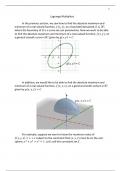
In the previous section, we saw how to find the absolute maximum and
minimum of a real-valued function, 𝑓(𝑥, 𝑦), on a bounded domained, 𝐷 ⊆ ℝ2 ,
where the boundary of 𝐷 is a curve we can parametrize. Now we want to be able
to find the absolute maximum and minimum of a real-valued function, 𝑓(𝑥, 𝑦), on
a general smooth curve in ℝ2 given by 𝑔(𝑥, 𝑦) = 𝐶.
𝑔(𝑥, 𝑦) = 𝐶
In addition, we would like to be able to find the absolute maximum and
minimum of a real-valued function, 𝑓(𝑥, 𝑦, 𝑧), on a general smooth surface in ℝ3
given by 𝑔(𝑥, 𝑦, 𝑧) = 𝐶.
𝑔(𝑥, 𝑦, 𝑧) = 𝐶
For example, suppose we want to know the maximum value of
𝑓(𝑥, 𝑦, 𝑧) = 𝑥 + 𝑧 subject to the constraint that (𝑥, 𝑦, 𝑧) must lie on the unit
sphere, 𝑥 2 + 𝑦 2 + 𝑧 2 = 1. Let’s call this constraint set 𝑆.
, 2
Notice that even for functions of 1 variable, a continuous function need not
have a maximum or minimum value. For example, 𝑓(𝑥) = 𝑥 doesn’t have a
maximum or minimum value if 𝑥 ∈ ℝ or if 0 < 𝑥 < 1. However, if the constraint
set 𝑆 is closed and bounded, and 𝑓 is a continuous function, then 𝑓 does have a
maximum and a minimum value on 𝑆.
We know for a real-valued function, 𝑓: ℝ3 → ℝ, we search for relative
maxima and minima at points where ∇𝑓(𝑥0 , 𝑦0 , 𝑧0 ) = 0, where (𝑥0 , 𝑦0 , 𝑧0 ) ∈ ℝ3 .
These are critical points. Now, we want to find maxima and minima for 𝑓(𝑥, 𝑦, 𝑧)
when its domain is restricted to a level surface, 𝑆, in ℝ3 given by 𝑔(𝑥, 𝑦, 𝑧) = 𝐶.
Theorem (The Method of Lagrange Multipliers):
Suppose 𝑓: 𝑈 ⊆ ℝ𝑛 → ℝ and 𝑔: ℝ𝑛 → ℝ, where 𝑛 = 2 or 3 are
continuously differentiable functions. Let 𝑆 be the level surface (or curve) given
by 𝑔(𝑥, 𝑦, 𝑧) = 𝐶. Assume ∇𝑔(𝑥, 𝑦, 𝑧) ≠ ⃗0. If 𝑓 restricted to 𝑆 has a local
maximum or minimum at (𝑥0 , 𝑦0 , 𝑧0 ), then there is a real number, 𝜆 (which
might be 0), such that:
∇𝑓 (𝑥0 , 𝑦0 , 𝑧0 ) = 𝜆(∇𝑔(𝑥0 , 𝑦0 , 𝑧0 ))
In this case, we say (𝑥0 , 𝑦0 , 𝑧0 ) is a critical point of 𝑓 restricted to 𝑆.
Proof: We have already seen that ∇𝑔(𝑥, 𝑦, 𝑧) is perpendicular to the
tangent plane of 𝑆 at (𝑥, 𝑦, 𝑧) ∈ 𝑆, since:
𝑆 = {(𝑥, 𝑦, 𝑧) ∈ ℝ3 | 𝑔(𝑥, 𝑦, 𝑧) = 𝐶 }.
This is true for any point (𝑥, 𝑦, 𝑧) ∈ 𝑆.
Now, let’s show if 𝑓: ℝ3 → ℝ has a relative maximum or minimum at
(𝑥0 , 𝑦0 , 𝑧0 ) ∈ 𝑆, then ∇𝑓(𝑥0 , 𝑦0 , 𝑧0 ) is also perpendicular to the tangent plane
to 𝑆 at (𝑥0 , 𝑦0 , 𝑧0 ).
Lagrange Multipliers
In the previous section, we saw how to find the absolute maximum and
minimum of a real-valued function, 𝑓(𝑥, 𝑦), on a bounded domained, 𝐷 ⊆ ℝ2 ,
where the boundary of 𝐷 is a curve we can parametrize. Now we want to be able
to find the absolute maximum and minimum of a real-valued function, 𝑓(𝑥, 𝑦), on
a general smooth curve in ℝ2 given by 𝑔(𝑥, 𝑦) = 𝐶.
𝑔(𝑥, 𝑦) = 𝐶
In addition, we would like to be able to find the absolute maximum and
minimum of a real-valued function, 𝑓(𝑥, 𝑦, 𝑧), on a general smooth surface in ℝ3
given by 𝑔(𝑥, 𝑦, 𝑧) = 𝐶.
𝑔(𝑥, 𝑦, 𝑧) = 𝐶
For example, suppose we want to know the maximum value of
𝑓(𝑥, 𝑦, 𝑧) = 𝑥 + 𝑧 subject to the constraint that (𝑥, 𝑦, 𝑧) must lie on the unit
sphere, 𝑥 2 + 𝑦 2 + 𝑧 2 = 1. Let’s call this constraint set 𝑆.
, 2
Notice that even for functions of 1 variable, a continuous function need not
have a maximum or minimum value. For example, 𝑓(𝑥) = 𝑥 doesn’t have a
maximum or minimum value if 𝑥 ∈ ℝ or if 0 < 𝑥 < 1. However, if the constraint
set 𝑆 is closed and bounded, and 𝑓 is a continuous function, then 𝑓 does have a
maximum and a minimum value on 𝑆.
We know for a real-valued function, 𝑓: ℝ3 → ℝ, we search for relative
maxima and minima at points where ∇𝑓(𝑥0 , 𝑦0 , 𝑧0 ) = 0, where (𝑥0 , 𝑦0 , 𝑧0 ) ∈ ℝ3 .
These are critical points. Now, we want to find maxima and minima for 𝑓(𝑥, 𝑦, 𝑧)
when its domain is restricted to a level surface, 𝑆, in ℝ3 given by 𝑔(𝑥, 𝑦, 𝑧) = 𝐶.
Theorem (The Method of Lagrange Multipliers):
Suppose 𝑓: 𝑈 ⊆ ℝ𝑛 → ℝ and 𝑔: ℝ𝑛 → ℝ, where 𝑛 = 2 or 3 are
continuously differentiable functions. Let 𝑆 be the level surface (or curve) given
by 𝑔(𝑥, 𝑦, 𝑧) = 𝐶. Assume ∇𝑔(𝑥, 𝑦, 𝑧) ≠ ⃗0. If 𝑓 restricted to 𝑆 has a local
maximum or minimum at (𝑥0 , 𝑦0 , 𝑧0 ), then there is a real number, 𝜆 (which
might be 0), such that:
∇𝑓 (𝑥0 , 𝑦0 , 𝑧0 ) = 𝜆(∇𝑔(𝑥0 , 𝑦0 , 𝑧0 ))
In this case, we say (𝑥0 , 𝑦0 , 𝑧0 ) is a critical point of 𝑓 restricted to 𝑆.
Proof: We have already seen that ∇𝑔(𝑥, 𝑦, 𝑧) is perpendicular to the
tangent plane of 𝑆 at (𝑥, 𝑦, 𝑧) ∈ 𝑆, since:
𝑆 = {(𝑥, 𝑦, 𝑧) ∈ ℝ3 | 𝑔(𝑥, 𝑦, 𝑧) = 𝐶 }.
This is true for any point (𝑥, 𝑦, 𝑧) ∈ 𝑆.
Now, let’s show if 𝑓: ℝ3 → ℝ has a relative maximum or minimum at
(𝑥0 , 𝑦0 , 𝑧0 ) ∈ 𝑆, then ∇𝑓(𝑥0 , 𝑦0 , 𝑧0 ) is also perpendicular to the tangent plane
to 𝑆 at (𝑥0 , 𝑦0 , 𝑧0 ).