1
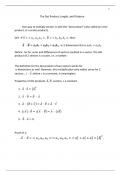
The Dot Product, Length, and Distance
One way to multiply vectors is with the “dot product” (also called an inner
product, or a scalar product).
Def. If 𝐴⃑ = < 𝑎1 , 𝑎2 , 𝑎3 >, 𝐵
⃑⃑ = < 𝑏1 , 𝑏2 , 𝑏3 >, then:
⃑⃑⃑ ∙ 𝑩
𝑨 ⃑⃑⃑ = 𝒂𝟏 𝒃𝟏 + 𝒂𝟐 𝒃𝟐 + 𝒂𝟑 𝒃𝟑 , in 2 dimensions this is 𝑎1 𝑏1 + 𝑎2 𝑏2 .
Notice: So far, sums and differences of vectors resulted in a vector. The dot
product of 2 vectors is a scalar, i.e. a number.
The definition for the dot product of two vectors works for
𝑛-dimensions as well. However, this multiplication only makes sense for 2
vectors: , 𝑐 ∙ 𝐴⃑ ,where 𝑐 is a constant, is meaningless.
Properties of dot products: 𝐴⃑, 𝐵
⃑⃑, vectors, 𝑐 a constant.
2
1. 𝐴⃑ ∙ 𝐴⃑ = |𝐴⃑|
2. 𝐴⃑ ∙ 𝐵 ⃑⃑ ∙ 𝐴⃑
⃑⃑ = 𝐵
3. 𝐴⃑ ∙ (𝐵
⃑⃑ + 𝐶⃑) = 𝐴⃑ ∙ 𝐵
⃑⃑ + 𝐴⃑ ∙ 𝐶⃑
4. (𝑐𝐴⃑ ) ∙ 𝐵
⃑⃑ = 𝑐(𝐴⃑ ∙ 𝐵
⃑⃑) = 𝐴⃑ ∙ (𝑐𝐵
⃑⃑)
⃑ ∙ 𝐴⃑ = 0.
5. 0
Proof of 1:
2
𝐴⃑ ∙ 𝐴⃑ = < 𝑎1 , 𝑎2 , 𝑎3 >∙< 𝑎1 , 𝑎2 , 𝑎3 > = 𝑎12 + 𝑎22 + 𝑎32 = |𝐴⃑| .
, 2
Theorem: 𝐴⃑ ∙ 𝐵
⃑⃑ = |𝐴⃑| |𝐵
⃑⃑| cos 𝜃.
⃑
𝐴−𝐵
⃑
𝐵
𝜃
𝐴
Law of cosines:
2 2 2
|𝐴⃑ − 𝐵
⃑⃑| = |𝐴⃑| + |𝐵
⃑ | − 2|𝐴⃑| |𝐵
⃑⃑| cos 𝜃
But we also know:
2
|𝐴⃑ − 𝐵
⃑⃑| = (𝐴⃑ − 𝐵
⃑⃑) ∙ (𝐴⃑ − 𝐵
⃑⃑) = 𝐴⃑ ∙ 𝐴⃑ − 2𝐴⃑ ∙ 𝐵
⃑⃑ + 𝐵
⃑⃑ ∙ 𝐵
⃑⃑
2 2
= |𝐴⃑| + |𝐵
⃑ | − 2𝐴⃑ ∙ 𝐵
⃑⃑.
⟹ −2𝐴⃑ ∙ 𝐵
⃑⃑ = −2|𝐴⃑||𝐵
⃑⃑| cos 𝜃 ⇒ 𝐴⃑ ∙ 𝐵
⃑⃑ = |𝐴⃑||𝐵
⃑⃑| cos 𝜃.
Also,
𝐴⃑ ∙ 𝐵
⃑⃑
= cos 𝜃.
|𝐴⃑||𝐵⃑⃑|
Corollary: (The Cauchy-Schwarz Inequality) For any two vectors, 𝐴⃑, 𝐵 ⃑⃑, we have
|𝐴⃑ ∙ 𝐵
⃑⃑| ≤ |𝐴⃑||𝐵⃑⃑| and this equality holds if, and only if, 𝐴⃑ is a scalar multiple of 𝐵⃑⃑
or either 𝐴⃑ or 𝐵 ⃑⃑ .
⃑⃑ is 0
The Dot Product, Length, and Distance
One way to multiply vectors is with the “dot product” (also called an inner
product, or a scalar product).
Def. If 𝐴⃑ = < 𝑎1 , 𝑎2 , 𝑎3 >, 𝐵
⃑⃑ = < 𝑏1 , 𝑏2 , 𝑏3 >, then:
⃑⃑⃑ ∙ 𝑩
𝑨 ⃑⃑⃑ = 𝒂𝟏 𝒃𝟏 + 𝒂𝟐 𝒃𝟐 + 𝒂𝟑 𝒃𝟑 , in 2 dimensions this is 𝑎1 𝑏1 + 𝑎2 𝑏2 .
Notice: So far, sums and differences of vectors resulted in a vector. The dot
product of 2 vectors is a scalar, i.e. a number.
The definition for the dot product of two vectors works for
𝑛-dimensions as well. However, this multiplication only makes sense for 2
vectors: , 𝑐 ∙ 𝐴⃑ ,where 𝑐 is a constant, is meaningless.
Properties of dot products: 𝐴⃑, 𝐵
⃑⃑, vectors, 𝑐 a constant.
2
1. 𝐴⃑ ∙ 𝐴⃑ = |𝐴⃑|
2. 𝐴⃑ ∙ 𝐵 ⃑⃑ ∙ 𝐴⃑
⃑⃑ = 𝐵
3. 𝐴⃑ ∙ (𝐵
⃑⃑ + 𝐶⃑) = 𝐴⃑ ∙ 𝐵
⃑⃑ + 𝐴⃑ ∙ 𝐶⃑
4. (𝑐𝐴⃑ ) ∙ 𝐵
⃑⃑ = 𝑐(𝐴⃑ ∙ 𝐵
⃑⃑) = 𝐴⃑ ∙ (𝑐𝐵
⃑⃑)
⃑ ∙ 𝐴⃑ = 0.
5. 0
Proof of 1:
2
𝐴⃑ ∙ 𝐴⃑ = < 𝑎1 , 𝑎2 , 𝑎3 >∙< 𝑎1 , 𝑎2 , 𝑎3 > = 𝑎12 + 𝑎22 + 𝑎32 = |𝐴⃑| .
, 2
Theorem: 𝐴⃑ ∙ 𝐵
⃑⃑ = |𝐴⃑| |𝐵
⃑⃑| cos 𝜃.
⃑
𝐴−𝐵
⃑
𝐵
𝜃
𝐴
Law of cosines:
2 2 2
|𝐴⃑ − 𝐵
⃑⃑| = |𝐴⃑| + |𝐵
⃑ | − 2|𝐴⃑| |𝐵
⃑⃑| cos 𝜃
But we also know:
2
|𝐴⃑ − 𝐵
⃑⃑| = (𝐴⃑ − 𝐵
⃑⃑) ∙ (𝐴⃑ − 𝐵
⃑⃑) = 𝐴⃑ ∙ 𝐴⃑ − 2𝐴⃑ ∙ 𝐵
⃑⃑ + 𝐵
⃑⃑ ∙ 𝐵
⃑⃑
2 2
= |𝐴⃑| + |𝐵
⃑ | − 2𝐴⃑ ∙ 𝐵
⃑⃑.
⟹ −2𝐴⃑ ∙ 𝐵
⃑⃑ = −2|𝐴⃑||𝐵
⃑⃑| cos 𝜃 ⇒ 𝐴⃑ ∙ 𝐵
⃑⃑ = |𝐴⃑||𝐵
⃑⃑| cos 𝜃.
Also,
𝐴⃑ ∙ 𝐵
⃑⃑
= cos 𝜃.
|𝐴⃑||𝐵⃑⃑|
Corollary: (The Cauchy-Schwarz Inequality) For any two vectors, 𝐴⃑, 𝐵 ⃑⃑, we have
|𝐴⃑ ∙ 𝐵
⃑⃑| ≤ |𝐴⃑||𝐵⃑⃑| and this equality holds if, and only if, 𝐴⃑ is a scalar multiple of 𝐵⃑⃑
or either 𝐴⃑ or 𝐵 ⃑⃑ .
⃑⃑ is 0