1
Some Differentiation Rules
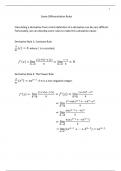
Calculating a derivative from a limit definition of a derivative can be very difficult.
Fortunately, we can develop some rules to make this calculation easier.
Derivative Rule 1: Constant Rule
𝑑
(𝑐) = 0 where 𝑐 is a constant.
𝑑𝑥
𝑓(𝑥+ℎ)−𝑓(𝑥) 𝑐−𝑐
𝑓 ′ (𝑥 ) = lim = lim = 0.
ℎ→0 ℎ ℎ→0 ℎ
Derivative Rule 2: The Power Rule
𝑑
(𝑥 𝑛 ) = 𝑛𝑥 𝑛−1 if 𝑛 is a non-negative integer.
𝑑𝑥
′( 𝑓(𝑥+ℎ)−𝑓(𝑥) ′( (𝑥+ℎ)𝑛 −𝑥 𝑛
𝑓 𝑥 ) = lim = 𝑓 𝑥 ) = lim
ℎ→0 ℎ ℎ→0 ℎ
𝑥 𝑛 +𝑛ℎ𝑥 𝑛−1 +⋯+ℎ𝑛 −𝑥 𝑛
= lim
ℎ→0 ℎ
𝑛ℎ𝑥 𝑛−1 +⋯+ℎ𝑛
= lim
ℎ→0 ℎ
ℎ(𝑛𝑥 𝑛−1 +⋯+ℎ𝑛−1 )
= lim
ℎ→0 ℎ
= lim(𝑛𝑥 𝑛−1 + ⋯ + ℎ𝑛−1 ) = 𝑛𝑥 𝑛−1 .
ℎ→0
, 2
Ex. find 𝑓′(𝑥) for the following functions
a. 𝑓(𝑥 ) = 𝜋 4
b. 𝑓(𝑥 ) = 𝑥 100
c. 𝑓(𝑥 ) = 𝑥.
a. 𝑓 ′ (𝑥 ) = 0, by the constant rule.
b. 𝑓 ′ (𝑥 ) = 100𝑥 99 , by the power rule.
c. 𝑓 ′ (𝑥 ) = 1, by the power rule (𝑥 = 𝑥 1 ).
Derivative Rule 3: The constant multiple rule
𝑑
(𝑐𝑓(𝑥)) = 𝑐𝑓′(𝑥).
𝑑𝑥
𝑔(𝑥+ℎ)−𝑔(𝑥)
If 𝑔(𝑥) = 𝑐𝑓(𝑥) then 𝑔′ (𝑥 ) = lim
ℎ→0 ℎ
𝑐𝑓(𝑥+ℎ)−𝑐𝑓(𝑥)
= lim
ℎ→0 ℎ
𝑓 (𝑥+ℎ)−𝑓(𝑥)
= 𝑐 lim = 𝑐𝑓 ′ (𝑥 ).
ℎ→0 ℎ
5𝑥 8
Ex. find 𝑔’(𝑥) for 𝑔(𝑥 ) = − .
3
5 5 40
𝑔(𝑥 ) = − 𝑥 8 , so 𝑔′ (𝑥 ) = (− ) (8𝑥 7 ) = − 𝑥7.
3 3 3
Some Differentiation Rules
Calculating a derivative from a limit definition of a derivative can be very difficult.
Fortunately, we can develop some rules to make this calculation easier.
Derivative Rule 1: Constant Rule
𝑑
(𝑐) = 0 where 𝑐 is a constant.
𝑑𝑥
𝑓(𝑥+ℎ)−𝑓(𝑥) 𝑐−𝑐
𝑓 ′ (𝑥 ) = lim = lim = 0.
ℎ→0 ℎ ℎ→0 ℎ
Derivative Rule 2: The Power Rule
𝑑
(𝑥 𝑛 ) = 𝑛𝑥 𝑛−1 if 𝑛 is a non-negative integer.
𝑑𝑥
′( 𝑓(𝑥+ℎ)−𝑓(𝑥) ′( (𝑥+ℎ)𝑛 −𝑥 𝑛
𝑓 𝑥 ) = lim = 𝑓 𝑥 ) = lim
ℎ→0 ℎ ℎ→0 ℎ
𝑥 𝑛 +𝑛ℎ𝑥 𝑛−1 +⋯+ℎ𝑛 −𝑥 𝑛
= lim
ℎ→0 ℎ
𝑛ℎ𝑥 𝑛−1 +⋯+ℎ𝑛
= lim
ℎ→0 ℎ
ℎ(𝑛𝑥 𝑛−1 +⋯+ℎ𝑛−1 )
= lim
ℎ→0 ℎ
= lim(𝑛𝑥 𝑛−1 + ⋯ + ℎ𝑛−1 ) = 𝑛𝑥 𝑛−1 .
ℎ→0
, 2
Ex. find 𝑓′(𝑥) for the following functions
a. 𝑓(𝑥 ) = 𝜋 4
b. 𝑓(𝑥 ) = 𝑥 100
c. 𝑓(𝑥 ) = 𝑥.
a. 𝑓 ′ (𝑥 ) = 0, by the constant rule.
b. 𝑓 ′ (𝑥 ) = 100𝑥 99 , by the power rule.
c. 𝑓 ′ (𝑥 ) = 1, by the power rule (𝑥 = 𝑥 1 ).
Derivative Rule 3: The constant multiple rule
𝑑
(𝑐𝑓(𝑥)) = 𝑐𝑓′(𝑥).
𝑑𝑥
𝑔(𝑥+ℎ)−𝑔(𝑥)
If 𝑔(𝑥) = 𝑐𝑓(𝑥) then 𝑔′ (𝑥 ) = lim
ℎ→0 ℎ
𝑐𝑓(𝑥+ℎ)−𝑐𝑓(𝑥)
= lim
ℎ→0 ℎ
𝑓 (𝑥+ℎ)−𝑓(𝑥)
= 𝑐 lim = 𝑐𝑓 ′ (𝑥 ).
ℎ→0 ℎ
5𝑥 8
Ex. find 𝑔’(𝑥) for 𝑔(𝑥 ) = − .
3
5 5 40
𝑔(𝑥 ) = − 𝑥 8 , so 𝑔′ (𝑥 ) = (− ) (8𝑥 7 ) = − 𝑥7.
3 3 3