1
Definite Integrals
So far we have only considered Riemann sums for functions 𝑓(𝑥) over intervals
where 𝑓(𝑥) ≥ 0. What happens if 𝑓(𝑥) ≤ 0 on an interval or if 𝑓(𝑥) ≥ 0 on
part of the interval and 𝑓(𝑥) ≤ 0 on the rest of the interval?
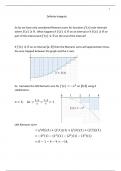
If 𝑓(𝑥) ≤ 0 on an interval [𝑎, 𝑏] then the Riemann sums will approximate minus
the area trapped between the graph and the 𝑥 -axis.
𝑦 = 𝑓(𝑥)
Ex. Calculate the left Riemann sum for 𝑓 (𝑥 ) = −𝑥 2 on [0,4] using 4
subdivisions.
0 1 2 3 4
𝑏−𝑎 4−0
𝑛 = 4, ∆𝑥 = = =1
𝑛 4
𝑓(𝑥) = −𝑥 2
Left Riemann sum=
= (𝑓(0))(1) + (𝑓(1))(1) + (𝑓(2))(1) + (𝑓(3))(1)
= −02 (1) − (12 )(1) − (22 )(1) − (32 )(1)
= 0 − 1 − 4 − 9 = −14.
, 2
This is an approximation of minus the area between the graph of 𝑓(𝑥) and the 𝑥
axis. The more subdivisions we take the better the approximation will be. In the
limit, we will get minus the area between the graph of 𝑓(𝑥) and the 𝑥 axis.
If 𝑓(𝑥) is sometimes positive and sometimes negative on an interval [𝑎, 𝑏] the
Riemann sums will approximate the net area between the graph of 𝑓(𝑥) and the
𝑥 axis, counting the area with a positive sign when 𝑓(𝑥 ) ≥ 0 and with a negative
sign when 𝑓 (𝑥 ) ≤ 0.
𝑏
𝑎
Net Area= lim ∑𝑛 ∗
𝑘=1 f(𝑥𝑘 )∆𝑥 .
𝑛→∞
Def. A general partition of [𝑎, 𝑏] consists of 𝑛 subintervals
[𝑥0, 𝑥1 ], [𝑥1, 𝑥2 ], [𝑥2, 𝑥3 ], … , [𝑥𝑛−1, 𝑥𝑛 ]
where 𝑥0 = 𝑎 and 𝑥𝑛 = 𝑏. The length of the 𝑘th subinterval is
∆𝑥𝑘 = 𝑥𝑘 − 𝑥𝑘−1 , for 𝑘 = 1,2, . . . , 𝑛.
Def. a General Riemann Sum for 𝑓 on [𝑎, 𝑏] is the sum
∑𝑛𝑘=1 f(𝑥𝑘 ∗ )∆𝑥𝑘 = f(𝑥1 ∗ )∆𝑥1 + f(𝑥2 ∗ )∆𝑥2 + ⋯ + f(𝑥𝑛 ∗ )∆𝑥𝑛
where 𝑥𝑘 ∗ is any point in [𝑥𝑘−1, 𝑥𝑘 ].
Definite Integrals
So far we have only considered Riemann sums for functions 𝑓(𝑥) over intervals
where 𝑓(𝑥) ≥ 0. What happens if 𝑓(𝑥) ≤ 0 on an interval or if 𝑓(𝑥) ≥ 0 on
part of the interval and 𝑓(𝑥) ≤ 0 on the rest of the interval?
If 𝑓(𝑥) ≤ 0 on an interval [𝑎, 𝑏] then the Riemann sums will approximate minus
the area trapped between the graph and the 𝑥 -axis.
𝑦 = 𝑓(𝑥)
Ex. Calculate the left Riemann sum for 𝑓 (𝑥 ) = −𝑥 2 on [0,4] using 4
subdivisions.
0 1 2 3 4
𝑏−𝑎 4−0
𝑛 = 4, ∆𝑥 = = =1
𝑛 4
𝑓(𝑥) = −𝑥 2
Left Riemann sum=
= (𝑓(0))(1) + (𝑓(1))(1) + (𝑓(2))(1) + (𝑓(3))(1)
= −02 (1) − (12 )(1) − (22 )(1) − (32 )(1)
= 0 − 1 − 4 − 9 = −14.
, 2
This is an approximation of minus the area between the graph of 𝑓(𝑥) and the 𝑥
axis. The more subdivisions we take the better the approximation will be. In the
limit, we will get minus the area between the graph of 𝑓(𝑥) and the 𝑥 axis.
If 𝑓(𝑥) is sometimes positive and sometimes negative on an interval [𝑎, 𝑏] the
Riemann sums will approximate the net area between the graph of 𝑓(𝑥) and the
𝑥 axis, counting the area with a positive sign when 𝑓(𝑥 ) ≥ 0 and with a negative
sign when 𝑓 (𝑥 ) ≤ 0.
𝑏
𝑎
Net Area= lim ∑𝑛 ∗
𝑘=1 f(𝑥𝑘 )∆𝑥 .
𝑛→∞
Def. A general partition of [𝑎, 𝑏] consists of 𝑛 subintervals
[𝑥0, 𝑥1 ], [𝑥1, 𝑥2 ], [𝑥2, 𝑥3 ], … , [𝑥𝑛−1, 𝑥𝑛 ]
where 𝑥0 = 𝑎 and 𝑥𝑛 = 𝑏. The length of the 𝑘th subinterval is
∆𝑥𝑘 = 𝑥𝑘 − 𝑥𝑘−1 , for 𝑘 = 1,2, . . . , 𝑛.
Def. a General Riemann Sum for 𝑓 on [𝑎, 𝑏] is the sum
∑𝑛𝑘=1 f(𝑥𝑘 ∗ )∆𝑥𝑘 = f(𝑥1 ∗ )∆𝑥1 + f(𝑥2 ∗ )∆𝑥2 + ⋯ + f(𝑥𝑛 ∗ )∆𝑥𝑛
where 𝑥𝑘 ∗ is any point in [𝑥𝑘−1, 𝑥𝑘 ].