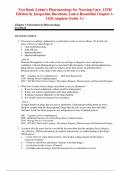
TEST BANK FOR LEHNE’S PHARMACOLOGY IN NURSING CARE
1. The nurse is teaching a patient how a medication works to treat an illness. To do this, the nurse has to rely on which source of knowledge? a. clinical pharmacology. b. drug efficacy. c. pharmacokinetics. d. pharmacotherapeutics. ANS: D Pharmacotherapeutics is the study of the use of drugs to diagnose, treat, and prevent conditions. Clinical pharmacology is concerned with all aspects of drug–human interactions. Drug efficacy measures the extent to which a given drug causes an intended effect. Pharmacokinetics is the study of the impact of the body on a drug. DIF: Cognitive Level: Comprehension REF: Four Basic Terms TOP: Nursing Process: Implementation MSC: NCLEX Client Needs Category: Physiologic Integrity: Pharmacologic and Parenteral Therapies 2. If a drug is described as easy to administer, what does this mean? a. It can be stored indefinitely without need for refrigeration. b. It does not interact significantly with other medications. c. It enhances patient adherence to the drug regimen. d. It is usually relatively inexpensive to produce. ANS: C A major benefit of drugs that are easy to administer is that patients taking them are more likely to comply with the drug regimen. Drugs that are easy to give may have the other attributes listed, but those properties are independent of ease of administration. DIF: Cognitive Level: Comprehension REF: Additional Properties of an Ideal Drug: Ease of Administration TOP: Nursing Process: Assessment MSC: NCLEX Client Needs Category: Physiologic Integrity: Pharmacologic and Parenteral Therapies 3. A patient tells the nurse that he was told by the prescriber that the analgesic he is taking is very effective. Which statement by the patient demonstrates an understanding of the drug‘s effectiveness? a. ―I don‘t have to worry about toxicity, since it takes a large amount of this drug to cause an overdose.‖ b. ―It has no side effects and doesn‘t interact with other drugs.‖ c. ―I only have to take it every 12 hours.‖ d. ―It might make me sleepy, and it lessens pain for several hours at a time.‖ ANS: D A drug is effective if it produces the intended effects, even if it also produces side effects. Because no drug is completely safe, the level of toxicity does not determine effectiveness. All drugs have side effects and many react with other substances; these do not affect the drug‘s effectiveness. Ease of administration is independent of a drug‘s effectiveness. DIF: Cognitive Level: Comprehension REF: Properties of an Ideal Drug TOP: Nursing Process: Evaluation MSC: NCLEX Client Needs Category: Physiologic Integrity: Pharmacologic and Parenteral Therapies MULTIPLE RESPONSE 1. What are the properties of an ideal drug? (Select all that apply.) a. Irreversible action b. Predictability c. Ease of administration d. Chemical stability e. A simple trade name ANS: B, C, D In addition to predictability, ease of administration, and chemical stability, other properties include a reversible action so that any harm the drug may cause can be undone and a simple generic name, because generic names are usually complex and difficult to remember and pronounce. DIF: Cognitive Level: Comprehension REF: Properties of an Ideal Drug | Additional Properties of an Ideal Drug TOP: Nursing Process: Assessment MSC: NCLEX Client Needs Category: Physiologic Integrity: Pharmacologic and Parenteral Therapies 2. Before administering a medication, what does the nurse need to know to evaluate how individual patient variability might affect the patient‘s response to the medication? (Select all that apply.) a. Chemical stability of the medication b. Ease of administration c. Family medical history d. Patient‘s age e. Patient‘s diagnosis ANS: C, D, E The family medical history can indicate genetic factors that may affect a patient‘s response to a medication. Patients of different ages can respond differently to medications. The patient‘s illness can affect how drugs are metabolized. The chemical stability of the medication and the ease of administration are properties of drugs. DIF: Cognitive Level: Analysis REF: Sources of Individual Variation TOP: Nursing Process: Implementation MSC: NCLEX Client Needs Category: Physiologic Integrity: Reduction of Risk Potential Chapter 2: Application of Pharmacology in Nursing Practice Test Bank MULTIPLE CHOICE 1. A patient is using a metered-dose inhaler containing albuterol for asthma. The medication label instructs the patient to administer ―2 puffs every 4 hours as needed for coughing or wheezing.‖ The patient reports feeling jittery sometimes when taking the medication, and she doesn‘t feel that the medication is always effective. Which is not an appropriate nursing intervention for this patient? a. Asking the patient to demonstrate use of the inhaler b. Assessing the patient‘s exposure to tobacco smoke c. Auscultating lung sounds and obtaining vital signs d. Suggesting that the patient use one puff to reduce side effects ANS: D It is not within the nurse‘s scope of practice to change the dose of a medication without an order from a prescriber. Asking the patient to demonstrate inhaler use helps the nurse to evaluate the patient‘s ability to administer the medication properly and is part of the nurse‘s evaluation. Assessing tobacco smoke exposure helps the nurse determine whether nondrug therapies, such a smoke avoidance, can be used as an adjunct to drug therapy. Performing a physical assessment helps the nurse evaluate the patient‘s response to the medication. DIF: Cognitive Level: Application REF: Applying the Nursing Process in Drug Therapy: Preadministration Assessment [and all subsections under this heading] TOP: Nursing Process: Implementation MSC: NCLEX Client Needs Category: Physiologic Integrity: Pharmacologic and Parenteral Therapies 2. A postoperative patient is being discharged home with acetaminophen/hydrocodone (Lortab) for pain. The patient asks the nurse about using Tylenol for fever. Which statement by the nurse is correct? a. ―It is not safe to take over-the-counter drugs with prescription medications.‖ b. ―Taking the two medications together poses a risk of drug toxicity.‖ c. ―There are no known drug interactions, so this will be safe.‖ d. ―Tylenol and Lortab are different drugs, so there is no risk of overdose.‖ ANS: B Tylenol is the trade name and acetaminophen is the generic name for the same medication. It is important to teach patients to be aware of the different names for the same drug to minimize the risk of overdose. Over-the-counter (OTC) medications and prescription medications may be taken together unless significant harmful drug interactions are possible. Even though no drug interactions are at play in this case, both drugs contain acetaminophen, which could lead to toxicity. DIF: Cognitive Level: Application REF: Application of Pharmacology in Patient Education: Dosage an
Written for
- Institution
- PHARMACOLOGY IN NURSING
- Course
- PHARMACOLOGY IN NURSING
Document information
- Uploaded on
- December 18, 2024
- Number of pages
- 1034
- Written in
- 2024/2025
- Type
- Exam (elaborations)
- Contains
- Questions & answers
Subjects
-
test bank
-
pharmacology in nursing care
-
12th edition by jacqueline burchum laura rosenth

Also available in package deal