Aerodynamics Test 2 Review With 100% Verified Answers
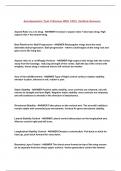
Aspect Ratio vis a vis drag - ANSWER Increase in aspect ratio = decrease drag. High
aspect ratio = decreased drag.
Best Planform for Stall Progression - ANSWER Rectangular wings have the most
desirable stall progression. Stall progression - where a stall begins at the wing root and
goes out to the wing tips.
Aspect ratio vis a vis Wingtip Vortices - ANSWER High aspect ratio wings take the vortex
away from the fuselage, reducing strength of the vortex. Split the tip of the vortex with
winglets, hence drag is reduced and so will vortices be weaker.
Axis of Aircraft Movement - ANSWER Type of flight control surface rotation stability:
elevator is pitch, ailerons is roll, rudder is yaw.
Static Stability - ANSWER Positive static stability: once controls are released, aircraft
returns to straight and level flight. Negative static stability: once controls are released,
aircraft continues to deviate in the direction of disturbance.
Directional Stability - ANSWER Takes place on the vertical axis. The aircraft's ability to
remain stable with unwanted yaw movements. Vertical fin gives directional stability.
Lateral Stability Control - ANSWER Lateral control takes place on the longitudinal axis.
Ailerons control right and left turns.
Longitudinal Stability Control - ANSWER Elevators control pitch. Pull back on stick for
nose up, push stick forward for nose down.
Boundary Layer Control - ANSWER The shock wave formed on top of the wing causes
air to separate from the wing's upper surface. Vortex generators control the laminar
Aspect Ratio vis a vis drag - ANSWER Increase in aspect ratio = decrease drag. High
aspect ratio = decreased drag.
Best Planform for Stall Progression - ANSWER Rectangular wings have the most
desirable stall progression. Stall progression - where a stall begins at the wing root and
goes out to the wing tips.
Aspect ratio vis a vis Wingtip Vortices - ANSWER High aspect ratio wings take the vortex
away from the fuselage, reducing strength of the vortex. Split the tip of the vortex with
winglets, hence drag is reduced and so will vortices be weaker.
Axis of Aircraft Movement - ANSWER Type of flight control surface rotation stability:
elevator is pitch, ailerons is roll, rudder is yaw.
Static Stability - ANSWER Positive static stability: once controls are released, aircraft
returns to straight and level flight. Negative static stability: once controls are released,
aircraft continues to deviate in the direction of disturbance.
Directional Stability - ANSWER Takes place on the vertical axis. The aircraft's ability to
remain stable with unwanted yaw movements. Vertical fin gives directional stability.
Lateral Stability Control - ANSWER Lateral control takes place on the longitudinal axis.
Ailerons control right and left turns.
Longitudinal Stability Control - ANSWER Elevators control pitch. Pull back on stick for
nose up, push stick forward for nose down.
Boundary Layer Control - ANSWER The shock wave formed on top of the wing causes
air to separate from the wing's upper surface. Vortex generators control the laminar