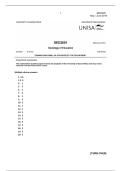
1 SED2601
May / June 2019
Multiple choice answers:
1. 3 2.
1 3. 4
4. 1
5. 3
6. 1
7. 4
8. 1
9. 3
10. 3
11. 1
12. 1
13. 2
14. 2
15. 3
16. 3
17. 4
18. 3
19. 3
20. 2
[TURN OVER]
, QUESTION 1
Answer the following compulsory multiple-choice questions and write the answers in
your examination book, e.g 1. 5; 2. 6 etc
INDICATE THE CORRECT ANSWER (S)
1. The sociology of education:
a) Examines the relationship between the school, politics, economics and culture
b) Is not really sociology
c) Is critical of discipline in schools
d) Ignores the role of teachers in schools
1. (b) 2.
(d)
3. (a)
4. (c)
2. Which of the following are aspects that Ballantine and Hammock (2012)
consider should be part of education?
a) The ability to think creatively
b) The cultivation of a global mind-set
c) The provision of training in problem solving
d) Respect for others
1. (a), (b), (c) and (d)
2. (a) and (c)
3. (a) and (d)
4. (b), (c) and (d)
3. At a macro level sociologists see schooling through the following lens:
a) Small-scale, classroom practices
b) Teacher/learner interactions
c) Large scale social forces such as politics and the economy
d) Scientific study.
1. (a) and (b)
2. (c) and (d)
3. (a)
4. (c)
4. Functionalists suggest that schools have a latent function which is to …
a) produce people who share the same economic and political practices.
b) produce institutions.
c) teach traditional school subjects.
d) produce people who share the cultural practices and norms of society.
1. (a) and (d)
May / June 2019
Multiple choice answers:
1. 3 2.
1 3. 4
4. 1
5. 3
6. 1
7. 4
8. 1
9. 3
10. 3
11. 1
12. 1
13. 2
14. 2
15. 3
16. 3
17. 4
18. 3
19. 3
20. 2
[TURN OVER]
, QUESTION 1
Answer the following compulsory multiple-choice questions and write the answers in
your examination book, e.g 1. 5; 2. 6 etc
INDICATE THE CORRECT ANSWER (S)
1. The sociology of education:
a) Examines the relationship between the school, politics, economics and culture
b) Is not really sociology
c) Is critical of discipline in schools
d) Ignores the role of teachers in schools
1. (b) 2.
(d)
3. (a)
4. (c)
2. Which of the following are aspects that Ballantine and Hammock (2012)
consider should be part of education?
a) The ability to think creatively
b) The cultivation of a global mind-set
c) The provision of training in problem solving
d) Respect for others
1. (a), (b), (c) and (d)
2. (a) and (c)
3. (a) and (d)
4. (b), (c) and (d)
3. At a macro level sociologists see schooling through the following lens:
a) Small-scale, classroom practices
b) Teacher/learner interactions
c) Large scale social forces such as politics and the economy
d) Scientific study.
1. (a) and (b)
2. (c) and (d)
3. (a)
4. (c)
4. Functionalists suggest that schools have a latent function which is to …
a) produce people who share the same economic and political practices.
b) produce institutions.
c) teach traditional school subjects.
d) produce people who share the cultural practices and norms of society.
1. (a) and (d)