

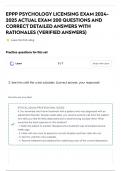
EPPP PSYCHOLOGY LICENSING EXAM 2024-
2025 ACTUAL EXAM 200 QUESTIONS AND
CORRECT DETAILED ANSWERS WITH
RATIONALES (VERIFIED ANSWERS)
Leave the first rating
Practice questions for this set
Learn 3/7 Study with Learn
3. See him until the crisis subsides. (correct answer, your response)
Give this one a try later!
ETHICAL/LEGAL/PROFESSIONAL ISSUES
6. You terminate short-term treatment with a patient who was diagnosed with an
adjustment disorder. Several weeks later, you receive a phone call from the patient,
who tells you that he feels depressed and is experiencing suicidal intent. What
would be the best response to this situation?
• 1. Refer the patient to another therapist since treatment was terminated several
weeks ago.
• 2. Meet with him once to assess his current situation and then refer him out.
• 3. See him until the crisis subsides.
• 4. Resume treatment and address the underlying roots of the current depression.
, COGNITIVE-AFFECTIVE BASES OF BEHAVIOR
181. Which of the following statements typifies a person's reaction to an event
according to two-factor theory?
• 1. The person experiences autonomic arousal, and then has an emotional reaction.
• 2. The person experiences autonomic arousal and an emotional reaction to the
2
event simultaneously.
• 3. The person experiences autonomic arousal, then cognitively interprets the
arousal, and then experiences an emotion.
• 4. The person experiences autonomic arousal, then experiences an emotion, and
then cognitively interprets the emotion.
BIOLOGICAL BASES OF BEHAVIOR
15. When would the administration of Ritalin to a child with ADHD be
contraindicated?
3 • 1. If tics are present.
• 2. If the child has a learning disorder.
• 3. If the child has conduct problems.
• 4. If the child has comorbid depression.
COGNITIVE-AFFECTIVE BASES OF BEHAVIOR
11. Of the following, which describes the type of memory that can retain an exact
copy of what is seen for a second?
4 • 1. Sensory memory.
• 2. Eidetic (photographic) memory.
• 3. Echoic memory.
• 4. Short-term memory.
Don't know?
Terms in this set (200)
,BIOLOGICAL BASES OF 1. Irritability, fatigue, and headaches. (correct
BEHAVIOR answer, your response)
1. Which of the following
describes
postconcussion
syndrome?
• 1. Irritability, fatigue, and
headaches.
• 2. Loss of consciousness
for minutes to an hour.
• 3. Loss of consciousness
for hours to days.
•4. Headaches and
numbness on one side of
the body.
, ETHICAL/LEGAL/PROFE 3. when a patient admits to homicidal intent, the
SSIONAL ISSUES therapist must attempt to warn the intended victim
2. According to the and must tell the police, as well as take further steps
Tarasoff II ruling: such as securing medications or hospitalization for
• 1. a therapist has a duty the patient. (correct answer)
to protect when he or
she becomes aware of a
potential homicidal
situation in the course of
therapy.
• 2. when a patient admits
to homicidal intent and
there is a "reasonably
identifiable victim," the
therapist has a duty to
warn the intended victim
as well as the police.
• 3. when a patient admits
to homicidal intent, the
therapist must attempt to
warn the intended victim
and must tell the police,
as well as take further
steps such as securing
medications or
hospitalization for the
patient.
• 4. when a patient admits
to vague homicidal
intent, the therapist must
ascertain who the
intended victim is.
2025 ACTUAL EXAM 200 QUESTIONS AND
CORRECT DETAILED ANSWERS WITH
RATIONALES (VERIFIED ANSWERS)
Leave the first rating
Practice questions for this set
Learn 3/7 Study with Learn
3. See him until the crisis subsides. (correct answer, your response)
Give this one a try later!
ETHICAL/LEGAL/PROFESSIONAL ISSUES
6. You terminate short-term treatment with a patient who was diagnosed with an
adjustment disorder. Several weeks later, you receive a phone call from the patient,
who tells you that he feels depressed and is experiencing suicidal intent. What
would be the best response to this situation?
• 1. Refer the patient to another therapist since treatment was terminated several
weeks ago.
• 2. Meet with him once to assess his current situation and then refer him out.
• 3. See him until the crisis subsides.
• 4. Resume treatment and address the underlying roots of the current depression.
, COGNITIVE-AFFECTIVE BASES OF BEHAVIOR
181. Which of the following statements typifies a person's reaction to an event
according to two-factor theory?
• 1. The person experiences autonomic arousal, and then has an emotional reaction.
• 2. The person experiences autonomic arousal and an emotional reaction to the
2
event simultaneously.
• 3. The person experiences autonomic arousal, then cognitively interprets the
arousal, and then experiences an emotion.
• 4. The person experiences autonomic arousal, then experiences an emotion, and
then cognitively interprets the emotion.
BIOLOGICAL BASES OF BEHAVIOR
15. When would the administration of Ritalin to a child with ADHD be
contraindicated?
3 • 1. If tics are present.
• 2. If the child has a learning disorder.
• 3. If the child has conduct problems.
• 4. If the child has comorbid depression.
COGNITIVE-AFFECTIVE BASES OF BEHAVIOR
11. Of the following, which describes the type of memory that can retain an exact
copy of what is seen for a second?
4 • 1. Sensory memory.
• 2. Eidetic (photographic) memory.
• 3. Echoic memory.
• 4. Short-term memory.
Don't know?
Terms in this set (200)
,BIOLOGICAL BASES OF 1. Irritability, fatigue, and headaches. (correct
BEHAVIOR answer, your response)
1. Which of the following
describes
postconcussion
syndrome?
• 1. Irritability, fatigue, and
headaches.
• 2. Loss of consciousness
for minutes to an hour.
• 3. Loss of consciousness
for hours to days.
•4. Headaches and
numbness on one side of
the body.
, ETHICAL/LEGAL/PROFE 3. when a patient admits to homicidal intent, the
SSIONAL ISSUES therapist must attempt to warn the intended victim
2. According to the and must tell the police, as well as take further steps
Tarasoff II ruling: such as securing medications or hospitalization for
• 1. a therapist has a duty the patient. (correct answer)
to protect when he or
she becomes aware of a
potential homicidal
situation in the course of
therapy.
• 2. when a patient admits
to homicidal intent and
there is a "reasonably
identifiable victim," the
therapist has a duty to
warn the intended victim
as well as the police.
• 3. when a patient admits
to homicidal intent, the
therapist must attempt to
warn the intended victim
and must tell the police,
as well as take further
steps such as securing
medications or
hospitalization for the
patient.
• 4. when a patient admits
to vague homicidal
intent, the therapist must
ascertain who the
intended victim is.


