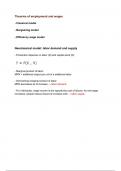
Theories of employment and wages
- Classical model
- Bargaining model
- Efficiency wage model
Neoclassical model: labor demand and supply
- Production depends on labor (N) and capital stock (K):
- Marginal product of labor:
MPN = additional output per unit of a additional labor
- Diminishing marginal product of labor:
MPN decreases as N increase → labor demand
- For individuals, wage income is the opportunity cost of leisure. As real wage
increases, people reduce leisure & increase work → labor supply
,Equilibrium in the labor market (Normal Situation)
Equilibrium requires that labor supply = labor demand; this generates equilibrium real
wage and full-employment.
The role of flexible wages is crucial for equilibrium
At N = N*, Output is at full employment Y = F(K, N) = Y*
Neoclassical model (Abnormal Situation)
, Neoclassical model
A massive involuntary unemployment exists in practice. Why?
Something gets in way of market forces driving the wage level down
Examples:
(1) Legal minimum wage set at W*
(2) Labor union activities
(3) Mandated benefits, safety regulations , or restrictions on layoffs and
dismissals
(4) Public safety net policies, such as disability insurance and unemployment
insurance
Karl Marx’s labor market
According to Marx, in a typical capitalist economy, the labor market can be divided into
two parts:
(1) the active army of labor (the pool of employed workers)
(2) the reserve army of labor (the pool of unemployed workers that is potentially
available to capitalists).
Classical Theory: Reserve army of labor
Growth and capital accumulation increase the demand for labor
- Classical model
- Bargaining model
- Efficiency wage model
Neoclassical model: labor demand and supply
- Production depends on labor (N) and capital stock (K):
- Marginal product of labor:
MPN = additional output per unit of a additional labor
- Diminishing marginal product of labor:
MPN decreases as N increase → labor demand
- For individuals, wage income is the opportunity cost of leisure. As real wage
increases, people reduce leisure & increase work → labor supply
,Equilibrium in the labor market (Normal Situation)
Equilibrium requires that labor supply = labor demand; this generates equilibrium real
wage and full-employment.
The role of flexible wages is crucial for equilibrium
At N = N*, Output is at full employment Y = F(K, N) = Y*
Neoclassical model (Abnormal Situation)
, Neoclassical model
A massive involuntary unemployment exists in practice. Why?
Something gets in way of market forces driving the wage level down
Examples:
(1) Legal minimum wage set at W*
(2) Labor union activities
(3) Mandated benefits, safety regulations , or restrictions on layoffs and
dismissals
(4) Public safety net policies, such as disability insurance and unemployment
insurance
Karl Marx’s labor market
According to Marx, in a typical capitalist economy, the labor market can be divided into
two parts:
(1) the active army of labor (the pool of employed workers)
(2) the reserve army of labor (the pool of unemployed workers that is potentially
available to capitalists).
Classical Theory: Reserve army of labor
Growth and capital accumulation increase the demand for labor