MNG3702 - Top past exam questions
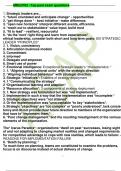
1. Strategic leaders are...
1. *future orientated and anticipate change* - opportunities
2. *get things done * - best initiative - make difference.
3. *open new horizons* interpret different events, efficencie.
4. *reach out to stakeholders* value input, build trust
5. *fit to lead* - resilient, resourceful
6. *do the 'next' right thing and learn from experiences*
ethical leadership, consider both short and long term goals: SIX STRATEGIC
LEADER *PRINCIPLES*
2. 1. Vision, consistency
2. Articulation business models
3. Commitment
4. informed
5. Delegate and empower
6. Smart use of power
7. Emotional intelligence: Exceptional Strategic leader's *characteristics: *
3. 1. *Aligning organisational units* with the strategic direction
2. *Aligning individual behaviour* with strategic direction
3. Strategic *initiatives*: Enablers of strategy deployment
4. 1 *Communicating the strategy*
2 *Organisational learning and adaption*
3 *Resource allocation*: 3 components of strategy deployment
5. 1. New strategy was formulated but was *not implemented*,
2. Implemented in such a way that the implementation was *incomplete *
3. Strategic objectives were *not attained*
4. Or the implementation was *unacceptable *to key *stakeholders*.
5. Strategic *objectives* are *too complex* or *poorly understood*, lack consis-
tency and do not provide clear future direction to members of the organization
that have to* implement them,*
6. *Poor change management *and the resulting misalignment of the various
elements of the organization.
The* Icarus Paradox*: organizations *dwell on past *successes, losing sight
of and not adapting to changing market realities and changed requirements
for competitive advantage to cope with new realities, which leads to failure: -
REASONS FOR IMPLEMENTATION FAILURE
6. *Death by planning: *
To much time on planning, teams are constituted to examine the problems,
focus is on discourse instead of actual delivery of change
1/2
1. Strategic leaders are...
1. *future orientated and anticipate change* - opportunities
2. *get things done * - best initiative - make difference.
3. *open new horizons* interpret different events, efficencie.
4. *reach out to stakeholders* value input, build trust
5. *fit to lead* - resilient, resourceful
6. *do the 'next' right thing and learn from experiences*
ethical leadership, consider both short and long term goals: SIX STRATEGIC
LEADER *PRINCIPLES*
2. 1. Vision, consistency
2. Articulation business models
3. Commitment
4. informed
5. Delegate and empower
6. Smart use of power
7. Emotional intelligence: Exceptional Strategic leader's *characteristics: *
3. 1. *Aligning organisational units* with the strategic direction
2. *Aligning individual behaviour* with strategic direction
3. Strategic *initiatives*: Enablers of strategy deployment
4. 1 *Communicating the strategy*
2 *Organisational learning and adaption*
3 *Resource allocation*: 3 components of strategy deployment
5. 1. New strategy was formulated but was *not implemented*,
2. Implemented in such a way that the implementation was *incomplete *
3. Strategic objectives were *not attained*
4. Or the implementation was *unacceptable *to key *stakeholders*.
5. Strategic *objectives* are *too complex* or *poorly understood*, lack consis-
tency and do not provide clear future direction to members of the organization
that have to* implement them,*
6. *Poor change management *and the resulting misalignment of the various
elements of the organization.
The* Icarus Paradox*: organizations *dwell on past *successes, losing sight
of and not adapting to changing market realities and changed requirements
for competitive advantage to cope with new realities, which leads to failure: -
REASONS FOR IMPLEMENTATION FAILURE
6. *Death by planning: *
To much time on planning, teams are constituted to examine the problems,
focus is on discourse instead of actual delivery of change
1/2