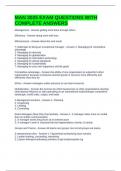
MAN 3025 EXAM QUESTIONS WITH
COMPLETE ANSWERS
Management - Answer-getting work done through others
Efficiency - Answer-doing more with less
Effectiveness - Answer-about the end result
7 challenges to being an exceptional manager - Answer-1. Managing for competitive
advantage
2. Managing for diversity
3. Managing for globalization
4. Managing for information technology
5. Managing for ethical standards
6. Managing for sustainability
7. Managing for your own happiness and life goals
Competitive advantage - Answer-the ability of one organization to outperform other
organizations because it produces desired goods or services more efficiently and
effectively than they do
Ethics - Answer-managers under pressure to use best resources
Globalization - Answer-the process by which businesses or other organizations develop
international influence or start operating on an international scale/changes competitive
landscape, world order, output, and trade
4 Managerial Functions - Answer-1. Planning
2. Organizing
3. Leading
4. Controlling
Roles Managers Must Play Successfully - Answer-1. A manager relies more on verbal
than on written communication
2. A manager works long hours at an intense pace
3. A manager's work is characterized by fragmentation, brevity, & variety
Groups and Teams - Answer-All teams are groups, but not all groups are teams
3 interpersonal roles - Answer-1. Figurehead-symbolizing org's mission
2. Leader-training, counseling, mentoring
3. Liaison-linking/coordinating activities of ppl inside/outside org
, 3 informational roles - Answer-1. Monitor-analyze info from internal and external
environments
2. Disseminator-influence attitudes and behaviors of employees
3. Spokesperson-positively influence the way people respond to the organization
4 decisional roles - Answer-1. Entrepreneur-deciding new projects/programs to invest in
2. Disturbance Handler-managing unexpected event/crisis
3. Resource Allocator-assigning resources b/w functions, setting budgets for lower
managers
4. Negotiator-reaching agreements b/w managers, unions, customer's etc
Groups - Answer-2 or more freely acting individuals who have a common purpose
Teams - Answer-groups of two or more people who interact and influence each other,
are mutually accountable for achieving common goals associated with organizational
objectives, and perceive themselves as a social entity within an organization
formal group - Answer-established to do something productive for an org, headed by a
leader
informal group - Answer-formed by ppl seeking friendship, no official leader
self-managed teams - Answer-groups of employees with the authority and skills to
manage themselves/empower with accountability, ownership, selection, socializing,
training, and appropriate awards
Building Effective Teams - Answer-Collaboration-sharing info/coordinating efforts to
achieve collective outcome
Trust-reciprocal faith in others
Performance-goals/feedback
Motivation-through mutual accountability
Composition-collections of jobs, personalities, values, knowledge, skills etc
Roles-expectations of behavior in a certain position
Norms-general guidelines that members must follow
Advice/committee team - Answer-broaden the info base for managerial decisions
Production Team - Answer-team that consists of frontline employees who produce
tangible output/responsible for day to day operations
Project/task/research team - Answer-work to creatively problem solve by applying
specialized knowledge (cross functional)
Action teams - Answer-work to accomplish tasks that require people with specialized
training and a high degree of coordination (swat, hospital surgery teams)
COMPLETE ANSWERS
Management - Answer-getting work done through others
Efficiency - Answer-doing more with less
Effectiveness - Answer-about the end result
7 challenges to being an exceptional manager - Answer-1. Managing for competitive
advantage
2. Managing for diversity
3. Managing for globalization
4. Managing for information technology
5. Managing for ethical standards
6. Managing for sustainability
7. Managing for your own happiness and life goals
Competitive advantage - Answer-the ability of one organization to outperform other
organizations because it produces desired goods or services more efficiently and
effectively than they do
Ethics - Answer-managers under pressure to use best resources
Globalization - Answer-the process by which businesses or other organizations develop
international influence or start operating on an international scale/changes competitive
landscape, world order, output, and trade
4 Managerial Functions - Answer-1. Planning
2. Organizing
3. Leading
4. Controlling
Roles Managers Must Play Successfully - Answer-1. A manager relies more on verbal
than on written communication
2. A manager works long hours at an intense pace
3. A manager's work is characterized by fragmentation, brevity, & variety
Groups and Teams - Answer-All teams are groups, but not all groups are teams
3 interpersonal roles - Answer-1. Figurehead-symbolizing org's mission
2. Leader-training, counseling, mentoring
3. Liaison-linking/coordinating activities of ppl inside/outside org
, 3 informational roles - Answer-1. Monitor-analyze info from internal and external
environments
2. Disseminator-influence attitudes and behaviors of employees
3. Spokesperson-positively influence the way people respond to the organization
4 decisional roles - Answer-1. Entrepreneur-deciding new projects/programs to invest in
2. Disturbance Handler-managing unexpected event/crisis
3. Resource Allocator-assigning resources b/w functions, setting budgets for lower
managers
4. Negotiator-reaching agreements b/w managers, unions, customer's etc
Groups - Answer-2 or more freely acting individuals who have a common purpose
Teams - Answer-groups of two or more people who interact and influence each other,
are mutually accountable for achieving common goals associated with organizational
objectives, and perceive themselves as a social entity within an organization
formal group - Answer-established to do something productive for an org, headed by a
leader
informal group - Answer-formed by ppl seeking friendship, no official leader
self-managed teams - Answer-groups of employees with the authority and skills to
manage themselves/empower with accountability, ownership, selection, socializing,
training, and appropriate awards
Building Effective Teams - Answer-Collaboration-sharing info/coordinating efforts to
achieve collective outcome
Trust-reciprocal faith in others
Performance-goals/feedback
Motivation-through mutual accountability
Composition-collections of jobs, personalities, values, knowledge, skills etc
Roles-expectations of behavior in a certain position
Norms-general guidelines that members must follow
Advice/committee team - Answer-broaden the info base for managerial decisions
Production Team - Answer-team that consists of frontline employees who produce
tangible output/responsible for day to day operations
Project/task/research team - Answer-work to creatively problem solve by applying
specialized knowledge (cross functional)
Action teams - Answer-work to accomplish tasks that require people with specialized
training and a high degree of coordination (swat, hospital surgery teams)