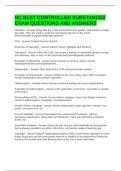
NC BLET CONTROLLED SUBSTANCES
EXAM QUESTIONS AND ANSWERS
Narcotics - Answer-Drugs that act on the Central Nervous System, and produce a sleep
like state. They are used in medicine, but heavily abused on the street.
Both physically and psychologically addictive.
CNS - Answer-Central Nervous System
Examples of Narcotics - Answer-Opium, Heroin, Dilaudid, and Demerol.
Stimulants - Answer-Affect the CNS, and create a feeling of excitement, greater energy,
and alertness. May or may not be physically and psychologically addictive.
Examples of Stimulants - Answer-Most common is cocaine. Others include
methamphetamine and amphetamines.
Depressants - Answer-They depress the CNS and pyschomotor activity.
Examples of Depressants - Answer-Alcohol is the most widely used. Other examples
include barbiturates and sedative hypnotics.
Hallucinogens - Answer-Induce intense emotional feeling and cause hallucinations.
Examples of Hallucinogens - Answer-LSD, psilocybin mushrooms, mescaline or peyote,
and ecstacy.
Phencyclidine (PCP) - Answer-Its own distinct category. Users may display reactions
similar to hallucinogens, stimulants, and depressants.
Volatile Solvent Inhalants - Answer-Model airplane glue, paint, gasoline, markers, nail
polish, correction fluid, etc.
Aerosol Inhalants - Answer-Discharged from pressurized containers, such as
hairsprays, deodorants, spray paint, air fresheners, frying pan lubricants, computer
duster, etc.
Anesthetic Inhalants - Answer-Gases kill pain and are used medically for that purpose.
Some abused examples are ether, chloroform, and nitrous oxide or laughing gas.
Cannabis - Answer-Delta-9 Tetrahydrocannabinol (THC) is the active ingredient in these
drugs. Marijuana and the more potent hashish or hashish oil is produced by boiling the
leaves of the female plant and allowing them to dry into a semi-solid mass.
, Two species of Cannabis Plants - Answer-Cannabis Sativa and Cannabis Indica
Research Chemicals - Answer-Synthetic cannabinoids, and synthetic chemicals
referred to as "bath salts"
Product names for Synthetic Cannabinoids - Answer-"Spice," "K2," "Kush," "GI Jane,'
and "Kryptonite."
Product names for Bath Salts - Answer-"Cloud 9" "Ivory Wave" and "Vanilla sky"
Controlled Substance Act - Answer-1970. Drug control efforts creating a category for all
dangerous drugs.
Schedule I - Answer-1. High Potential for Abuse
2. NO accepted medical use
3. Lack of safety for use under medical supervision
Examples of Schedule I - Answer-Heroin, LSD, MDMA (ecstacy), Mephedrone and
MDPV (bath salts)
Schedule II - Answer-1. High potential for abuse
2. Restricted medical use
3. Severe psychological and physiological dependence.
Examples of Schedule II - Answer-Cocaine, Methamphetamine, PCP, Ritalin, Dilaudid,
morphine sulfate
Schedule III - Answer-1. Potential for abuse less than Schedule II
2. Current accepted medical value in U.S.
3. Moderate or low physiological dependence with high psychological dependence.
Examples of Schedule III - Answer-Hydrocodone and Anabolic Steroids
Schedule IV - Answer-1. Low potential for abuse relative to Schedule III
2. Current accepted medical value
3. Limited physiological or psychological dependence
Examples of Schedule IV - Answer-Diazepam (Valium), Phentermine, Alprazolam
(Xanax)
Schedule V - Answer-1. Low potential for abuse
2. Current accepted medical value
3. Limited physiological or psychological dependence
Example of Schedule V - Answer-cough syrup with codeine
EXAM QUESTIONS AND ANSWERS
Narcotics - Answer-Drugs that act on the Central Nervous System, and produce a sleep
like state. They are used in medicine, but heavily abused on the street.
Both physically and psychologically addictive.
CNS - Answer-Central Nervous System
Examples of Narcotics - Answer-Opium, Heroin, Dilaudid, and Demerol.
Stimulants - Answer-Affect the CNS, and create a feeling of excitement, greater energy,
and alertness. May or may not be physically and psychologically addictive.
Examples of Stimulants - Answer-Most common is cocaine. Others include
methamphetamine and amphetamines.
Depressants - Answer-They depress the CNS and pyschomotor activity.
Examples of Depressants - Answer-Alcohol is the most widely used. Other examples
include barbiturates and sedative hypnotics.
Hallucinogens - Answer-Induce intense emotional feeling and cause hallucinations.
Examples of Hallucinogens - Answer-LSD, psilocybin mushrooms, mescaline or peyote,
and ecstacy.
Phencyclidine (PCP) - Answer-Its own distinct category. Users may display reactions
similar to hallucinogens, stimulants, and depressants.
Volatile Solvent Inhalants - Answer-Model airplane glue, paint, gasoline, markers, nail
polish, correction fluid, etc.
Aerosol Inhalants - Answer-Discharged from pressurized containers, such as
hairsprays, deodorants, spray paint, air fresheners, frying pan lubricants, computer
duster, etc.
Anesthetic Inhalants - Answer-Gases kill pain and are used medically for that purpose.
Some abused examples are ether, chloroform, and nitrous oxide or laughing gas.
Cannabis - Answer-Delta-9 Tetrahydrocannabinol (THC) is the active ingredient in these
drugs. Marijuana and the more potent hashish or hashish oil is produced by boiling the
leaves of the female plant and allowing them to dry into a semi-solid mass.
, Two species of Cannabis Plants - Answer-Cannabis Sativa and Cannabis Indica
Research Chemicals - Answer-Synthetic cannabinoids, and synthetic chemicals
referred to as "bath salts"
Product names for Synthetic Cannabinoids - Answer-"Spice," "K2," "Kush," "GI Jane,'
and "Kryptonite."
Product names for Bath Salts - Answer-"Cloud 9" "Ivory Wave" and "Vanilla sky"
Controlled Substance Act - Answer-1970. Drug control efforts creating a category for all
dangerous drugs.
Schedule I - Answer-1. High Potential for Abuse
2. NO accepted medical use
3. Lack of safety for use under medical supervision
Examples of Schedule I - Answer-Heroin, LSD, MDMA (ecstacy), Mephedrone and
MDPV (bath salts)
Schedule II - Answer-1. High potential for abuse
2. Restricted medical use
3. Severe psychological and physiological dependence.
Examples of Schedule II - Answer-Cocaine, Methamphetamine, PCP, Ritalin, Dilaudid,
morphine sulfate
Schedule III - Answer-1. Potential for abuse less than Schedule II
2. Current accepted medical value in U.S.
3. Moderate or low physiological dependence with high psychological dependence.
Examples of Schedule III - Answer-Hydrocodone and Anabolic Steroids
Schedule IV - Answer-1. Low potential for abuse relative to Schedule III
2. Current accepted medical value
3. Limited physiological or psychological dependence
Examples of Schedule IV - Answer-Diazepam (Valium), Phentermine, Alprazolam
(Xanax)
Schedule V - Answer-1. Low potential for abuse
2. Current accepted medical value
3. Limited physiological or psychological dependence
Example of Schedule V - Answer-cough syrup with codeine