

METABOLIC BIOCHEMISTRY 2024
▪ Metabolic Biochemistry
Welcome! :) Ready to learn some Biochemistry? I hope to guide you in your
understanding of the course...Lets begin.
Lecture 1 – Introduction to Metabolic Biochemistry
1. What is Metabolism?
2. Sources of Energy
3. Adenosine triphosphate (ATP) – “The Energy Currency of Cells”
4. NAD+ - Carrier of H+ and e- (Oxidant – Reductant)
5. Metabolic Pathways
6. Reduced Molecules Release more Energy
7. Metabolomics
1. What is Metabolism?
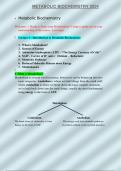
Metabolism is a broad word in science, however it can be broken up into two
main categories. Anabolism is where we build things from the small stuff,
whilst catabolism is where we break down the large complex structures
we've built back down into the small things, usually the most fundamental
being energy in the form of ATP.
Metabolism
Catabolism Anabolism
The break down of molecules to form The energy used from catabolic pathways
Energy in the form of ATP. to perform cellular work (eg build proteins)
, lOMoAR cPSD| 37668344
(eg: Glycolysis)
• Metabolites: The substrates (reactants), intermediates, products of
metabolic pathways.
2. Sources of Energy
• Carbohydrates
• Proteins
• Fats and Lipids
Carbohydrates (Pasta, potatoes, rice)
Carbohydrates (or sugars) form monosaccharides, disaccharides and
polysaccharides . They all eventually contain the compound Glucose which
once broken down becomes vital in the production of ATP.
Atoms : (C, O, H) Plentiful amount of –OH groups
Downloaded by mary daniel ()
, lOMoAR cPSD| 37668344
Monosaccharides/Disaccharides Polysaccharides
Different forms of Glucose
• Starch Polymer of Glucose monosaccharide’s
• Cellulose D Glucose, found primarily in plant cell walls.
Downloaded by mary daniel ()
, lOMoAR cPSD| 37668344
• Glycogen Branched form of Glucose primarily stored in liver and
muscles.
Proteins ( baked beans, chicken, meat, fish)
• The building blocks of cells and tissues. Some common proteins
utilized in the body are hemoglobin (O2 transporter), enzymes
(catalysts), trans membrane proteins (ion channels), actin (muscular
contraction).
Proteins are formed from mRNA via translation inside a ribosome. mRNA is
translated into amino acids that form distinct long chains. Proteins as a
review can take on four main structures Structure = Function
Primary Structure
Amino acid polymer
Secondary Structure
Alpha Helix + Beta
Sheets
Tertiary Structure
Complex
folding/shaping of the
protein
Quaternary Structure
Integration of more
than one protein
Downloaded by mary daniel ()
▪ Metabolic Biochemistry
Welcome! :) Ready to learn some Biochemistry? I hope to guide you in your
understanding of the course...Lets begin.
Lecture 1 – Introduction to Metabolic Biochemistry
1. What is Metabolism?
2. Sources of Energy
3. Adenosine triphosphate (ATP) – “The Energy Currency of Cells”
4. NAD+ - Carrier of H+ and e- (Oxidant – Reductant)
5. Metabolic Pathways
6. Reduced Molecules Release more Energy
7. Metabolomics
1. What is Metabolism?
Metabolism is a broad word in science, however it can be broken up into two
main categories. Anabolism is where we build things from the small stuff,
whilst catabolism is where we break down the large complex structures
we've built back down into the small things, usually the most fundamental
being energy in the form of ATP.
Metabolism
Catabolism Anabolism
The break down of molecules to form The energy used from catabolic pathways
Energy in the form of ATP. to perform cellular work (eg build proteins)
, lOMoAR cPSD| 37668344
(eg: Glycolysis)
• Metabolites: The substrates (reactants), intermediates, products of
metabolic pathways.
2. Sources of Energy
• Carbohydrates
• Proteins
• Fats and Lipids
Carbohydrates (Pasta, potatoes, rice)
Carbohydrates (or sugars) form monosaccharides, disaccharides and
polysaccharides . They all eventually contain the compound Glucose which
once broken down becomes vital in the production of ATP.
Atoms : (C, O, H) Plentiful amount of –OH groups
Downloaded by mary daniel ()
, lOMoAR cPSD| 37668344
Monosaccharides/Disaccharides Polysaccharides
Different forms of Glucose
• Starch Polymer of Glucose monosaccharide’s
• Cellulose D Glucose, found primarily in plant cell walls.
Downloaded by mary daniel ()
, lOMoAR cPSD| 37668344
• Glycogen Branched form of Glucose primarily stored in liver and
muscles.
Proteins ( baked beans, chicken, meat, fish)
• The building blocks of cells and tissues. Some common proteins
utilized in the body are hemoglobin (O2 transporter), enzymes
(catalysts), trans membrane proteins (ion channels), actin (muscular
contraction).
Proteins are formed from mRNA via translation inside a ribosome. mRNA is
translated into amino acids that form distinct long chains. Proteins as a
review can take on four main structures Structure = Function
Primary Structure
Amino acid polymer
Secondary Structure
Alpha Helix + Beta
Sheets
Tertiary Structure
Complex
folding/shaping of the
protein
Quaternary Structure
Integration of more
than one protein
Downloaded by mary daniel ()


