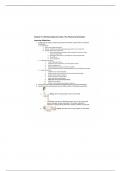
Chapter 3 Collecting Objective Data: The Physical Examination
Learning Objectives
1. Explain how to prepare oneself, the physical environment, and the client for a physical
examination.
a. Preparing self:
i. Assess own feelings & anxieties.
ii. Achieve confidence by performing a physical assessment on a friend/ fam.
iii. Prevent transmission of infections
1. Wash hands before examination, after examination, & when in direct
contact w/ body fluids
2. Wear gloves when there is a possibility of contact w/ body fluids
3. Wear PPE prn
4. Pt care equipment
b. Preparing environment:
i. Comfortable, warm temp.
ii. Private area w/o interruptions; close door & pull curtains
iii. Quiet w/o distractions
iv. Adequate lighting: sunlight works best if available.
v. Firm examination bed/ table w/ bedside table/ tray to hold equipment needed
b. Preparing the client:
i. Establish nurse-client relationship
ii. Explain procedure & describe the step of the Physical examination
iii. Respect client's requests / desires
iv. Explain importance of examination
v. Leave room when client changes
vi. Begin exam w/ less intrusive procedures
vii. Explain the procedures
viii. Explain to client why position change is necessary
2. Survey the various pieces of equipment needed to perform a physical examination.
3. Describe various client positions used for different parts of the physical examination
a. sitting: client is sitting upright on side of exam table.
i. This position is good for evaluating the head, neck, lungs, chest, back,
breast, vital signs, & upper extremities. This position permits full
expansion of lungs & allows examiner to assess symmetry of body parts
b. supine: client lies down w/ legs together on exam table.
, i. Small pillow may be placed for comfort. Raise HOB if pt has difficulty
breathing. In this position the abdominal muscles relax & allows easy
access to peripheral pulse sites. May assess the head, neck, chest,
breasts, axillae, abdomen, heart, lungs & all extremities.
c. dorsal recumbent: pt lies down on exam table w/ knees
bent, legs separated & feet flat on table.
i. Assess head neck, chest, lungs, heart, extremities, breast, & peripheral
pulses. Abdomen should not be assessed bc abdominal muscles are
contracted in this position.
d. sims: pt lies on R/L side w/ lower arm placed behind body
& upper arm flexed at shoulder & elbow. Leg is slightly flexed at the knee while
upper leg is flexed at a sharper angle & pulled forward.
i. Assess the rectal & vaginal areas. Clients w/ joint problems & elderly
clients may have difficulty getting & staying in this position.
e. standing: assess posture, balance, gait, & examination of male
genitalia.
f. prone: pt lies down on Abd w/ head on side.
i. Assesses the hip joint (mainly) & client. Clients w/ cardiac & respiratory
problems cannot tolerate position.
g. knee-chest: client kneels on exam table w/ weigh of body
supported by chest & knees. A 90-degree angle btw body & hips. Arms above
head w/ head turned to one side & small pillow to provide comfort.
i. Used to examine rectum
Learning Objectives
1. Explain how to prepare oneself, the physical environment, and the client for a physical
examination.
a. Preparing self:
i. Assess own feelings & anxieties.
ii. Achieve confidence by performing a physical assessment on a friend/ fam.
iii. Prevent transmission of infections
1. Wash hands before examination, after examination, & when in direct
contact w/ body fluids
2. Wear gloves when there is a possibility of contact w/ body fluids
3. Wear PPE prn
4. Pt care equipment
b. Preparing environment:
i. Comfortable, warm temp.
ii. Private area w/o interruptions; close door & pull curtains
iii. Quiet w/o distractions
iv. Adequate lighting: sunlight works best if available.
v. Firm examination bed/ table w/ bedside table/ tray to hold equipment needed
b. Preparing the client:
i. Establish nurse-client relationship
ii. Explain procedure & describe the step of the Physical examination
iii. Respect client's requests / desires
iv. Explain importance of examination
v. Leave room when client changes
vi. Begin exam w/ less intrusive procedures
vii. Explain the procedures
viii. Explain to client why position change is necessary
2. Survey the various pieces of equipment needed to perform a physical examination.
3. Describe various client positions used for different parts of the physical examination
a. sitting: client is sitting upright on side of exam table.
i. This position is good for evaluating the head, neck, lungs, chest, back,
breast, vital signs, & upper extremities. This position permits full
expansion of lungs & allows examiner to assess symmetry of body parts
b. supine: client lies down w/ legs together on exam table.
, i. Small pillow may be placed for comfort. Raise HOB if pt has difficulty
breathing. In this position the abdominal muscles relax & allows easy
access to peripheral pulse sites. May assess the head, neck, chest,
breasts, axillae, abdomen, heart, lungs & all extremities.
c. dorsal recumbent: pt lies down on exam table w/ knees
bent, legs separated & feet flat on table.
i. Assess head neck, chest, lungs, heart, extremities, breast, & peripheral
pulses. Abdomen should not be assessed bc abdominal muscles are
contracted in this position.
d. sims: pt lies on R/L side w/ lower arm placed behind body
& upper arm flexed at shoulder & elbow. Leg is slightly flexed at the knee while
upper leg is flexed at a sharper angle & pulled forward.
i. Assess the rectal & vaginal areas. Clients w/ joint problems & elderly
clients may have difficulty getting & staying in this position.
e. standing: assess posture, balance, gait, & examination of male
genitalia.
f. prone: pt lies down on Abd w/ head on side.
i. Assesses the hip joint (mainly) & client. Clients w/ cardiac & respiratory
problems cannot tolerate position.
g. knee-chest: client kneels on exam table w/ weigh of body
supported by chest & knees. A 90-degree angle btw body & hips. Arms above
head w/ head turned to one side & small pillow to provide comfort.
i. Used to examine rectum