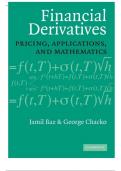
,FINANNCIAL
DERIVATIVES
(Hull Fund7e )
7th EDITION
TEST BANK
CHAPTER 1 - 24
, NOTE:
Test bank questions for all chapters except the last additional
questions (contains some additional questions that instructors might
find useful) are included.
Some questions are multiple choice; other have numerical answers.
For each chapter there are 10 questions that can be quickly graded as
correct or incorrect. The test bank questions have been expanded and
improved for this edition.
NB: ALL ANSWERS TO THE TEST BANK ARE ON THE LAST 5 PAGES.
, Test Bank: Chapter 1
Introduction
1. List three types of traders in futures, forward, and options markets
i. ________
ii. ________
iii. _ _ _ _ _ _ _ _
2. Which of the following is not true (circle one)
a. When a CBOE call option on IBM is exercised, IBM issues more stock
b. An American option can be exercised at any time during its life
c. An call option will always be exercised at maturity if the underlying asset price is greater
than the strike price
d. A put option will always be exercised at maturity if the strike price is greater than the
underlying asset price.
3. A trader enters into a one-year short forward contract to sell an asset for $60 when the spot price
is $58. The spot price in one year proves to be $63. What is the trader’s gain or loss? Show a dollar
amount and indicate whether it is a gain or a loss.
_ _ _ _ _ _ _ _ _ _
4. A trader buys 100 European call options (i.e., one contract) with a strike price of $20 and a time to
maturity of one year. The cost of each option is $2. The price of the underlying asset proves to be
$25 in one year. What is the trader’s gain or loss? Show a dollar amount and indicate whether it is a
gain or a loss.
_ _ _ _ _ _ _ _ _ _
5. A trader sells 100 European put options (i.e., one contract) with a strike price of $50 and a time to
maturity of six months. The price received for each option is $4. The price of the underlying asset is
$41 in six months. What is the trader’s gain or loss? Show a dollar amount and indicate whether it is
a gain or a loss.
__________
DERIVATIVES
(Hull Fund7e )
7th EDITION
TEST BANK
CHAPTER 1 - 24
, NOTE:
Test bank questions for all chapters except the last additional
questions (contains some additional questions that instructors might
find useful) are included.
Some questions are multiple choice; other have numerical answers.
For each chapter there are 10 questions that can be quickly graded as
correct or incorrect. The test bank questions have been expanded and
improved for this edition.
NB: ALL ANSWERS TO THE TEST BANK ARE ON THE LAST 5 PAGES.
, Test Bank: Chapter 1
Introduction
1. List three types of traders in futures, forward, and options markets
i. ________
ii. ________
iii. _ _ _ _ _ _ _ _
2. Which of the following is not true (circle one)
a. When a CBOE call option on IBM is exercised, IBM issues more stock
b. An American option can be exercised at any time during its life
c. An call option will always be exercised at maturity if the underlying asset price is greater
than the strike price
d. A put option will always be exercised at maturity if the strike price is greater than the
underlying asset price.
3. A trader enters into a one-year short forward contract to sell an asset for $60 when the spot price
is $58. The spot price in one year proves to be $63. What is the trader’s gain or loss? Show a dollar
amount and indicate whether it is a gain or a loss.
_ _ _ _ _ _ _ _ _ _
4. A trader buys 100 European call options (i.e., one contract) with a strike price of $20 and a time to
maturity of one year. The cost of each option is $2. The price of the underlying asset proves to be
$25 in one year. What is the trader’s gain or loss? Show a dollar amount and indicate whether it is a
gain or a loss.
_ _ _ _ _ _ _ _ _ _
5. A trader sells 100 European put options (i.e., one contract) with a strike price of $50 and a time to
maturity of six months. The price received for each option is $4. The price of the underlying asset is
$41 in six months. What is the trader’s gain or loss? Show a dollar amount and indicate whether it is
a gain or a loss.
__________