

Written by students who passed Immediately available after payment Read online or as PDF Wrong document? Swap it for free 4.6 TrustPilot
logo-home
Document preview thumbnail
Preview 2 out of 5 pages
Exam (elaborations)

Physics Exam #1 Exam Questions With Correct Detailed Answers.

Document preview thumbnail
Preview 2 out of 5 pages

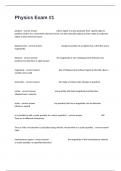
position - correct answer where object is at any particular time. specify object's position relative to a convenient reference frame. we often describe objects as they relate to stationary object in that reference frame. displacement - correct answer change in position of an object (has a direction and a magnitude) distance - correct answer the magnitude or size of displacement between two positions (no direction or sign) (scalar) magnitude - correct answer size of displacement without regard to direction (just a number and a unit) kinematics - correct answer the study of motion (also changes in position) vector - correct answer any quantity with both magnitude and direction (displacement, velocity) scalar - correct answer any quantity that has a magnitude, but no direction (distance, speed) is it possible to add a scalar quantity to a vector quantity? - correct answer NO! They are in different dimensions. True or False: Acceleration is calculated using velocity. Acceleration is a scalar quantity. - correct answer False instantaneous speed - correct answer the magnitude of the instantaneous velocity (a scalar quantity, no specified direction) example of difference between instantaneous speed and instantaneous velocity? - correct answer IV= 40 m/s due North IS= 40 m/s Acceleration - correct answer rate of change in velocity (m/s^2) true or false: there is acceleration when velocity changes either in magnitude, direction, or both. - correct answer TRUE deceleration - correct answer when an object slows down, its acceleration is opposite to the direction of its motion True or False? total distance traveled must be either equal to or greater than the magnitude of total displacement. - correct answer TRUE Explain constant acceleration and the position vs. time graph of falling objects. - correct answer -the acceleration of free-falling objects is constant. -in a position vs. time graph would be a downward opening parabola. The velocity of the coin decreases until it reaches 0 and then increases in the opposite direction what does 0 acceleration mean? - correct answer the velocity is not changing slope of displacement vs. time - correct answer velocity average velocity (if acceleration is constant) slope of velocity vs. time - correct answer acceleration When does a velocity vector change? - correct answer when its magnitude or its direction changes -when your velocity is changing, you are accelerating you are accelerating when you change your _____, ________ or ________. - correct answer -speed -direction -BOTH when velocity is constant, you have ______ acceleration. - correct answer 0 Dynamics - correct answer the study of the forces that cause objects and systems to move force - correct answer a push or a pull (has both magnitude and direction=a vector quantity) free body diagram - correct answer a technique used to illustrate all the external forces acting on a body restoring force - correct answer a standard force that a spring would exert in order to pull itself back to its original shape. normal force - correct answer perpendicular to the surface Newton's first law of motion (law of inertia) - correct answer a body at rest remains at rest, or if in motion, remains in motion at a constant velocity unless acted on by a net external force. mass - correct answer the quantity of matter in a substance inertia - correct answer the property of a body to remain at rest or to remain in motion with constant velocity (inertia of an object is measured by its mass) standard in kg Newton's Second Law - correct answer the acceleration of a system is directly proportional to and in the same direction as the two net external force on the system and inversely proportional to mass Newton's third law of motion (the law of action and reaction) - correct answer whenever the body exerts force on a second body, the first body experiences a force that is equal in magnitude and opposite in direction to the force that it exerts. thrust - correct answer reaction force that pushed a body forward in response to a backwards force. Rockets, cars, and airplanes push forward by a thrust reaction force. scalar and vector of mass vs. weight - correct answer weight (force of gravity)=vector mass=scalar REMEMBER THIS LAW!!!!!!! - correct answer CONSTANT VELOCITY=NO ACCELERATION= NO NET FORCE!!!!!!! projectile motion/independence of motion - correct answer the horizontal and vertical components of 2-D motion are independent of one another. Any motion in the horizontal distance does not affect motion in the vertical direction gravity near the earth's surface - correct answer -proportional to the mass -constant as a function of position -pointing straight downward (constant force=constant acceleration) projectile motion - correct answer motion of a particle through a region of space where it is subject to constant acceleration energy - correct answer the ability to do work work - correct answer the transfer of energy by a force that causes an object to be displaced; the product of the component of the force in the direction of the displacement joule - correct answer standard unit of work and energy Newton-meters - correct answer 1 kg x m^2/s^2 =1 Joule= 1 Nm true or false: an object's mass is directly proportional to its inertia. - correct answer TRUE true or false: a boy walks horizontally while carrying a heavy box @ constant speed. the body is doing no work on the box. - correct answer TRUE Power - correct answer Measure of how quickly work is done, it is the rate at which work is done (J/s)

Content preview

Physics Exam #1

position - correct answer where object is at any particular time. specify object's
position relative to a convenient reference frame. we often describe objects as they relate to stationary
object in that reference frame.


displacement - correct answer change in position of an object (has a direction and a
magnitude)


distance - correct answer the magnitude or size of displacement between two
positions (no direction or sign) (scalar)


magnitude - correct answer size of displacement without regard to direction (just a
number and a unit)


kinematics - correct answer the study of motion (also changes in position)


vector - correct answer any quantity with both magnitude and direction
(displacement, velocity)


scalar - correct answer any quantity that has a magnitude, but no direction
(distance, speed)


is it possible to add a scalar quantity to a vector quantity? - correct answer NO!
They are in different dimensions.


True or False: Acceleration is calculated using velocity. Acceleration is a scalar quantity. - correct answer
False


instantaneous speed - correct answer the magnitude of the instantaneous velocity
(a scalar quantity, no specified direction)

, example of difference between instantaneous speed and instantaneous velocity? - correct answer
IV= 40 m/s due North

IS= 40 m/s


Acceleration - correct answer rate of change in velocity

(m/s^2)


true or false: there is acceleration when velocity changes either in magnitude, direction, or both. -
correct answer TRUE


deceleration - correct answer when an object slows down, its acceleration is
opposite to the direction of its motion


True or False? total distance traveled must be either equal to or greater than the magnitude of total
displacement. - correct answer TRUE


Explain constant acceleration and the position vs. time graph of falling objects. - correct answer
-the acceleration of free-falling objects is constant.

-in a position vs. time graph would be a downward opening parabola. The velocity of the coin decreases
until it reaches 0 and then increases in the opposite direction


what does 0 acceleration mean? - correct answer the velocity is not changing


slope of displacement vs. time - correct answer velocity

average velocity (if acceleration is constant)


slope of velocity vs. time - correct answer acceleration


When does a velocity vector change? - correct answer when its magnitude or its
direction changes

Document information

Uploaded on
November 25, 2024
Number of pages
5
Written in
2024/2025
Type
Exam (elaborations)
Contains
Questions & answers
$13.49

Wrong document? Swap it for free Within 14 days of purchase and before downloading, you can choose a different document. You can simply spend the amount again.
Written by students who passed
Immediately available after payment
Read online or as PDF

Seller avatar
Reputation scores are based on the amount of documents a seller has sold for a fee and the reviews they have received for those documents. There are three levels: Bronze, Silver and Gold. The better the reputation, the more your can rely on the quality of the sellers work.
RealGrades
4.0
(26)
Sold
196
Followers
52
Items
12321
Last sold
6 days ago


Why students choose Stuvia

Created by fellow students, verified by reviews

Quality you can trust: written by students who passed their tests and reviewed by others who've used these notes.

Didn't get what you expected? Choose another document

No worries! You can instantly pick a different document that better fits what you're looking for.

Pay as you like, start learning right away

No subscription, no commitments. Pay the way you're used to via credit card and download your PDF document instantly.

Student with book image

“Bought, downloaded, and aced it. It really can be that simple.”

Alisha Student

Working on your references?

Create accurate citations in APA, MLA and Harvard with our free citation generator.

Working on your references?

Frequently asked questions
