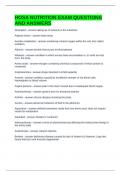
HOSA NUTRITION EXAM QUESTIONS
AND ANSWERS
Absorption - answer-taking up of nutrients in the intestines
Adipose tissue - answer-fatty tissue
Aerobic metabolism - answer-combining nutrient oxygen within the cell; also called
oxidation.
Albumin - answer-protein that occurs in blood plasma
Alkalosis - answer-condition in which excess base accumulates in, or acids are lost
from, the body.
Amino acids - answer-nitrogen containing chemical compounds of which protein is
composed
Amphetamines - answer-drugs intended to inhibit appetite
Anemia - answer-condition caused by insufficient number of red blood cells,
haemoglobin or blood volume.
Angina pectoris - answer-pain in the heart muscle due to inadequate blood supply.
Arteriosclerosis - answer-generic term for thickened arteries
Arthritis - answer-chronic disease involving the joints
Ascites - answer-abnormal collection of fluid in the abdomen.
Aspartame - answer-artificial sweetener made from two amino acid; does not require
insulin for metabolism
Aspirated - answer-inhaled or suctioned
Atherosclerosis - answer-a form of arteriolosclerosis affecting the intima (inner lining) of
the artery walls
Avitaminosis - answer-without vitamins
Beriberi - answer-deficiency disease caused by lack of vitamin b1 thiamine. Legs feel
heavy feet burn and muscles degenerate.
, Basal metabolism rate bmr - answer-the rate at which energy is needed for body
maintenance.
Bile - answer-secretion of the liver, stored in the gallbladder, essential for the digestion
of fat.
Bioavailable - answer-the ability of a nutrient to be readily absorbed and used by the
body
Biotin - answer-a b vitamin, necessary for metabolism
Bolus - answer-food in the mouth that is ready to be swallowed
Botulism - answer-deadliest of food poisoning; cost by the bacteria clostridium
botulinum
Bran - answer-outer covering of grain kernels. Contains minerals b vitamins cellulose
and protein
Buffer systems - answer-protective systems regulating amounts of hydrogen ions in
body fluids
Cachexia - answer-severe malnutrition and body wasting caused by chronic disease
Caliper - answer-mechanical device used to measure percentage of body fat by skinfold
measurement
Calorie - answer-represents the amount of heat needed to raise temperature of 1 kg of
water 1°c
Carboxypeptidase - answer-pancreatic enzyme necessary for protein digestion
Nutrients (6) - answer-chemical substances that are found in food and necessary for
good health. Carbohydrates, fats, proteins, vitamins, minerals, water.
Essential nutrient - answer-nutrients found only in food
Carbohydrates - answer-about 50% of diet. Provides energy. Protein sparing action.
Normal fat metabolism. Three types.
Monosaccharides - answer-simplest form of carbohydrates. No digestion required. Can
be easily absorbed directly into the blood stream from the small intestine they include
glucose fructose and galactose
Disaccharides - answer-double sugars. Hydrolysis to monosaccharides. Examples are
sucrose maltose and lactose
AND ANSWERS
Absorption - answer-taking up of nutrients in the intestines
Adipose tissue - answer-fatty tissue
Aerobic metabolism - answer-combining nutrient oxygen within the cell; also called
oxidation.
Albumin - answer-protein that occurs in blood plasma
Alkalosis - answer-condition in which excess base accumulates in, or acids are lost
from, the body.
Amino acids - answer-nitrogen containing chemical compounds of which protein is
composed
Amphetamines - answer-drugs intended to inhibit appetite
Anemia - answer-condition caused by insufficient number of red blood cells,
haemoglobin or blood volume.
Angina pectoris - answer-pain in the heart muscle due to inadequate blood supply.
Arteriosclerosis - answer-generic term for thickened arteries
Arthritis - answer-chronic disease involving the joints
Ascites - answer-abnormal collection of fluid in the abdomen.
Aspartame - answer-artificial sweetener made from two amino acid; does not require
insulin for metabolism
Aspirated - answer-inhaled or suctioned
Atherosclerosis - answer-a form of arteriolosclerosis affecting the intima (inner lining) of
the artery walls
Avitaminosis - answer-without vitamins
Beriberi - answer-deficiency disease caused by lack of vitamin b1 thiamine. Legs feel
heavy feet burn and muscles degenerate.
, Basal metabolism rate bmr - answer-the rate at which energy is needed for body
maintenance.
Bile - answer-secretion of the liver, stored in the gallbladder, essential for the digestion
of fat.
Bioavailable - answer-the ability of a nutrient to be readily absorbed and used by the
body
Biotin - answer-a b vitamin, necessary for metabolism
Bolus - answer-food in the mouth that is ready to be swallowed
Botulism - answer-deadliest of food poisoning; cost by the bacteria clostridium
botulinum
Bran - answer-outer covering of grain kernels. Contains minerals b vitamins cellulose
and protein
Buffer systems - answer-protective systems regulating amounts of hydrogen ions in
body fluids
Cachexia - answer-severe malnutrition and body wasting caused by chronic disease
Caliper - answer-mechanical device used to measure percentage of body fat by skinfold
measurement
Calorie - answer-represents the amount of heat needed to raise temperature of 1 kg of
water 1°c
Carboxypeptidase - answer-pancreatic enzyme necessary for protein digestion
Nutrients (6) - answer-chemical substances that are found in food and necessary for
good health. Carbohydrates, fats, proteins, vitamins, minerals, water.
Essential nutrient - answer-nutrients found only in food
Carbohydrates - answer-about 50% of diet. Provides energy. Protein sparing action.
Normal fat metabolism. Three types.
Monosaccharides - answer-simplest form of carbohydrates. No digestion required. Can
be easily absorbed directly into the blood stream from the small intestine they include
glucose fructose and galactose
Disaccharides - answer-double sugars. Hydrolysis to monosaccharides. Examples are
sucrose maltose and lactose