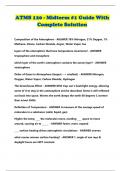
ATMS 120 - Midterm #1 Guide With
Complete Solution
Composition of the Atmosphere - ANSWER 78% Nitrogen, 21% Oxygen, 1%
Methane, Ozone, Carbon Dioxide, Argon, Water Vapor too
layers of the atomsphere that have temperature inversions? - ANSWER
troposphere and mesophere
which layer of the earth's atmosphere contains the ozone layer? - ANSWER
stratosphere
Order of Gases in Atmosphere (largest --> smallest) - ANSWER Nitrogen,
Oxygen, Water Vapor, Carbon Dioxide, Hydrogen
The Greenhouse Effect - ANSWER GHG trap sun's heat/light energy, allowing
some of it to stay in the astmosphere and be absorbed. Some is still reflected
out back into space. Warms the earth (keeps the earth 60 degrees C warmer
than w/out GHG)
Definition of Temperature - ANSWER A measure of the average speed of
molecules in a substance (solid, liquid, gas)
Higher the temp ____ the molecules move, needing ____ space to move
around, causing air to ______ - ANSWER faster, more, expand
____ surface heating drives atmospheric circulations - ANSWER uneven
what causes uneven surface heating? - ANSWER 1. angle of sun rays &
daylight hours are NOT constant
,2. The earth has many diff. surface types that absorb energy differently
average surface air temp - ANSWER 59 deg F
Summer Solstice - ANSWER June 21st, sun is direct on the TROPIC OF
CANCER
which seasonal equinox/solstice has the MOST daylight hours - ANSWER
summer solstice
Autumnal Equinox - ANSWER September 21st, suns rays are direct on the
EQUATOR
Which equinox/solstice has the 12 hours of daylight and 12 hours of night
(equal) - ANSWER Autumnal equinox & Vernal equinox
Winter solstice - ANSWER December 21st, suns rays direct on the TROPIC OF
CAPRICORN
which equinox/solstice has the LEAST daylight hours - ANSWER Winter
Solstice
Vernal Equinox - ANSWER March 21st, sun's rays are direct on the equator
What causes seasons, day light, and the directness of the sun's rays
throughout the year? - ANSWER Axial tilt of the earth
Winter - ANSWER low sun angle, fewer daylight hours, suns path to
atmosphere = long
Summer - ANSWER high sun angle, more daylight hours, suns path to
atmosphere = short
T/F: Land heats up faster than water - ANSWER TRUE
, Know the impact on the climate of a region that is near a large body of
water. - ANSWER cooler summers, warmer winters = oceans, less variation in
temperatures. places without nearby land have more variation in
temperatures
The layers of the earth's atmosphere are defined by their _____ - ANSWER
temperature profiles
temperature inversion - ANSWER any layer of the atmosphere where the
temperature increases w/ height
troposphere - ANSWER all of the earths weather occurs here, 80% of
atmospheric mass resides in it
Pressure - ANSWER force per unit area applied by the air (weight of the air in
a column over an area) measured in mb
low surface pressure (<1000 mb) - ANSWER clouds, precipitation & unsettled
weather
high surface pressure (>1000 mb) - ANSWER fair weather (nice)
Heat is _____ to change from a liquid to a gas (evaporation) - ANSWER
required (absorbed)
Heat is ____ to change from a gas to a liquid (condensation) - ANSWER
released
Latent Heat - ANSWER heat assocaited w/ phase changes
Vapor Pressure - ANSWER Force per unit area applied ONLY by the water
vapor molecules --> Weight of the water vapor measured in mb (calculated
based on dewpoint temperature)
Complete Solution
Composition of the Atmosphere - ANSWER 78% Nitrogen, 21% Oxygen, 1%
Methane, Ozone, Carbon Dioxide, Argon, Water Vapor too
layers of the atomsphere that have temperature inversions? - ANSWER
troposphere and mesophere
which layer of the earth's atmosphere contains the ozone layer? - ANSWER
stratosphere
Order of Gases in Atmosphere (largest --> smallest) - ANSWER Nitrogen,
Oxygen, Water Vapor, Carbon Dioxide, Hydrogen
The Greenhouse Effect - ANSWER GHG trap sun's heat/light energy, allowing
some of it to stay in the astmosphere and be absorbed. Some is still reflected
out back into space. Warms the earth (keeps the earth 60 degrees C warmer
than w/out GHG)
Definition of Temperature - ANSWER A measure of the average speed of
molecules in a substance (solid, liquid, gas)
Higher the temp ____ the molecules move, needing ____ space to move
around, causing air to ______ - ANSWER faster, more, expand
____ surface heating drives atmospheric circulations - ANSWER uneven
what causes uneven surface heating? - ANSWER 1. angle of sun rays &
daylight hours are NOT constant
,2. The earth has many diff. surface types that absorb energy differently
average surface air temp - ANSWER 59 deg F
Summer Solstice - ANSWER June 21st, sun is direct on the TROPIC OF
CANCER
which seasonal equinox/solstice has the MOST daylight hours - ANSWER
summer solstice
Autumnal Equinox - ANSWER September 21st, suns rays are direct on the
EQUATOR
Which equinox/solstice has the 12 hours of daylight and 12 hours of night
(equal) - ANSWER Autumnal equinox & Vernal equinox
Winter solstice - ANSWER December 21st, suns rays direct on the TROPIC OF
CAPRICORN
which equinox/solstice has the LEAST daylight hours - ANSWER Winter
Solstice
Vernal Equinox - ANSWER March 21st, sun's rays are direct on the equator
What causes seasons, day light, and the directness of the sun's rays
throughout the year? - ANSWER Axial tilt of the earth
Winter - ANSWER low sun angle, fewer daylight hours, suns path to
atmosphere = long
Summer - ANSWER high sun angle, more daylight hours, suns path to
atmosphere = short
T/F: Land heats up faster than water - ANSWER TRUE
, Know the impact on the climate of a region that is near a large body of
water. - ANSWER cooler summers, warmer winters = oceans, less variation in
temperatures. places without nearby land have more variation in
temperatures
The layers of the earth's atmosphere are defined by their _____ - ANSWER
temperature profiles
temperature inversion - ANSWER any layer of the atmosphere where the
temperature increases w/ height
troposphere - ANSWER all of the earths weather occurs here, 80% of
atmospheric mass resides in it
Pressure - ANSWER force per unit area applied by the air (weight of the air in
a column over an area) measured in mb
low surface pressure (<1000 mb) - ANSWER clouds, precipitation & unsettled
weather
high surface pressure (>1000 mb) - ANSWER fair weather (nice)
Heat is _____ to change from a liquid to a gas (evaporation) - ANSWER
required (absorbed)
Heat is ____ to change from a gas to a liquid (condensation) - ANSWER
released
Latent Heat - ANSWER heat assocaited w/ phase changes
Vapor Pressure - ANSWER Force per unit area applied ONLY by the water
vapor molecules --> Weight of the water vapor measured in mb (calculated
based on dewpoint temperature)